Get Full Government Meeting Transcripts, Videos, & Alerts Forever!
Get email alerts on the Recovery Housing topic
No spam. Unsubscribe anytime.
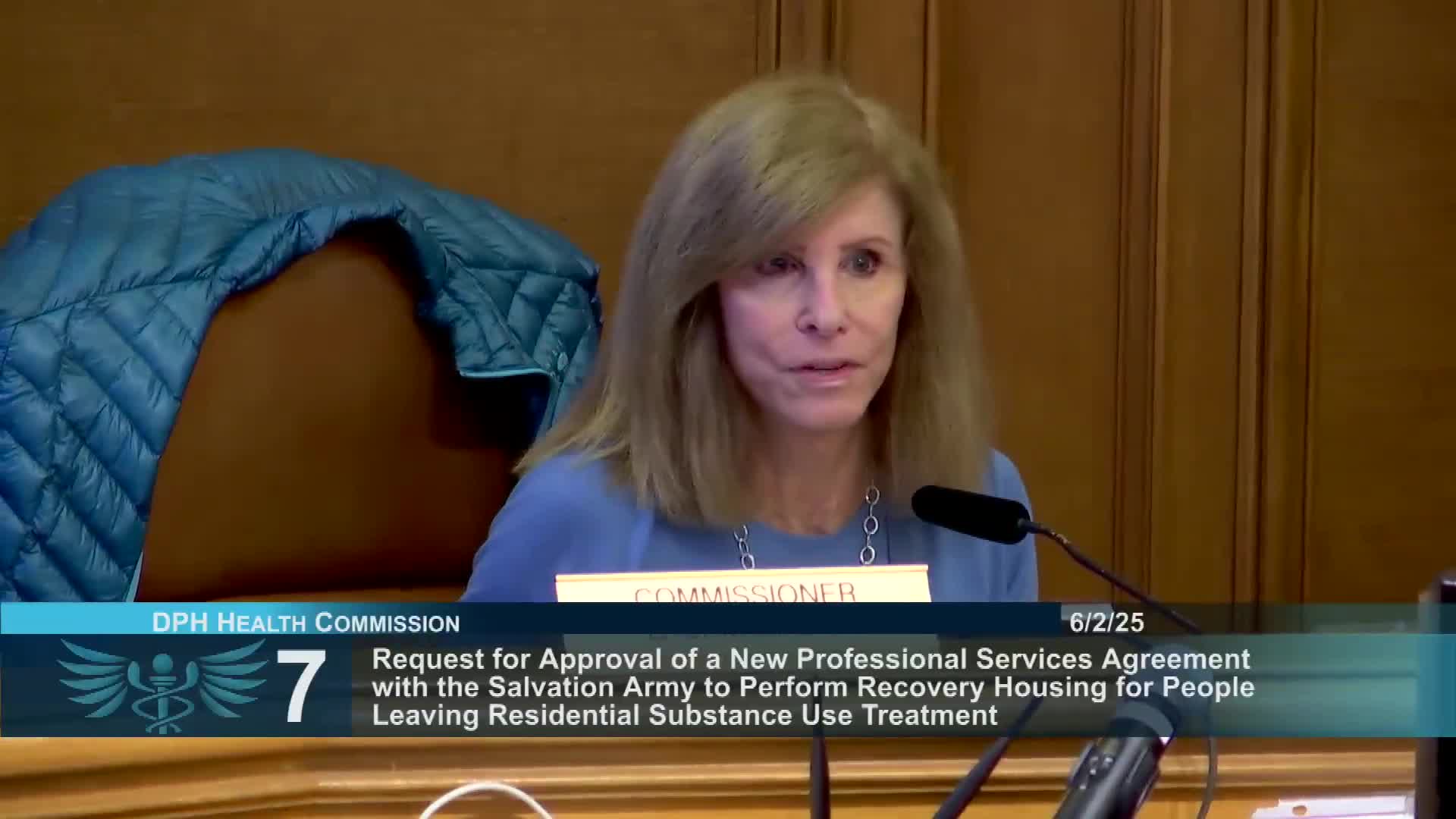
Health Commission approves Salvation Army Marina Inn recovery housing amid robust neighborhood debate
Summary
The San Francisco Health Commission on June 5 approved a two‑year contract with the Salvation Army to convert the Marina Inn into abstinence‑based recovery housing for people who have completed residential substance‑use treatment.
The San Francisco Health Commission on June 5 approved a two‑year contract with the Salvation Army to convert the Marina Inn into an abstinence‑based recovery housing program for people who have completed residential substance‑use treatment. The contract’s base value was presented as $7.3 million with a 12% contingency; meeting materials and the motion record list the total with contingency in the neighborhood of $8.0 million.
The program is designed as a long‑term, structured sober‑living environment: residents will be required to have completed 3–6 months of residential treatment before entry, participate in a daily schedule of life‑skills and recovery meetings, maintain abstinence (confirmed with random drug testing) and pursue work or training. Salvation Army staff described the program as a four‑phase, two‑year residential recovery continuum intended to support housing, employment and family reunification.
Why it matters: Commissioners and department staff framed the Marina Inn project as the “back end” of the city’s behavioral‑health continuum designed to reduce returns to street homelessness by providing a structured stepping stone from residential treatment to independent living. At the same time the proposal provoked a large public response: proponents described individual success stories and program effectiveness, while many nearby residents raised concerns about safety, placement near schools and parks, and neighborhood notification procedures.
Program design and oversight - Capacity and structure: The Salvation Army proposes 40 units that the department estimated could house up to 68 people, with 24‑hour on‑site staffing, background checks for participants and a strict no‑guests/no‑loitering policy. - Services: On‑site case management, workforce development, financial planning and mandated recovery group attendance. Random drug testing and immediate triage to withdrawal management or residential treatment for people who relapse were described as enforcement mechanisms. - Eligibility and exclusions: Program applicants must be San Francisco residents who have completed residential substance‑use treatment. The contract excludes people with arson, sex‑offense convictions and certain violent crimes; other cases may be reviewed case‑by‑case. - Monitoring and community commitments: DPH requires weekly startup meetings (moving to monthly), quarterly performance reporting and on‑site visits. The Salvation Army committed to biweekly community meetings during startup; DPH included a good‑neighbor policy in the contract requiring the operator to address street and sidewalk issues outside the facility.
Community reaction and public safety commitments The public comment period drew more than 60 people in the room and dozens more in adjacent overflow, with many speakers on both sides. Supporters — including multiple residents in recovery and program staff — described the Salvation Army’s Joseph McPhee program and other Salvation Army sites as evidence that a highly structured, abstinence‑based approach can produce housing stability and employment. Salvation Army staff reported a 76% program “success” rate at another pilot site and high post‑graduation housing and employment rates at six‑ and twelve‑month checks.
Opponents and nearby residents said the Marina location is next to a playground and three schools and argued placement would endanger children and lower neighborhood safety. Several speakers also said neighborhood notification materials were inconsistent (one flyer said “services dedicated for women,” another described a prioritized floor for women), and they asked why the city chose this neighborhood rather than sites closer to treatment and services in other parts of the city.
Public‑safety measures described in the meeting included assigned police foot beats, retired‑officer ambassadors, security cameras and a publicly posted QR code to report non‑emergency concerns directly to the local police sector; the Police Department and mayor’s office told the commission they would prioritize patrol and coordination around the site. DPH and the mayor’s office said the short‑term patrol commitment could be extended if needed.
Process and remaining approvals Commissioners approved the contract but staff noted the site will also require planning/land‑use action; DPH said the mayor’s office will seek an amendment to the Interim Housing and Hotels ordinance so the Marina Inn can be designated interim housing, with a likely next step in the Board of Supervisors’ Land Use Committee in June. Services are expected to begin after land‑use approval and contract certification, likely in late summer or early fall.
Commissioners and DPH said they will monitor startup carefully and report back in director’s reports, and the mayor’s office encouraged ongoing community participation in oversight meetings.