Get Full Government Meeting Transcripts, Videos, & Alerts Forever!
Get email alerts on the Budget topic
No spam. Unsubscribe anytime.
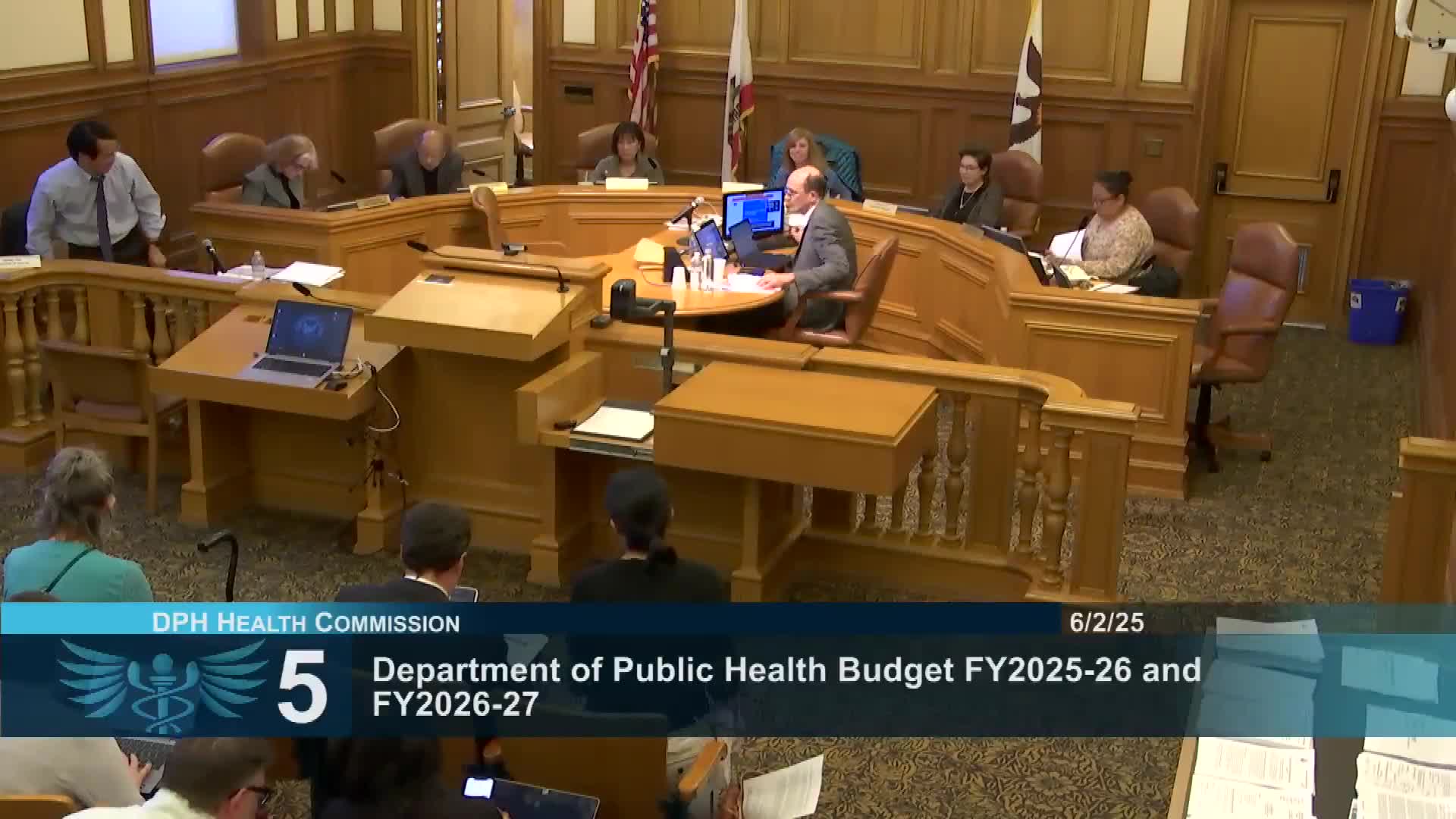
DPH budget proposal preserves staffing, adds $75M for behavioral health while trimming some community contracts
Summary
San Francisco Department of Public Health leaders on June 5 presented a two‑year budget plan that seeks to reduce reliance on general‑fund dollars, add treatment capacity for behavioral health and implement administrative efficiencies while identifying $36 million in near‑term reductions and up to $17 million in unallocated contract cuts in year two.
San Francisco Department of Public Health leaders on June 5 presented a two‑year budget plan that seeks to reduce reliance on general‑fund dollars, add treatment capacity for behavioral health and implement administrative efficiencies while identifying $36 million in near‑term reductions and up to $17 million in unallocated contract cuts in year two.
The proposal, presented to the San Francisco Health Commission by Director Tsai and senior finance staff, would hold the department’s budget near $3.38 billion and keep roughly 7,700 budgeted full‑time equivalents while eliminating or realigning about 200 position lines. “We worked hard to maximize the revenues, preserve those direct care services and core services and staffing,” Chief Operating Officer Jen Louie told commissioners. “This is one of the most challenging budgets that I’ve seen in years.”
Why it matters: The budget is the department’s response to a growing citywide structural deficit and a central element of the mayor’s “breaking the cycle” initiative to expand behavioral‑health treatment. The DPH plan pairs a major investment — roughly $56 million in new initiatives the first year that annualize to about $75 million in year two — with targeted reductions to community‑based organization (CBO) contracts and administrative savings.
What’s in the proposal - New behavioral‑health investments: Staff described nearly $75 million in annualized investments by the second year devoted largely to expanding treatment beds, shelter health staffing and intensive outpatient programs. Deputy Finance Officer Emily Gibbs said the package includes about $50 million in additional bed investments and nearly $13 million to expand intensive outpatient and navigation services. - Revenue and structural moves: CFO Drew Merrill and staff said the plan assumes more aggressive Medi‑Cal and hospital‑revenue capture, other billing improvements and a mix of fund‑balance and general‑fund support. The mayor’s budget also sets aside a citywide reserve to buffer state or federal changes. - Positions and contracting: The department said there are no layoffs but 200 budgeted positions will be affected: about 156 vacant positions proposed for deletion and roughly 25 incumbent staff identified for reassignment within classifications. The presentation listed about $9.6 million in specified CBO contract reductions beginning in fiscal year 2025‑26 and a further $17 million in unallocated reductions that would begin in 2026‑27 unless revised.
Public comment and concerns Public commentators pressed DPH on two separate issues. Representatives from GLIDE and the Tenderloin Food Policy Council criticized proposed cuts to programs funded by San Francisco’s sugary‑drink distributor tax (commonly known as the “soda tax”), arguing those grants back prevention, food security and community leadership development. “We were very disappointed that the full amount of the grant was cut in this budget,” said Alyona Binder, policy director for GLIDE’s Center for Social Justice.
Separately, several speakers raised questions about staffing at Laguna Honda Hospital (LHH). A written comment read into the record by a member of the public flagged apparent discrepancies in the budget pages about whether savings would come from home‑health aide positions or patient‑care assistant (CNA) positions and asked the commission to explain the impact on nursing staffing and patient care. The commenter, Patrick Monette Shaw, said in public comment, “This is absolutely the last thing SFTPH should allow at LHH,” and asked the commission for a fuller discussion.
Agency responses and clarifications DPH staff and Director Tsai addressed those concerns in the meeting. Staff said the LHH changes are intended to up‑skill existing home health aides (many of whom hold CNA licenses) into certified patient‑care assistant roles that provide hands‑on skilled‑nursing support; DPH said the conversion would increase pay for those workers and that the department will support training for the small number of aides who need certification. On the soda‑tax funding, staff said the mayor’s budget shifts a portion of funds toward direct nutrition assistance and voucher programs administered by the Human Services Agency while other prevention and policy‑systems work will be reduced or restructured; commissioners and community members said they want to preserve upstream prevention funding.
Process and next steps The mayor submitted the city budget to the Board of Supervisors for review; DPH staff told the commission the budget is likely to be reviewed in the Board’s budget and finance committee hearings in mid‑June. Staff also noted that the unallocated $17 million in year two was presented as a placeholder so the department can run a community‑engaged process to identify reductions rather than imposing specific cuts immediately.
Commission response Commissioners praised staff for presenting a “thoughtful” and “strategic” plan under difficult fiscal constraints, while several asked for stronger assurances about monitoring impacts to community partners and continued updates on key implementation milestones, including the number and classification of affected positions at Laguna Honda.
The Health Commission did not take an adopting vote on the mayor’s budget during the hearing; the item was presented for discussion and public comment only. DPH officials said they will return with implementation details and monitoring reports as the budget proceeds through the Board of Supervisors process.