Get Full Government Meeting Transcripts, Videos, & Alerts Forever!
Get email alerts on the Refuse Rates topic
No spam. Unsubscribe anytime.
San Francisco refuse rates administrator trims Recology request, proposes new oversight and pilot funds
Summary
At a May 30 hearing, the San Francisco refuse rates administrator proposed lower rate increases than Recology requested, introduced 26 service-level agreements and cost-control rules, and left decisions about a trash-processing facility and several environment department add‑backs for further study and a June 25 hearing.
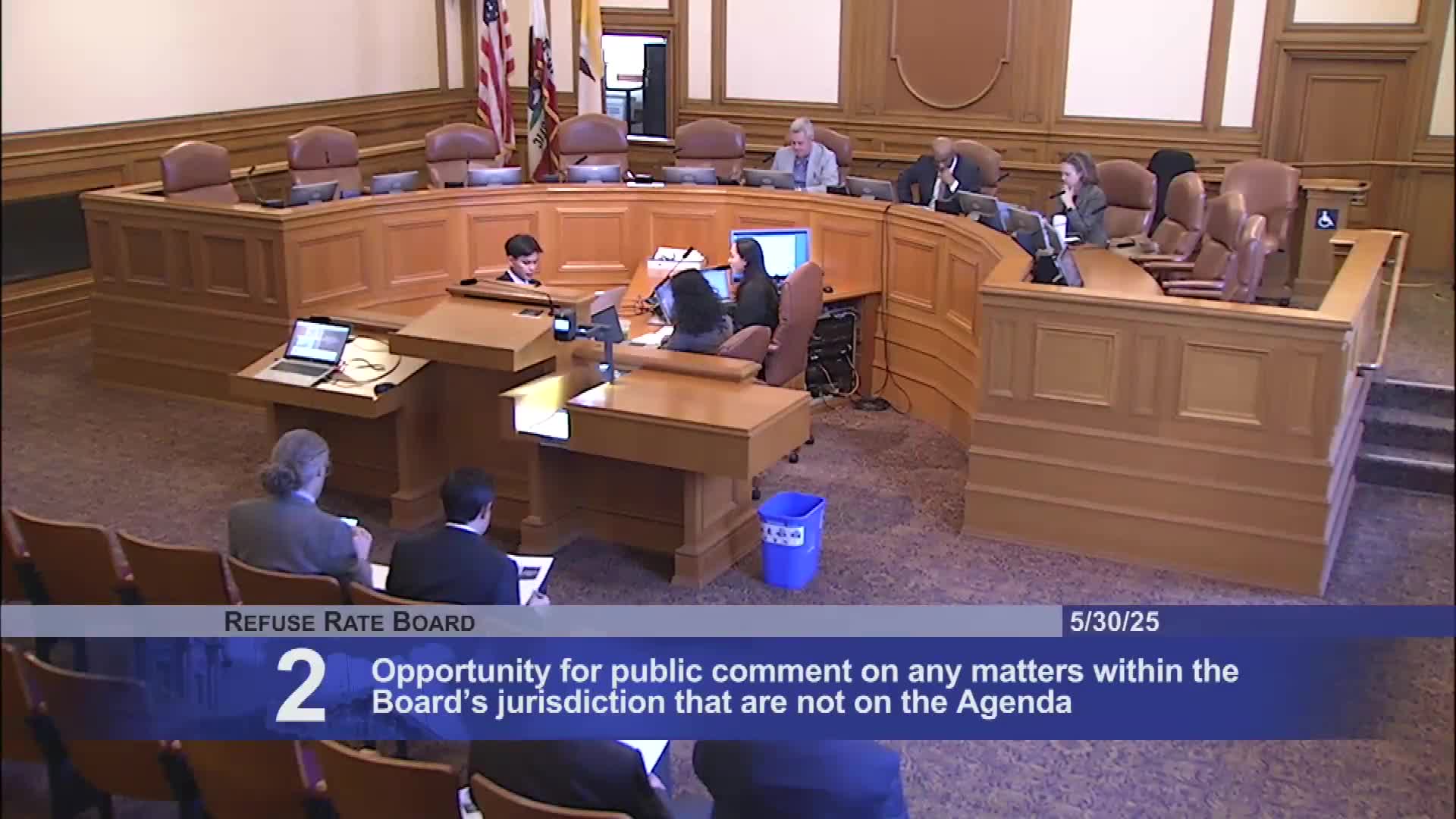
San Francisco''—The Refuse Rate Board on May 30 heard the refuse rates administrator's proposed rate order that would reduce portions of Recology's requested 2026'2028 increases, add new regulatory controls and service-level agreements, and fund small pilots for diversion and outreach while deferring major capital choices such as a full trash-processing facility.
Refuse rates administrator Jay Liao, of the Controller's Office, told the board the office's proposal would lower Recology's initial 2026 collections increase from 18.18% to 12.59% and produce smaller cumulative increases over three years than Recology proposed. He described a package of regulatory improvements including 26 service-level agreements, a new variance-reporting trigger and a 100% balancing-account rebalance policy intended to strengthen oversight and transparency.
Why it matters: The proposal affects monthly bills for residential and commercial customers across San Francisco and would finance both continued services and modest program enhancements for zero-waste goals. The hearing produced disagreement about how aggressively to fund new environmental work and infrastructure; the board did not vote and scheduled a follow-up hearing for June 25 to consider adjustments and additional details.
Liao summarized differences between Recology's application and the administrator's adjustments. "These 3 mechanisms combined, service level agreements, cost controls, balance account, create the basis for rate administration for the next 3 years," he said, arguing the changes would improve accountability.
What the numbers show: Recology's application (submitted Jan. 3) requested year-one collection rate changes of 18.18% (2026), with further increases of 7.53% (2027) and 3.86% (2028). The administrator proposed 12.59% (2026), 8.36% (2027) and 4.55% (2028). Liao said that, on a per-unit example set the office used, Recology's proposal would increase average monthly per-unit charges by about $9.39 in the first year, while the administrator's proposal would raise them by about $6.44, a roughly $2.45 to $3.34 monthly difference per unit in year one.
Tipping fees and capital: The administrator recommended slightly lower tipping fees than Recology: $262.88 per ton in 2026 versus Recology's $269.05, with smaller per-ton savings in later years. The administrator's proposal does not include Recology's contingent schedule tied to building a mixed-waste processing facility; the office recommended funding $400,000 over the first two years for further study and pilots instead of authorizing the full contingency. Consultants also briefed the board on capital risks: HF&H said a full transition to zero-emission heavy vehicles or large new facilities could add materially to long-term costs and would require further study.
Regulatory changes: The proposed regulatory package includes (as described by Liao): 26 service-level agreements documenting hauler obligations; a variance-report trigger for cost deviations greater than 5% and $500,000 that subjects excesses to recoverability review; baseline operating metrics tied to performance; a 10% cap by broad cost category above which costs would be non-recoverable; and a rebalanced balancing account that would capture over- or under-earnings at 100% for future reconciliation. Liao said the changes move the city away from "handshake" agreements and toward a more systematic monitoring regime.
Environment Department priorities: Leo Chi, deputy director of the San Francisco Environment Department, presented the department's narrowed add-back package and explained how its requests relate to the city's zero-waste and greenhouse-gas goals. "Zero waste and the environment is an essential part of Prop F," Chi said, noting the department's interest in upstream reduction, outreach and a measured approach to trash-processing pilots. Chi identified positions and programs the department sought to add to the rates-funded impound account (initially a $3.0 million ask) and said the department had identified some items it would de-prioritize to limit rate impacts.
Public input and focus groups: The administrator reported extensive outreach and said the office received 164 written Prop F objections after the report was issued; 159 objected to the increase, 24 cited service issues and five supported some rate increases. The office's focus groups, held in English, Cantonese and Spanish, found support for clearer, multilingual outreach materials and a $10 quarterly bill increase as a commonly stated willingness-to-pay ceiling among participants (the Cantonese group was an exception and opposed any increase). In public comment at the hearing, residents and groups gave mixed views: Natalie Calhoun Wexler urged maintaining and expanding reuse and repair programs; Marie Rabiel said the proposed increases are unaffordable in the current economic climate and urged substantially smaller rate hikes; Alex Duretsky of Connected SF urged more transparency, competitive procurement for large projects and stronger public oversight, saying, "This proposal should be rejected in its current form and replaced with a process that includes public oversight, competitive bidding, and clear financial accountability."
What was not decided: The board did not vote on the rate order. Members asked staff for additional detail and scheduled another hearing for June 25. Liao offered options to adjust the 0-waste capital reserve, impound-account add-backs and program enhancements before the next hearing.
Meeting context and next steps: The hearing included detailed financial and programmatic testimony from the refuse rates administrator, the Environment Department, consultants and public commenters. The board will reconvene June 25 to consider possible adjustments to the administrator's proposal and any final rate order; any adopted rates would become effective Oct. 1 if approved.
Ending note: No formal action was taken at the May 30 hearing; the board left the record open for written objections and will revisit the item at the June 25 meeting.