Get Full Government Meeting Transcripts, Videos, & Alerts Forever!
Get email alerts on the Ethics Conflict Of Interest topic
No spam. Unsubscribe anytime.
South Padre Island ethics board tables conflict-of-interest complaints against mayor and local businessman
Summary
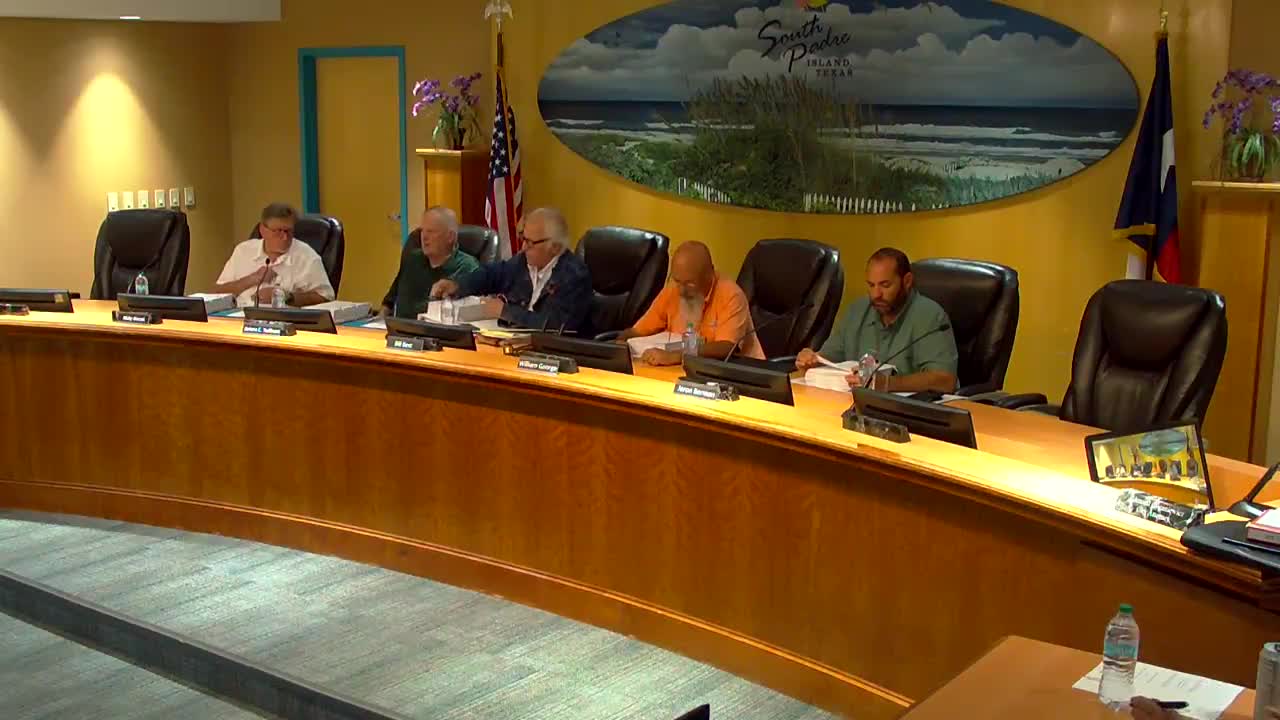
SOUTH PADRE ISLAND, Texas — The South Padre Island Board of Ethics on Monday heard testimony alleging Mayor Patrick McNulty and local businessman Joe Rico could have benefited from the city—s newly designated arts district, and then voted to table formal decisions until members can review voluminous submissions.
SOUTH PADRE ISLAND, Texas — The South Padre Island Board of Ethics on Monday heard hours of testimony and documentary evidence on complaints alleging Mayor Patrick McNulty and local businessman Joe Rico had potential financial conflicts tied to the city—s newly designated arts and entertainment district, then voted to defer any final decision until members have had more time to review filings.
Complainant Stephen McCauley and his attorney, Bridal Lederma, argued the creation of the arts district gave distinguishable economic benefits to businesses and property inside the district and that McNulty and associates stood to gain. The board voted to permit McCauley a hearing and later tabled formal decisions on the complaints, placing conditions on the continuation of the record.
Why it matters: The complaint centers on whether elected officials— private business interests or partnerships were likely to be affected by a city zoning action that created an arts/cultural district. McCauley—s presentation cited franchise tax records, a map of the district boundaries and state-level grant programs that apply only to properties inside cultural districts.
During the meeting, Lederma summarized evidence alleging that McNulty has ownership or partnership interests in several LLCs operating in or adjacent to the district and that a business partner, Alter Holland, owns land and parking lots within the designated area. "If you look at the Texas Commission on the Arts website," Lederma said during her presentation, "these strategies are place-based, in that they apply only to transactions, investments, residents, or enterprises within the boundaries of the cultural district." She added the agency awards grants that can fund improvements and promotion, noting awards of up to $250,000 referenced in material she put in the board packet.
Stephen McCauley, sworn in before addressing the board, told members the process had included large, unsworn submissions and asserted a history of what he described as retaliation and other irregularities affecting his businesses. "This hasn't been ran ethically or legally," McCauley said. "...I just want the opportunity to give a couple of more statements on how, yes, it could benefit."
Board process and votes - The board first approved the minutes from its May 7 meeting. The motion passed with three votes in favor and two abstentions (noted in the record as Nikki Novak and Jim), and the minutes were adopted. The board elected a chair (Bill, identified in discussion as Bill Best) and a vice chair in separate, unanimous votes. - On the substance of the complaint, board members voted to allow a hearing so McCauley could present testimony under oath. The hearing proceeded with Lederma presenting documentary material and McCauley sworn to speak. - After presentation and public comment, counsel advised the board it needed time to consider the extensive packet. The board then voted to table formal decisions on agenda items 4.4 (complaint against Mayor Patrick McNulty), 4.5 (complaint against Joe Rico) and 4.6 (show-cause for frivolous complaint) with specific conditions: no additional written materials will be accepted, no further testimony or witnesses will be presented on behalf of the complainant, and respondents (the officials named in the complaints) would be allowed to appear and make statements if they choose when the matter is reconvened. The motion also included an admonition that board members should not discuss the matter outside of public meetings or permitted communications with staff or counsel.
Board counsel and members repeated that the board was acting in an investigatory capacity and that it must follow its rules. During the presentation Lederma cited the South Padre Island Code of Ordinances, the Board of Ethics Rules and Procedures (sections 4.d.4, 5 and 6 were referenced in discussion) and an Attorney General opinion (GA-0796, dated Sept. 13, 2010) as part of her legal framework for the complaint.
What the complaint asserts and what the board heard Lederma displayed a map of the arts and entertainment district and highlighted areas she said were owned or managed by McNulty or his business partners. She told the board that names appearing on franchise tax filings showed McNulty, Rico and Alter Holland in partnership on multiple LLCs and that the park/parking-lot areas were integral to businesses such as Louie's Backyard and Tequila Sunset. Her argument focused on two lines of potential advantage to inside businesses: (1) access to state and other grants targeted to cultural districts and (2) a demonstrable increase in foot traffic, sales tax and property values documented in studies of other cultural districts.
Several board members questioned the evidentiary basis for individual ownership claims and whether benefits were speculative. One board member noted that the ethics code requires a showing that the action is "likely to affect the economic interests of the official," citing state and local legal standards discussed during the meeting. Board counsel emphasized the difference between showing a potential benefit (the standard Lederma argued applies under the local code) and proving an actual realized benefit.
Next steps and scheduling Board members instructed the city secretary to coordinate dates so the whole board can reconvene "as soon as practicable" to complete its review and decision-making process. Counsel said several members had not yet finished reviewing the voluminous submissions and that the board would set a follow-up meeting after members and counsel had time to examine the record. The board also indicated that respondents would be notified and allowed to appear and present a response when the matter is taken up again.
The meeting included extended public comments that raised broader concerns about city governance and enforcement practices unrelated to the specific legal elements of the ethics complaints. The board repeatedly reminded commenters of time limits and the distinction between public comment and the evidentiary hearing record.
For now, the board—s formal decision on whether McNulty or Rico violated the Code of Ethics is deferred pending the scheduled reconvening and the board—s review of the received materials.