Get Full Government Meeting Transcripts, Videos, & Alerts Forever!
Get email alerts on the Austin Water Financial Forecast topic
No spam. Unsubscribe anytime.
Austin Water forecasts multi‑year rate increases to fund $2.8B capital plan including $1B Walnut Creek expansion
Summary
Austin Water staff told commissioners on June 2 that the utility will phase in rate increases through 2030 to cover a growing capital program (now about $2.8 billion proposed, including a $1 billion Walnut Creek expansion), while using debt‑management tools and reserve balances to smooth impacts on customers.
Austin Water staff on June 2 laid out a five‑year financial forecast that calls for phased rate increases through fiscal 2030 to fund a sharply larger capital program, while using cash financing, defeasance and low‑interest loans to limit near‑term rate shocks.
Joseph Gonzales, assistant director of financial services for Austin Water, told commissioners that the utility expects rate increases to peak in fiscal 2026 at just over 9 percent before tapering toward inflationary levels in later years. Gonzales said the utility plans to phase those increases to reduce the immediate burden on residential customers and that staff expects a $10 million budget shortfall in fiscal 2026 as part of that phasing strategy.
The nut of the forecast is the utility’s expanding capital program. Austin Water’s adopted five‑year capital plan (the current working plan) was about $2.3 billion; staff proposed rolling the plan forward and increasing the five‑year program to roughly $2.8 billion, largely to program the Walnut Creek wastewater treatment plant expansion and upgrade, a project Gonzales described as a roughly $1 billion, generational investment.
Because large projects have long service lives, Austin Water is proposing to modify its cash‑financing policy for generational projects. The existing policy targets 35–50 percent cash financing of the annual capital program; staff told commissioners it will seek a two‑tier approach that retains the 35–50 percent target for most projects but lowers the cash target to about 20 percent for very large generational projects to avoid asking today’s customers to fund the bulk of a 50‑year asset up front.
Staff emphasized that debt management will remain central. Gonzales said Austin Water has used defeasance and other strategies since 2016 to smooth debt service and reduce borrowing costs, and that those transactions have saved the utility about $625 million since 2016. He also said the utility plans to pursue low‑interest loans from the Texas Water Development Board and federal WIFIA (Water Infrastructure Finance and Innovation Act) funding for the Walnut Creek project.
The forecast shows several revenue and cost drivers. Enrollment in the utility’s customer assistance program has grown rapidly: staff said residential enrollment rose from about 15,000 participants two years ago to more than 50,000 currently, and staff is working with Austin Energy to reach as many as 80,000 total customers under expanded council initiatives. To pay for broader assistance, the community benefit charge was doubled last year from $0.15 to $0.30 per 1,000 gallons. Gonzales said slower development has reduced capital recovery (impact) fees from a peak of roughly $44 million in 2022 to about $29–30 million in each of the last two years.
On financial metrics, staff reported that Austin Water’s bond ratings remain strong (Moody’s and S&P at AA, Fitch at AA‑ with stable outlooks). The utility’s policy target for debt service coverage is 1.75x (bond covenants require at least 1.25x). Gonzales said the utility’s current leverage and planned debt management actions are within rating agency tolerance but warned that materially higher cumulative debt could put pressure on ratings.
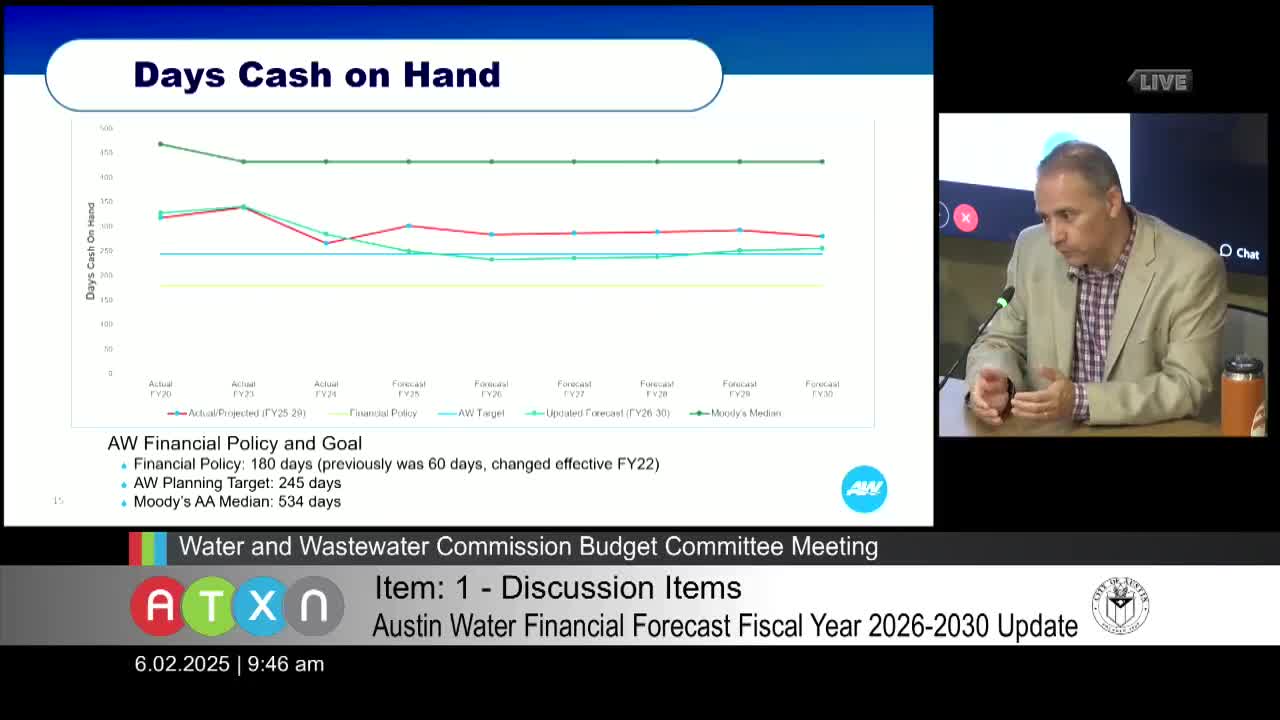
Staff also described liquidity and reserve policies. Days cash on hand have been above 300 days the last several years; the utility’s target is 245 days and Moody’s median peer level is higher. Gonzales said staff expects days‑cash to decline modestly (to roughly the 260–290‑day range) as the utility uses reserves to phase in rate increases. He reiterated that the revenue stability reserve (established after the prior drought to preserve about 120 days of operating cash) is restricted and would require council action to tap.
Commissioners asked about drought‑driven revenue variability, the budget schedule and whether growth or large industrial customers such as data centers could change demand forecasts. Gonzales and other staff said the city’s one‑day‑a‑week watering standard has reduced drought variability compared with the prior drought and that the utility expects modest population and customer growth (roughly 1–1.5 percent annually). Staff said they are not aware of any immediate, large new industrial water users but monitor potential projects and work with the city manager’s office on data center inquiries.
Staff outlined the near‑term budget process steps: the forecast was presented to council in April, the proposed Austin Water budget was submitted to the budget office in May, and the citywide budget presentation to council is scheduled for July 15 (staff said the commission will present its own, more detailed Austin Water budget materials to the commission the next day). Council budget hearings and adoption are scheduled in late July and mid‑August.
Gonzales, Christina Romero (Austin Water staff) and other presenters said staff will hold at least one additional commission meeting before the July council presentation to review capital improvements and significant forecast changes.
Ending: The forecast reflects Austin Water’s effort to balance infrastructure investment, affordability for low‑income customers and bond‑rating considerations; staff said further adjustments to financial policy and additional meetings with commissioners are planned before council considers a proposed budget in July.