Get Full Government Meeting Transcripts, Videos, & Alerts Forever!
Get email alerts on the Unified Development Code topic
No spam. Unsubscribe anytime.
Lynnwood staff present unified development code; fire sprinklers for new homes ignite debate
Summary
City planning staff and South County Fire briefed the Lynnwood City Council on a proposed Unified Development Code that would increase housing capacity and, at the department—s recommendation, require residential fire sprinklers in most new dwellings. Councilmembers asked for more cost data and alternatives before the June public hearing.
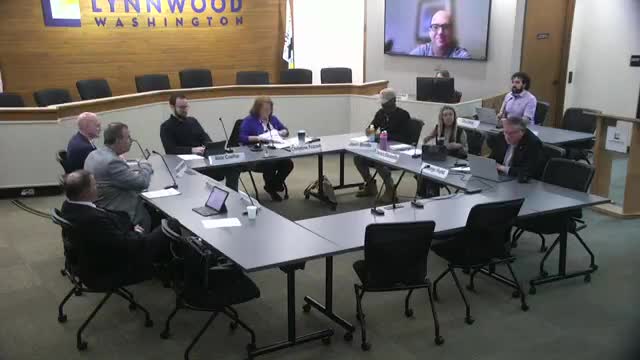
Lynnwood—s community planning manager and consultants on June 2 briefed the City Council on a proposed Unified Development Code (UDC) intended to implement new state middle-housing laws, increase housing supply and streamline permitting, and outlined a South County Fire recommendation to require residential fire sprinklers for most new construction.
The council heard that the UDC would consolidate several titles, repeal the existing zoning code, and allow more units per lot under state-mandated middle-housing changes. "The unified development code that is before council tonight is the next milestone along the path of proactive planning and continuous improvement," Community Planning Manager Carl Algren said during the presentation.
Why it matters: the package is meant to speed permitting and allow more units on existing lots to address housing supply, but it also contains new construction standards that could raise per-unit costs. A central point of debate was a South County Fire recommendation to require NFPA 13D-style residential sprinkler systems for most new single-family, middle-housing and ADU construction. Council members expressed support for life-safety goals but pressed staff and the fire marshal for clearer cost estimates and alternative thresholds before the scheduled public hearing.
What staff proposed - Code structure and timing: Staff said the UDC consolidates development regulations into a single code, leaving administrative sections largely intact, and would be presented for council consideration on June 23. The city has an adoption deadline on June 30 to adopt either the locally drafted UDC or a model ordinance from the Washington State Department of Commerce. - Housing and zoning changes: The UDC would allow more units per single-family lot (moving beyond state minimums in some cases), offer a density bonus for cottage housing, and maintain a 6,000-square-foot lot standard with a 35-foot height limit in residential areas. Staff said the UDC was drafted to increase predictability and cut permit timelines. - Design and landscaping: The draft includes design standards for entries, fenestration, roofs and street-facing landscaping intended to help new development blend into existing neighborhoods. - Permit processing: Staff plan to clarify Type 1/2/3 reviews and standardize submittal requirements; proposed changes include raising the PDR (preliminary devel. review) threshold from 1,000 to 3,000 square feet to reduce low-value administrative reviews.
Fire-sprinkler recommendation and alternatives South County Fire and the city—s presenters outlined the department—s view that expanding residential sprinkler requirements will reduce spread, toxic smoke exposure and building-to-building fire propagation as Lynnwood permits more units on smaller footprints. "Fire sprinklers offer the unique opportunity to take these gases and... getting them out of the air," a South County Fire official said, noting modern home furnishings and lithium-ion batteries produce faster, more toxic fires.
Current Lynnwood requirements staff described: - Sprinklers are required now for buildings larger than 5,000 square feet, for occupancies lacking minimum fire-flow (500 gallons per minute), and for 3-or-more attached dwelling units or long hydrant distances.
South County Fire—s recommended change: - Require NFPA 13D residential sprinkler systems for all new residential construction (single-family, middle housing and ADUs) and reduce the building-size trigger from 5,000 to 3,000 square feet.
Options the presentation offered for council consideration included thresholds at 800, 1,000, 1,200, 3,000 and 4,000 square feet; those alternatives were offered in response to the Planning Commission—s split recommendation.
Costs and savings discussed - Installation estimates presented by the fire office: about $4 per square foot in the Lynnwood area (which would make a 1,900-square-foot house roughly $7,600, or about 1.6% of a $500,000 house, per the presenter). Annual inspection costs were given as roughly $300—$700. - The city—s fire presenters said they had seen contractor quotes in the $5,000—$10,000 range and that a $20,000 figure mentioned by a councilmember appears higher than the estimates the fire office gathered; the discrepancy could reflect differing local practices such as use of a residential fire pump, which Lynnwood—s fire code officials said they would not require. - Potential insurance savings: presenters said sprinklers can lower homeowners—insurance costs; the fire office cited insurer discounts of roughly 15% (and more with alarm systems) in their outreach.
Council questions and planning commission input Council members pressed for: more data on who would bear the cost (developers vs. purchasers), the share of renters living in older non-sprinkler housing, and regional comparisons (Edmonds, Mountlake Terrace and Kenmore were cited as nearby jurisdictions with different thresholds). Council members also asked the fire marshal to provide empirical evidence comparing outcomes under different thresholds.
The Planning Commission had split its recommendation into two parts: it recommended approval of the draft UDC elements included in the staff report, and separately asked the council to further consider sprinkler requirements to better balance safety and housing affordability.
Next steps Staff said they will include council questions in the packet for the June 23 public hearing and expect public testimony during the outreach period. The council will consider adoption alternatives before the June 30 deadline tied to the Commerce model ordinance process.
What was not decided No formal council vote occurred on June 2. Councilmembers asked staff and the fire marshal for additional cost data, comparative jurisdictional evidence and consideration of possible offsets (insurance credits or other incentives) before final action.