Get Full Government Meeting Transcripts, Videos, & Alerts Forever!
Get email alerts on the Affordable Housing topic
No spam. Unsubscribe anytime.
Cameron County tables ‘no objection’ for Palm Breeze Village low‑income housing application
Summary
After a lengthy public hearing on a proposed 368‑unit affordable complex in the Brownsville ETJ, the Cameron County Commissioners Court voted to table a resolution of no objection so staff and county leaders can review financial impacts, tax‑exemption details and school‑district concerns.
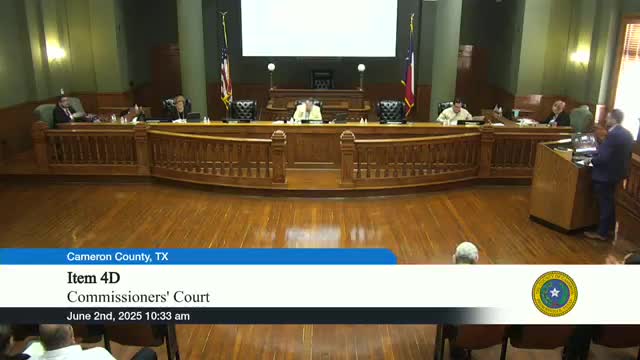
The Cameron County Commissioners Court on Monday tabled consideration of a resolution of no objection for the Palm Breeze Village apartment development — an affordable housing proposal in the Brownsville extraterritorial jurisdiction (ETJ) — after a multi‑hour public hearing focused on tax exemptions, developer fees and local benefits.
The hearing opened at the court’s special meeting after a motion to open the public hearing was made and seconded; county staff and project representatives answered commissioners’ questions before the court voted to table formal action. The developers and the Cameron County Housing Finance Corporation (HFC) representatives said the step was required to secure 4% federal low‑income housing tax credits from the Texas Department of Housing and Community Affairs (TDHCA). The court’s tabling preserves the county’s ability to request further financial detail and to seek school‑district input before any final county approval on tax‑exempt status.
Why it matters: Commissioners repeatedly raised concerns about how property tax exemptions would affect county revenue and school districts while HFC and the developer described how tax credit equity and a property tax exemption are necessary for the project’s financial viability. The court asked developers and the HFC for clearer dollar figures and a plan showing how the county will benefit if the HFC receives fees or ongoing revenue from the project.
Developers and housing officials who spoke at the hearing said the project is designed as affordable housing at 60% and 80% of area median income (AMI). Mark Milam, identified as the executive director for the Cameron County Housing Finance Corporation, described the planned project as providing housing for lower‑income households in the Southmost/Brownsville area and said the HFC intends to use funds it receives to support single‑family housing and other local projects.
Richard Ashton, with AMD Development (the developer), described the financial structure: the project relies on a layer of tax‑credit equity and a planned bond allocation. Ashton said the tax‑credit equity flowing into the project is about $25.26 million and that an estimated $3 million developer fee on the project would result in a share to Cameron County HFC (30% of the fee). "That 15‑year share is approximately $4,500,000," Ashton said, referring to the HFC's projected share over the initial 15‑year tax credit delivery period.
Developers and HFC representatives said rents at the project would be about 35% below comparable market‑rate units and asserted the property would be subject to a 40‑year land use restriction agreement supervised by TDHCA; they also said the project likely could not proceed as market‑rate housing without local assistance. "There is no way that it’s financially feasible for us to proceed with this" as market rate, Richard Ashton said.
Commissioners pressed the HFC and developers on the local fiscal tradeoffs. Commissioners asked for a line‑item pro forma showing (a) the value Cameron County would forgo in property taxes annually and over time; (b) the fees and ongoing revenue the HFC expects to receive; and (c) any offsets or commitments the HFC would make to direct funds back into county projects. During the hearing, HFC and developer representatives said the HFC expects to receive upfront and ongoing fees, and that a portion of those funds is planned for investments such as single‑family housing projects in Rio Hondo and other county needs.
After extended discussion — including concerns that county taxpayers and local school districts might bear an ongoing revenue loss — Commissioner Reese moved to table consideration of the resolution of no objection for submission to TDHCA; Commissioner Garza seconded and the motion carried. County staff and the developers agreed to return with more precise financial documentation and to coordinate outreach to the affected school district.
The court’s tabling is procedural: speakers repeatedly noted the current vote is not the final county action on a property tax exemption or bond issuance and that additional HFC and county steps would be required before any property could be removed from the tax rolls. The developers said they will submit a more detailed 15‑year pro forma and development budget to the court for review.
Next steps: The court directed staff to continue discussions with the HFC and the applicant, to obtain detailed fiscal projections and to solicit input from the school district before bringing the matter back for a formal county decision.