Get Full Government Meeting Transcripts, Videos, & Alerts Forever!
Get email alerts on the Cdbg Allocation topic
No spam. Unsubscribe anytime.
Committee recommends 2026 CDBG allocation, refers resolution to City Council
Summary
A Waukesha City advisory committee recommended staff allocations of $209,911 in 2026 Community Development Block Grant (CDBG) funds across facility projects and $37,043 for programs, and will refer an allocation resolution to City Council for final approval.
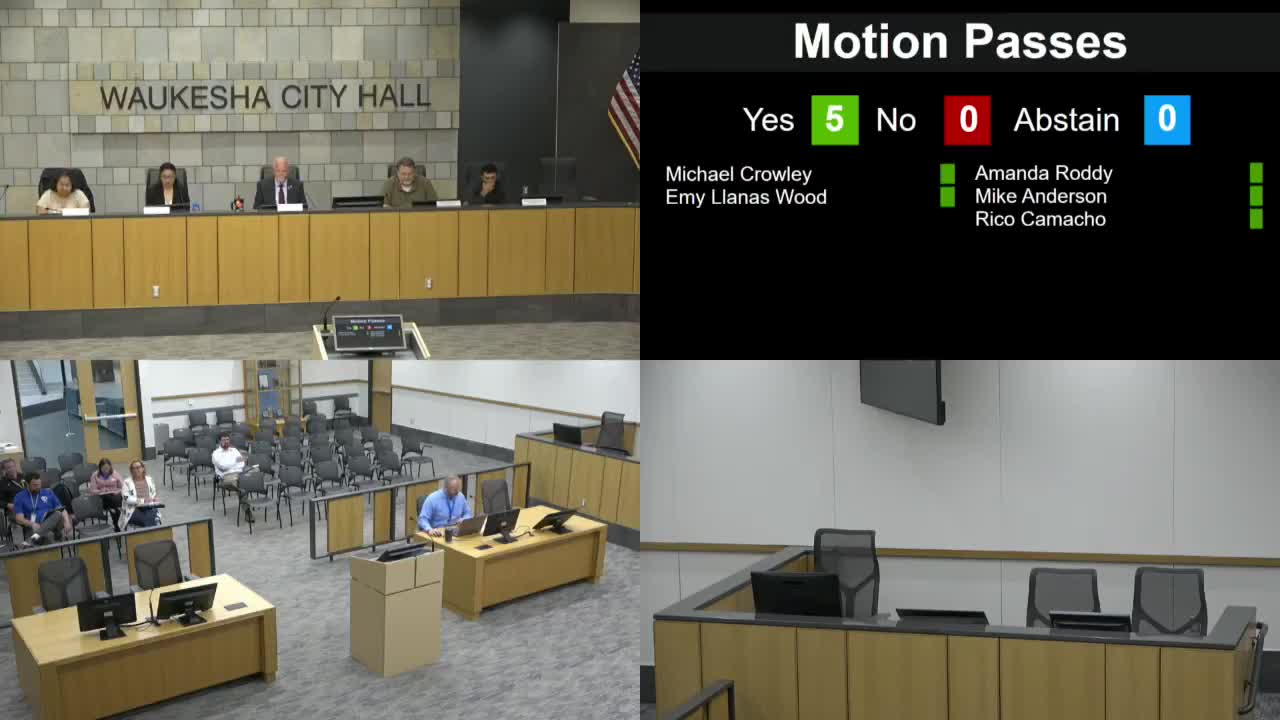
The Waukesha City Community Development advisory committee on May 20 reviewed staff recommendations for the city—ommunity Development Block Grant (CDBG) allocation for federal fiscal year 2026 and approved sending a resolution recommending those allocations to the City Council for approval.
Staff told the committee the city—stimated total entitlement for 2026 is $246,954; 85% of the entitlement is slated for facilities, housing and economic development projects ($209,911) and 15% for programs ($37,043). Staff said the total requests submitted by applicants exceeded available funds: $306,000 in project requests and program requests that in the aggregate were larger than the $37,043 available.
The committee recommended staff llocations that match available funding. Staff recommended $128,962 for ADA playground surfacing (matching a prior-year award level though less than the $226,000 requested), $25,000 for facade/sign/awning grants, $25,000 for landmarks paint-and-repair grants and $30,949 for public art projects, together totaling $209,911 for projects. For programs, staff recommended $15,000 for the senior activity coordinator, $6,743 for the merged Horb/Buckner swim-park-play program and $15,300 for the adaptive inclusion specialist, matching those program requests.
"That ensures that, at any given time we are 100% compliant, with ADA as far as the surfacing goes," said Melissa Lipska, Parks and Forestry operations manager, describing the city pproach to pour-in-place rubber surfacing for Buckner Park and Greenway Terrace playgrounds.
Parks staff explained the ADA surfacing keeps playground surfacing consistently compliant, while mulch or wood-fiber surfaces can quickly become noncompliant. Lipska said the balance of the playground project cost would be requested as part of the city's capital improvement program (CIP) budget process.
Charlie Griffith, a city staff member who described historic-property participation in the city's landmark paint-and-repair grant program, said the standard grant covers up to 15% of a project's cost, with a maximum of $3,000 per award. He said last year nine grants were awarded from a $20,000 allocation and the total estimated project cost covered by applicants was roughly $207,000.
Recreation staff presented the recommended program awards. Mark Thompson, recreation supervisor, said free senior programming and contracted peer-led technology classes are well used: "These programs always fill to capacity," he said, adding that the city's free senior offerings serve about 1,200 unduplicated participants annually and the broader senior portfolio served more than 2,000 unique participants across fee-based and free programs last year.
Gayla Evers, recreation supervisor, described the combined Horb/Buckner swim-park-play summer program for school-age children and noted the county asked the city to combine two small grants into a single allocation because the county does not favor awards under $5,000. She said the program partners with the school district and St. Vincent de Paul to provide enrichment, swim lessons and a free lunch for participants.
Evers and other staff said the adaptive inclusion specialist position (part-time) serves 11 before-and-after-school sites during the school year and about nine summer day-camp locations, providing supports so children with individualized education plans can participate in programs without one-to-one aides.
Staff also discussed a reallocation of the city'025 CDBG funds to reflect a county-level revision of available dollars. The city previously recorded $223,962 in 2025 allocations with $39,522 earmarked for programs; county guidance reduced those amounts to the 2026 entitlement level, and staff proposed reallocating funds from a public infrastructure line where no project plan yet exists.
Committee members were told the staff recommendation would be forwarded to the City Council for formal approval, with a goal of a council allocation resolution on the June 3 meeting agenda. The committee did not record a final vote on the allocation at the advisory meeting; the action is a recommendation to City Council.
The committee discussed practical effects of program reductions and pointed to departmental flexibility and other funding sources to cover shortfalls. "If it drops, then we have other things we can kinda shift around to make it work," said an unidentified staff member.
The committee packet and staff presenters listed a number of applicants and projects (ADA playgrounds at Buckner Park and Greenway Terrace; facades including a downtown Martinez law office renovation; public art projects including Freedman Alley murals and utility box wraps; landmark applicants; senior programming and the swim-park-play and adaptive inclusion programs). Committee members were advised the county administers some program funding under a memorandum of understanding (MOU) with the city and acts as an intermediary with HUD for program administration.
Next steps: staff will prepare an allocation resolution for the City Council, targeted for the June 3 meeting, and the council will take the formal vote to adopt the allocations and any reallocation of 2025 funds.
Notes: The committee's recommendations are advisory; final fund awards are subject to City Council approval and any further adjustments required by Waukesha County or HUD.