Get Full Government Meeting Transcripts, Videos, & Alerts Forever!
Get email alerts on the Coastal Zone Definition topic
No spam. Unsubscribe anytime.
Puerto Rico hearing exposes split over House Bill 25’s proposed redefinition of coastal public lands
Summary
Lawmakers and stakeholders debated House Bill 25, which would change the legal definition of Puerto Rico’s zona marítimo terrestre (ZMT). Engineers and builders urged a predictable, datum-based standard; environmental groups warned the bill weakens climate resilience and urged adoption of a science-led alternative.
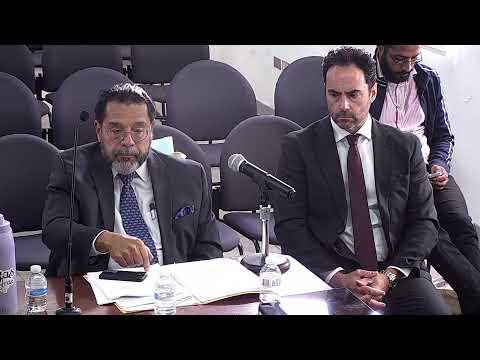
SAN JUAN, May 28, 2025 — The House of Representatives’ Commission on Natural Resources held a hybrid public hearing on Wednesday on House Bill 25, a technical but potentially far-reaching measure to change the legal definition of the zona marítimo terrestre (ZMT), the strip of land on Puerto Rico’s coast considered part of the public maritime-terrestrial domain.
The commission heard three substantive positions: the Colegio de Ingenieros y Agrimensores de Puerto Rico (CIAPR) pressed for technical precision and for waiting on a joint climate commission and pending rulemaking; Amigos del Mar urged stronger coastal protections and a science-led definition that responds to climate change; and the Asociación de Constructores de Puerto Rico and its counsel argued the bill should adopt a predictable tidal datum to reduce administrative discretion and litigation.
CIAPR President Carlos Roberto Furnier Morales framed the issue as primarily technical and urged that the definition of the ZMT be based on precise topographic, geologic and geodetic methods. “El deslinde la zona marítimo terrestre es una labor de carácter técnico,” Furnier said, adding that the college’s recommendations would reduce ambiguous terminology that now produces inconsistent agency decisions. CIAPR said the commission should await the joint commission on mitigation, adaptation and resiliency (CEAC) and the joint regulation process before final legislative action.
Representing Amigos del Mar, co‑director Elga Vanessa Uriarte Centeno told the commission the bill as written would shrink the ZMT and leave coastal ecosystems and public access more vulnerable to storms and sea‑level rise. “Proteger lo público es proteger a Puerto Rico,” Uriarte said, urging the legislature to adopt the scientific definition proposed by the island’s researchers rather than the bill’s language derived from older legal doctrine.
The Asociación de Constructores’ president, Agustín Rojo Montilla, and attorney Patricio Martínez Lorenzo argued the ZMT definition must produce predictable boundaries for property owners and investors. Martínez urged replacing the bill’s proposed “mayor desplazamiento horizontal de la marea astronómica durante los equinoccios” (maximum horizontal reach during equinoctial tides) with a tidal datum based on long‑term measurements—what he called the nivel medio de pleamar mayor (NMPM). Martínez said NMPM is a reproducible, NOAA‑compatible standard that reduces administrative discretion and litigation.
Speakers described administrative and technical problems under the present system. Witnesses reported “over 200” pending ZMT deslinde (boundary) cases at the Department of Natural and Environmental Resources (DRNA) that demonstrate inconsistent interpretations when agencies use different criteria (vegetation line, highest astronomical tide, storm waves). Martínez and others recommended that the law explicitly reference NOAA stations and published tidal procedures, require documentation and independent verification of deslindes, and establish transitional protections for preexisting property rights.
Environmental witnesses stressed the island’s vulnerability to climate change. Amigos del Mar cited studies and agency reports they said show significant coastal erosion and ecosystem loss, the role of dunes and vegetation in protecting shores, and the need to account for storm surges and cyclone‑driven waves in any delimitation. CIAPR and the constructors suggested integrating technical criteria such as LIDAR, local NOAA tide stations and an agreed datum into law or regulation to achieve consistent field measurements.
No committee vote or final action was taken at the hearing. Commissioners and attendees discussed whether the legislature should (a) adopt a clear, datum‑based statutory definition now to reduce uncertainty for developers and owners, or (b) postpone a statutory change pending the CEAC report and completion of a consolidated joint regulation that several witnesses said remains in process. The commission’s chair directed stakeholders to submit written material for the record within five business days.
Background and next steps: House Bill 25 proposes amending definitions in primary statutes governing docks/ports and the DRNA’s authorities. Witnesses frequently referenced (1) Ley 151 of June 28, 1968 (Ley de Muelles y Puertos de Puerto Rico), (2) Ley 1 of June 29, 1977 (law governing the DRNA/"Vigilantes"), (3) Reglamento 48‑60 (DRNA coastal regulation), and (4) ongoing work by the Comisión de Mitigación, Adaptación y Resiliencia (CEAC), with a preliminary report referenced as due on Dec. 31, 2026. Advocates for a datum‑based approach urged use of NOAA (referred to in testimony as NOA) tidal stations and the agency’s technical publications as the basis for any statutory datum.
The hearing record remains open for supplemental written submissions from CIAPR, Amigos del Mar, the Asociación de Constructores, NOAA materials and other technical exhibits the commission requested. The commission did not adopt or direct any immediate regulatory change at the session.