Get Full Government Meeting Transcripts, Videos, & Alerts Forever!
Get email alerts on the Parks Vendors Permits topic
No spam. Unsubscribe anytime.
Guam committee hears bill to let parks director set vendor limits, seeks criteria and budget clarity
Summary
The Guam Legislature committee heard testimony on Bill No. 390-31 (COR) to give the Department of Parks and Recreation director authority to set the number of vendors at park sites. DPR asked for flexibility to manage unpermitted vendors and require insurance; lawmakers requested written criteria and details on fund use before markup.
The Committee on Municipal Affairs, Tourism, Housing and Recreation heard public testimony Jan. 6 on Bill No. 390-31 (COR), which would add a new item to Guam law to allow the director of the Department of Parks and Recreation (DPR) to determine the appropriate number of vendors at park sites.
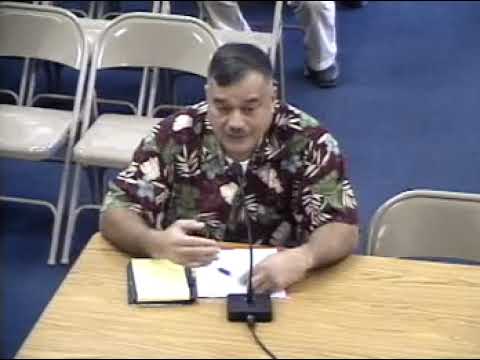
DPR Director Peter Salas Cabo told the committee he “fully support[s] the bill” and said the department seeks discretion so it can require permits, proof of liability insurance and enforce instructor-to-customer ratios for water-recreation vendors such as divers, canoeing and kayaking operators. “Allowing DPR to increase the number of vendors at certain park areas gives us the ability to better manage these unpermitted vendors by requiring them to come into our office and receive the proper permits,” Cabo said.
The bill would amend statutory and administrative provisions that DPR says now constrain it to a maximum of two to five vendors per park area under the current rules. Cabo told lawmakers the department has encountered situations in which more vendors were operating than the statute allowed: “Upon coming on board there were only 5 vendors allowed at the Two Lovers area, and we were handling 7,” he said, adding that the situation produced safety and code violations that the department had to address.
Lawmakers pressed DPR for more precise standards. Speaker Ben Pangolinan urged the department to provide recommendations on which parks should allow vendors and what criteria—park size, visitor counts or use type—should determine allowable vendor numbers. “There may be some parks where we don't want vendors in or that the number of vendors is dependent on the size of the park,” Pangolinan said.
Senators also asked for operational details DPR can provide to the committee before a markup. Senator Tony Atta and others requested a vendor list and a written packet the committee can review “within this timeline before session day,” with Speaker Pangolinan and committee members requesting the information “early next week” to help advance the legislation.
Committee members raised budget and accountability questions. Cabo said vendor fees are deposited into the general fund, while a separate Park Services Fund exists but has been handled unevenly in appropriations. Committee members cited a $250,000 authorization figure compared with roughly $200,000 actually provided in recent years, and DPR identified a current need to use a $193,000 special Park Services Fund allocation for supplies and fuel. Lawmakers emphasized that additional spending flexibility would require strengthened internal controls and assurances to the Office of Public Accountability (OPA). “If we can see some demonstrated and clear policies in place that will safeguard public funds and basically safeguard the program integrity, then I'm sure we could try to work something out,” a senator said.
DPR outlined several operating practices it already uses: vendor permits are annual, aligned with a June 30 to July 1 fiscal cycle; the permit is treated as a temporary privilege requiring vendors to arrive when parks open and leave when parks close; DPR has pushed new vendors to less-used parks such as Alupang and Paseo to spread tourism activity; and DPR requires proof of liability and insurance, particularly for water-sport vendors.
Committee members also probed enforcement and delinquency practices. DPR officials said a small number of vendors were late with payments—some short by about $500—and the department had been allowing vendors limited leeway while working case-by-case so the vendor can remain operational while catching up on fees.
The committee asked DPR to provide: a current vendor list and vendor application packet, written recommendations or proposed criteria for where and how many vendors should be allowed at specific parks, documentation of insurance and instructor-ratio standards used for water vendors, and an accounting of park-related fee receipts and Park Services Fund appropriations. The public hearing was adjourned at 9:49 a.m.
The record contains no formal committee action or vote on the bill at this hearing; lawmakers requested additional written material and an expedited timeline ahead of the January session.