Get Full Government Meeting Transcripts, Videos, & Alerts Forever!
Get email alerts on the Transportation Fuels topic
No spam. Unsubscribe anytime.
California agencies warn refinery exits could increase price volatility as they weigh emergency tools
Summary
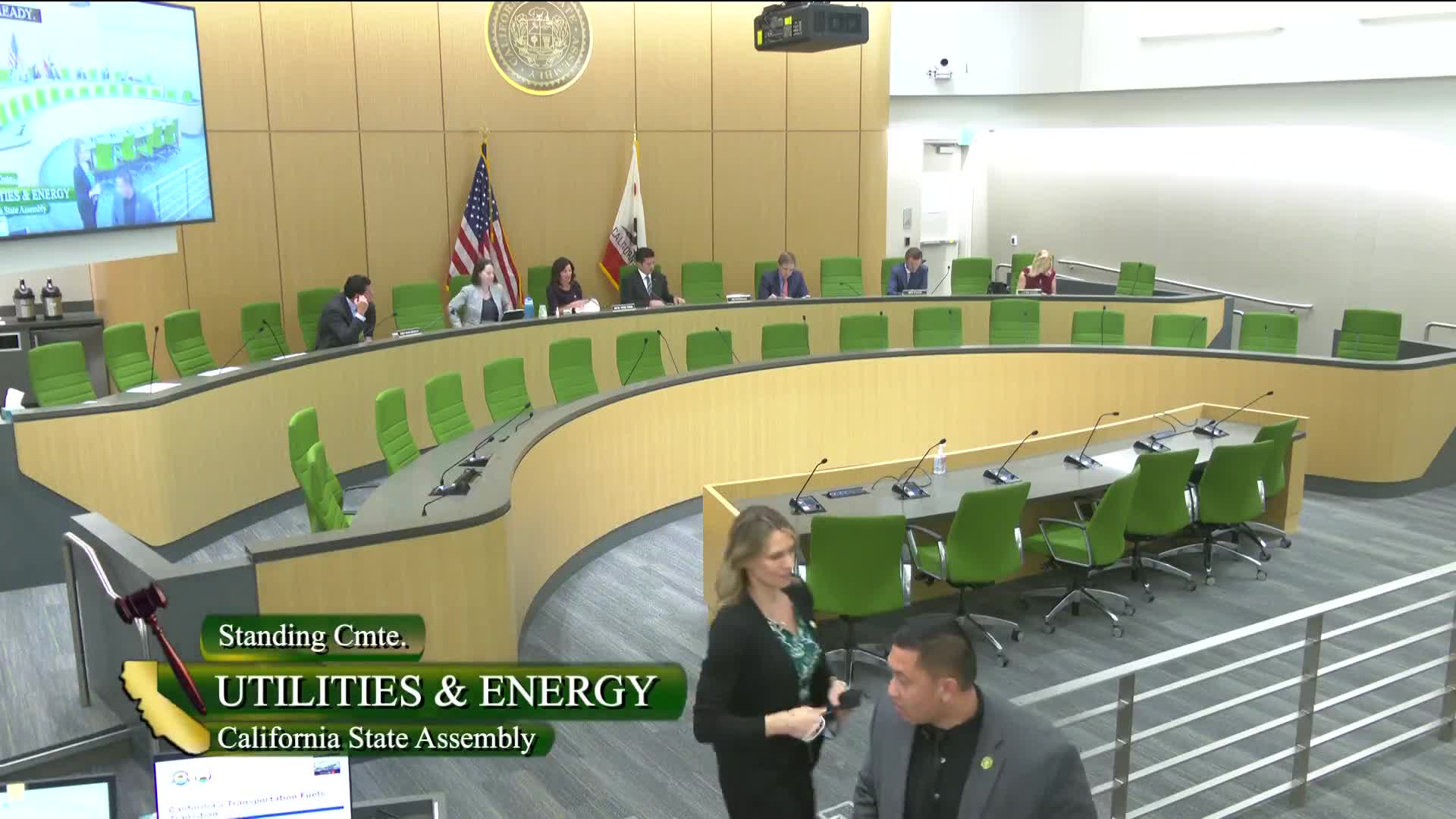
Chair Petrie‑Norris convened the Assembly Utilities and Energy hearing and told witnesses the recent Phillips 66 and Valero announcements mark "a pivotal moment" for California fuel supply and price stability.
Chair Petrie‑Norris opened the hearing by calling California’s fuels transition “one of the most complicated and I believe important challenges that policy makers will need to face in the decade ahead,” and said the recent Phillips 66 (Wilmington) and Valero (Benicia) announcements mark “a pivotal moment” for state supply and prices.
Agency witnesses described three linked risks: falling local refining capacity, continued demand for liquid fuels during the multi‑decade transition, and concentrated market structure that can amplify price moves. Liane Randolph, chair of the California Air Resources Board, told the committee that "fossil fuel use in vehicles is the single biggest source of climate and air pollution in the state," and said CARB’s programs (including the Low Carbon Fuel Standard, or LCFS) remain central to meeting state air‑quality and climate goals.
Ty Mylder, director of the Division of Petroleum Market Oversight (DPMO), summarized DPMO’s new findings on retail prices and margins: “Californians have been paying 41¢ per gallon extra for every gallon of gasoline sold since 2015,” a difference DPMO calls the "mystery gasoline surcharge" and that the division estimates amounts to roughly $57 billion cumulative since 2015. DPMO staff told the committee that branded retail outlets account for much of that difference (branded outlets show an average unexplained uplift of about 72¢ per gallon since 2015, versus roughly 34¢ for unbranded outlets) and that changes in market structure and vertical integration are key drivers.
The California Energy Commission (CEC) vice chair framed the problem systemically: California refineries already serve parts of Arizona and Nevada, and about 75% of the crude the state’s refineries process is imported rather than California crude. The CEC said state refining capacity that supports gasoline is roughly 1.7 million barrels per day in nameplate terms, with about 900,000 barrels per day devoted to gasoline production; as refining capacity and local crude extraction fall, the margin for absorbing outages or fires shrinks.
Panelists reviewed three categories of tools created or authorized in recent special‑session legislation (often referenced as SBX1‑2 and ABX2‑1): (1) transparency and reporting improvements, (2) planning and a fuels transition plan, and (3) limited market‑stability authorities (for example, a potential resupply requirement, minimum inventory standards, or a margin cap). Witnesses told lawmakers they had not implemented any mandatory margin cap or minimum‑inventory requirement and emphasized that the statute directs agencies to use such permissive tools only if the benefits outweigh the costs to consumers and market functioning.
Panelists also described the industry dynamics behind refinery decisions. DPMO described a widening gap since 2015 between California gross industry margins and those in the rest of the United States, with very large spikes during 2022–23. The division’s analysis, supported by external academic review, shows two different recent patterns: large, episodic spikes in wholesale/spot markets tied to outages and lower days‑of‑supply, and a persistent branded/unbranded retail spread that appears to leave some wholesalers and refiners less profitable even when branded networks do well. Several witnesses said that for some refineries the decision to close is the result of company assessments of long‑term returns, the timing and cost of major turnarounds (hundreds of millions of dollars), and global competition from newer, larger refineries.
Lawmakers pressed agencies for specific recommendations. The CEC said it will deliver a response to the governor by July 1 on immediate options and is working toward a fuller fuels transition plan later in the year; the CEC repeatedly emphasized it is still analyzing costs, market impacts and trade‑offs before deploying any of the special‑session authorities. DPMO said an investigatory and data‑analysis program is active and a public report from its economics team will follow. CARB underscored that air‑quality mandates and public‑health benefits are part of any transition calculus and said options exist that are not preempted by federal action.
Public commenters — including representatives of refinery communities, labor and environmental groups — urged simultaneous attention to worker protections, community health and stricter refinery safety enforcement while also noting the need to accelerate demand‑reduction measures such as electrification. Witnesses and members agreed that the choices will involve trade‑offs among affordability, reliability and the state's climate and public‑health goals.
What agencies will do next: CEC staff said it is translating stakeholder input into specific, implementable proposals and will present analyses of costs and market effects before using statutory tools; DPMO said it will continue investigations and pursue measures to improve retail competition and market liquidity; CARB said it will continue to update the scoping plan and identify options that protect health while enabling the fuel transition.
Because no formal or final actions (motions or rule adoptions) were taken at the hearing, the committee did not record votes. Agencies told the committee they will return with written products and recommendations according to the timelines discussed (governor response by July 1 and a fuller transition plan later in the year).