Get Full Government Meeting Transcripts, Videos, & Alerts Forever!
Get email alerts on the Building Safety Sprinklers topic
No spam. Unsubscribe anytime.
Milwaukee committee examines sprinkler rules after Highland Court fire; state law seen as barrier to retrofit mandates
Summary
Following a fire that killed five people at Highland Court, the Zoning, Neighborhoods and Development Committee heard presentations on Wisconsin building-code history, the limits on local retrofit requirements and steps the city can take now to improve life-safety inspections and tenant outreach.
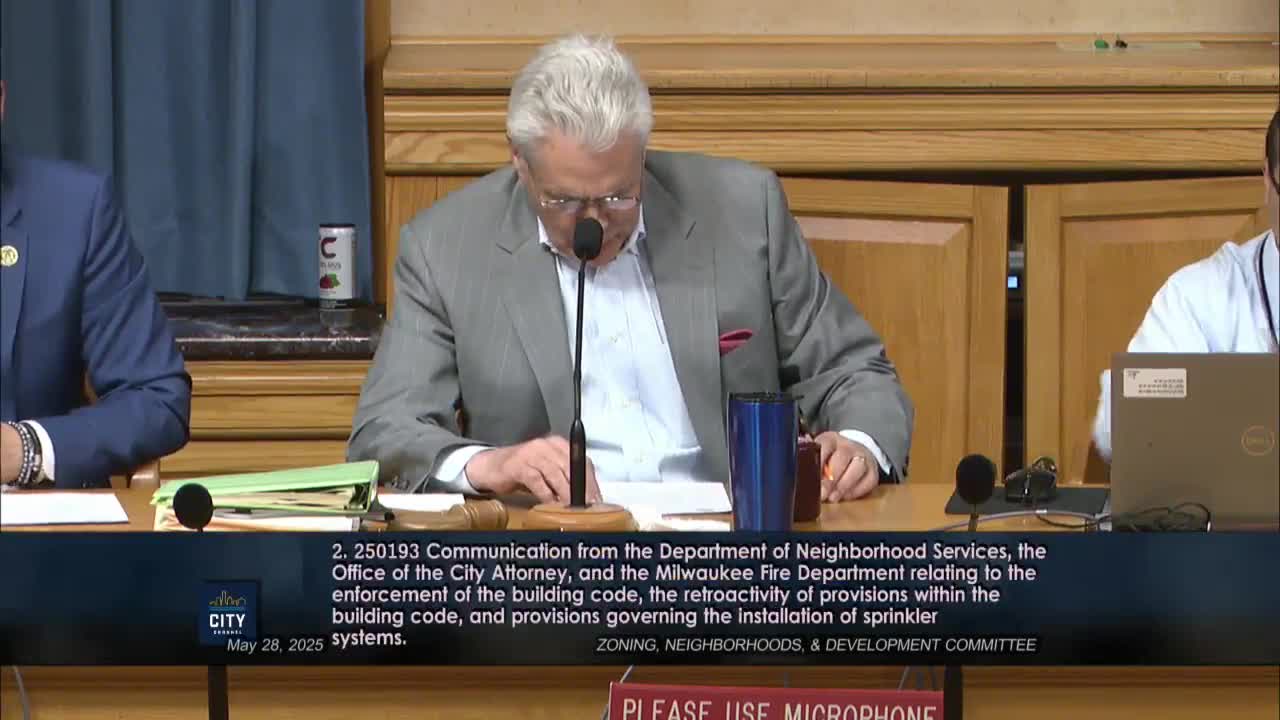
The Zoning, Neighborhoods and Development Committee examined whether Milwaukee can require sprinkler retrofits in older multifamily buildings after the May fire at 2725 West Highland Boulevard that killed five people and displaced more than 100 residents.
The committee heard a presentation from Hesamila Royo Vega, commissioner with the Department of Neighborhood Services (DNS), who summarized Wisconsin's adoption of building codes over the 20th and 21st centuries and said state law constrains local authority to mandate retrofits in many existing buildings. Royo Vega said Wisconsin adopted its first state building code in 1914, moved toward the International Building Code framework in the 2000s, and that the 2013 Wisconsin Act 270 (often referenced as Act 270) created a uniform commercial code that limits municipalities'ability to adopt local rules stricter than state standards.
DNS told the committee that whether an older, nonconforming building must be upgraded hinges on the type and extent of work done: alterations or additions that exceed certain thresholds (a "level 3" alteration or work on more than about 50% of the building area, as described at the hearing) will trigger compliance with current codes, including sprinkler requirements. DNS reported preliminary data showing roughly 600 multifamily properties in Milwaukee built before 1974 that may be nonconforming, and estimated about 7% of the city's multifamily rental stock could be in buildings that do not require sprinklers under existing law. Commissioner Royo Vega said that, in broad terms, that equates to about 10,000 units and possibly tens of thousands of residents living in unsprinkled multifamily buildings when including later construction cohorts.
City Attorney Evan Goicky and DNS staff told the committee that Act 270 creates a strict-conformity preemption that prevents municipalities from imposing retroactive sprinkler mandates except where the state explicitly permits. Goicky reviewed the legislative history and said Milwaukee and Madison had sought different treatment prior to the act but were brought into a statewide uniform framework when the law passed. Justin Morales and Calvin Lee from the city's Legislative Affairs Division told the committee there was no active state legislation at the time of the meeting to change that posture; they recommended pursuing state grants or subsidy programs (akin to lead-remediation funding) during the current budget cycle as the most pragmatic near-term path.
Milwaukee Fire Department leadership argued forcibly for stronger mandates or incentives. The Fire Chief said repeatedly that "if this building had been sprinklered, it would have been a considerably different outcome," and described the May fire response and the likelihood that functioning sprinklers would have reduced fatalities and displacement. The chief and others noted that some other U.S. cities require retrofits for older high-rises or multifamily buildings and that federal or state incentives (tax credits or grants) have been used elsewhere to offset retrofit costs.
DNS proposed near-term, city-level steps the department can take without changing state law: intensified life-safety inspections for nonconforming multifamily buildings (for example increasing sampling of interior units and raising inspection frequency to two or three times a year for targeted properties), expanded tenant education programs, and consideration of higher reinspection fees to financially encourage owners to bring properties into compliance. DNS also said it will continue compiling a more complete inventory of nonconforming buildings and their locations.
Committee members asked whether landlords must disclose to tenants that a building lacks sprinklers. City Attorney Goicky said his office would research whether the city could require disclosure or other tenant notices without running afoul of state preemption; Legislative Affairs staff also said they could investigate subsidy approaches in the budget process.
No ordinance or formal municipal retrofit requirement was adopted during the meeting. The committee directed DNS and the city attorney's office to continue analysis, provide more detailed data on the inventory of nonconforming buildings, and research legal options for tenant disclosure and incentive programs.