Get Full Government Meeting Transcripts, Videos, & Alerts Forever!
Get email alerts on the Airport Development topic
No spam. Unsubscribe anytime.
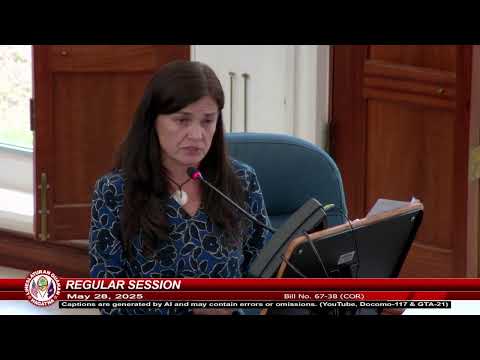
Legislature debates bill to expand GIAA leasing authority; procurement amendment fails
Summary
The Legislature debated Bill 67‑38 to expand the Guam International Airport Authority's authority to solicit and award long‑term leases and concession agreements, with supporters arguing it will attract maintenance and investment and opponents warning of procurement and oversight risks.
Lawmakers engaged in extended debate over Bill 67‑38, a measure to amend section 1203.1 of Title 12, Article 2 of the Guam Code Annotated to grant the Guam International Airport Authority (GIAA) expanded authority to set policies and procedures for solicitation, selection and awards of agreements for airport facilities and visitor‑related activities.
Sponsor remarks and objectives
The bill’s sponsor described the measure as a tool to make the airport competitive with regional peers, to attract airlines, aviation maintenance work and private investment, and to allow development of non‑aeronautical revenue streams on airport property. Speakers who supported the bill said longer concession and lease terms are commonly used elsewhere to give investors time to recover capital and that the airport’s expanded runway and facilities make Guam attractive for hangar construction, aircraft maintenance and final assembly operations that could create jobs.
Opposition and concerns raised
Opponents and some fellow senators urged caution. Objections included: the length of some proposed lease terms (up to 50 years), the bill’s proposed carve‑outs from standard procurement oversight, the need to protect the public trust over airport land and the potential conflict with bond covenants and FAA requirements. Several senators asked for stronger transparency provisions, public posting of policy drafts and an assurance that federal obligations (FAA fair‑market‑value requirements and bond covenant restrictions) would be met.
Floor amendments and votes
- Committee amendments: The bill as considered on the floor incorporated committee‑level changes, including requirements that concession policies be competitively solicited and that certain policies be subject to public posting and hearings.
- Proposed amendment to make airport agreements subject to Guam procurement law (5 GCA Chapter 5): A floor amendment that would have restored explicit procurement‑law compliance for airport leases and procurement was moved and debated. That amendment failed on the floor; the transcript records a hand‑raise count in favor of the amendment of four senators and an announced result that the amendment failed (floor language: "Amendment fails. Ladies and gentlemen, it's quad 20 to 6").
- Other changes: The bill contains provisions that require GIAA to follow FAA requirements, fair‑market‑value rules for certain non‑aeronautical leases, and to include prohibitions consistent with Guam law on activities that are not permitted (the sponsor said gaming had been explicitly addressed in prior committee markup).
Why this matters
Supporters argue Bill 67‑38 could catalyze economic diversification by enabling the airport to offer incentives and terms that attract maintenance, repair and overhaul (MRO) businesses, cargo assembly operations, and other aviation‑adjacent industries. Opponents say the bill grants too broad an administrative authority without sufficient public procurement safeguards and risks locking the public into long‑term agreements without adequate legislative oversight.
Votes and next steps
The transcript records the failed procurement amendment and multiple senators’ recorded support for the bill, but the full final disposition of Bill 67‑38 (final third‑reading vote) is not captured in the provided excerpt. Sponsors said the measure is being closely watched by potential investors and by the governor’s office overseas, and supporters urged timely action to attract interest.
Ending note
Lawmakers split between enabling airport competitiveness and preserving procurement safeguards. The failed procurement amendment signals a majority of the floor accepted broader airport authority in this session; however, senators pressed GIAA leadership for accountability and public transparency as the bill proceeds.