Get Full Government Meeting Transcripts, Videos, & Alerts Forever!
Get email alerts on the Tax Transparency topic
No spam. Unsubscribe anytime.
Guam Legislature advances BPT Transparency Act after debate over consumer impact and agency capacity
Summary
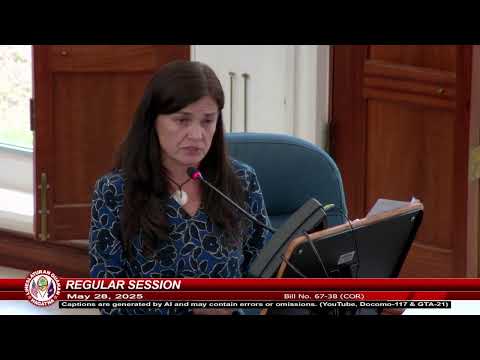
The Guam Legislature on the floor advanced Bill 59‑38 — the Business Privilege Tax Transparency Act of 2025 — to the third‑reading file after debate over whether requiring businesses to itemize the business privilege tax on receipts will aid consumer understanding or simply shift costs to shoppers.
The Legislature on the floor moved Bill 59‑38, the Business Privilege Tax (BPT) Transparency Act of 2025, to the third‑reading file after more than an hour of debate over whether requiring businesses to itemize the BPT on receipts would help consumers or effectively create a de facto sales tax.
Sponsor Senator Christopher Edwin Duenas introduced the bill as a transparency measure that would add a new 26‑11.2 to Title 2, Chapter 26 of the Guam Code Annotated to require businesses to show BPT as an itemized line on receipts, invoices and other customer documentation. Duenas said the measure is intended to give residents “the ability to see, understand and question how taxes factor into their daily expenses” and said jurisdictions such as Hawaii and New Mexico permit similar itemization by businesses.
Supporters said itemization would make the tax burden visible and improve public fiscal literacy, while opponents warned it would shift taxable visibility to consumers and could be regressive. A senator who identified themselves as representing “MTM” spoke in opposition, calling the bill a “Trojan horse” that will push BPT costs to shoppers and impose heavy compliance costs on small retailers. Other senators who spoke urged compromises to avoid unintended consequences and to allow adequate time and resources for the Department of Revenue and Taxation (DRT) to implement the change.
Key points of the bill and floor action
- What the bill would do: Require businesses to itemize the business privilege tax on sales receipts, invoices and related documents; keep BPT as a business tax but require disclosure to customers. The bill authorizes the Department of Revenue and Taxation to adopt rules to implement the measure.
- Timeline and enforcement changes: The body amended the bill on the floor to extend time for agency action. The bill as introduced required DRT to promulgate rules within 90 days and allowed a six‑month period before enforcement; senators approved an amendment replacing 90 days with a six‑month period for promulgation and explicitly incorporating the Administrative Adjudication Act (AAA) process for agency rules. The implemented schedule now contemplates roughly one year between enactment and full implementation (rules promulgation plus transition), as amended on the floor.
- Penalties and compliance: Floor remarks referenced proposed penalties described in the bill — $500 per non‑complying receipt up to $10,000 per year — and stressed DRT had responsibility to provide guidance and staggered compliance timelines for small or home‑based businesses.
- Discussion highlights and concerns: Multiple senators and several business testifiers raised implementation concerns. Opponents argued that many Guam point‑of‑sale (POS) systems used by small retailers are not configured for itemization and would require costly upgrades or training; supporters countered many retailers already have POS capability and that itemization would align Guam with practices in Hawaii (general excise tax itemization) and New Mexico (gross receipts tax itemization). Several senators noted DRT staffing constraints raised in committee testimony and urged that the agency receive the resources it needs to implement rule‑making and enforcement.
- Bonds and fiscal constraints: The sponsor and several colleagues noted the island’s bond covenants — a portion of BPT revenue is pledged to debt service — and said any future conversion from BPT to a sales tax would require multi‑year revenue data and careful coordination with bondholders. The sponsor argued itemization is a step toward transparent data collection, not an automatic conversion to a sales tax.
Floor votes and formal actions
- Amendment to change DRT rule‑making deadline from 90 days to 6 months (and to allow a 6‑month implementation period): Adopted on the floor without objection.
- Amendment to require that agency rules be processed under the Administrative Adjudication Act (AAA) prior to implementation: Adopted on the floor.
- Addition of Senator Cabell as a cosponsor: Adopted on the floor.
- Motion to place Bill 59‑38, as amended, on the third‑reading voting file: After discussion and an objection, the motion carried by voice/hand raise. The transcript records the motion passing; no roll‑call tally with individual member names was recorded in the floor exchange included in the transcript.
Why this matters
The measure addresses how a major recurring revenue source is communicated to consumers but intersects with several constraints: DRT capacity, the island’s bond covenants and the operational reality of Guam’s many small retailers. Supporters say itemization would improve public understanding of tax incidence; opponents say it risks increasing visible prices for consumers and imposing compliance costs on small businesses without clear consumer benefit.
What remains unresolved
The bill was placed on the third‑reading file, meaning final passage will depend on subsequent floor action. If enacted, DRT will issue rules and guidance during the amended rule‑making window and administer any penalties. Several senators pressed for a DRT staffing and budget assessment before the agency begins implementation.
Ending note
Senator Duenas said the measure is intended to increase transparency rather than to raise taxes and urged colleagues to treat it as a constructive reform. Opponents said they fear it will accelerate pressure to convert Guam’s business privilege tax into a retail sales tax.