Get Full Government Meeting Transcripts, Videos, & Alerts Forever!
Get email alerts on the Student Devices topic
No spam. Unsubscribe anytime.
District reports rising device repair costs, low collections from broken or lost Chromebooks
Summary
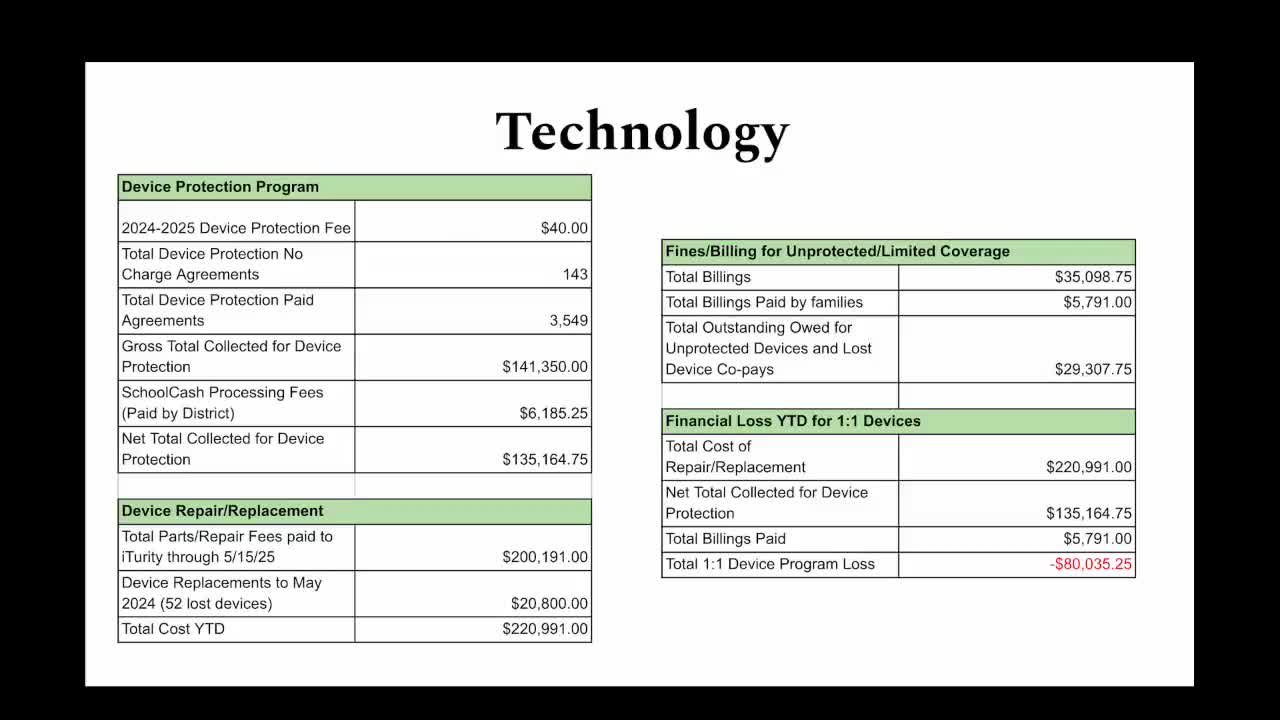
District technology staff told the board they spent $220,991 on device repairs and replacements this year while collecting roughly $135,165 in protection fees; outstanding family billings total about $29,308.
District staff reported that the 1:1 device program generated $141,350 in device protection fees this year, of which $6,185.25 was a processing fee, leaving net collections of $135,164.75.
Repair and replacement costs: Because the educational service district that had previously handled repairs discontinued the service, the district contracted repairs from a vendor (iTurity). Staff reported $200,191 in parts and repair fees for the year, plus $20,800 to replace 52 lost devices, for a total outlay of $220,991.
Unpaid family billings and net loss: Families without protection plans were billed a total of $35,098.75 for breakage and loss; the district has recouped $5,791 and reports an outstanding balance of $29,307.75. Later in the discussion a presenter said the district had “lost $80,035.25 this year,” which the administration said will be investigated further; board members asked the technology team to clarify the composition of those losses and to provide a labor‑versus‑parts breakdown for the vendor charges.
Behavior and causes: Board members and staff said damage is concentrated in middle schools, where device misuse and deliberate damage (including instances of students inserting graphite or other objects into charging ports in TikTok‑inspired challenges) were cited as drivers of repair costs. Staff said some devices were taken out of the district inventory entirely (lost) and that a subset of incidents reflect reckless or deliberate conduct for which families may be billed or disciplinary processes applied.
Policy and options discussed: The board asked staff to analyze whether raising the device protection fee further or shifting to an in‑house repair and refurbishment model would reduce long‑term costs. Staff noted that increasing the protection fee has limits: higher fees can become unaffordable for some families and do not guarantee improved care; hiring in‑house technicians might reduce labor charges but the district would still need to cover parts costs and management overhead. The board asked for a clearer cost breakdown (parts vs labor), seniority of billed device owners (how many are seniors who will graduate), and options for more robust student training and expectations about device care.
Next steps: Staff will provide a more detailed analysis of repair vendor labor vs. parts, explore repair staffing models, and report back with recommendations on fee levels and prevention strategies before the next budget cycle.