Get Full Government Meeting Transcripts, Videos, & Alerts Forever!
Get email alerts on the Municipal Finance topic
No spam. Unsubscribe anytime.
Board acknowledges certified tax rate and advances budget with first readings; finance director says Williamson County reassessment will raise levy
Summary
The Board acknowledged the state-certified tax rate and approved first readings of the city’s tax-rate and annual-budget ordinances; Finance Director Missy Holden said keeping the current nominal rate will raise property tax bills on the Williamson County side because reassessed values increased.
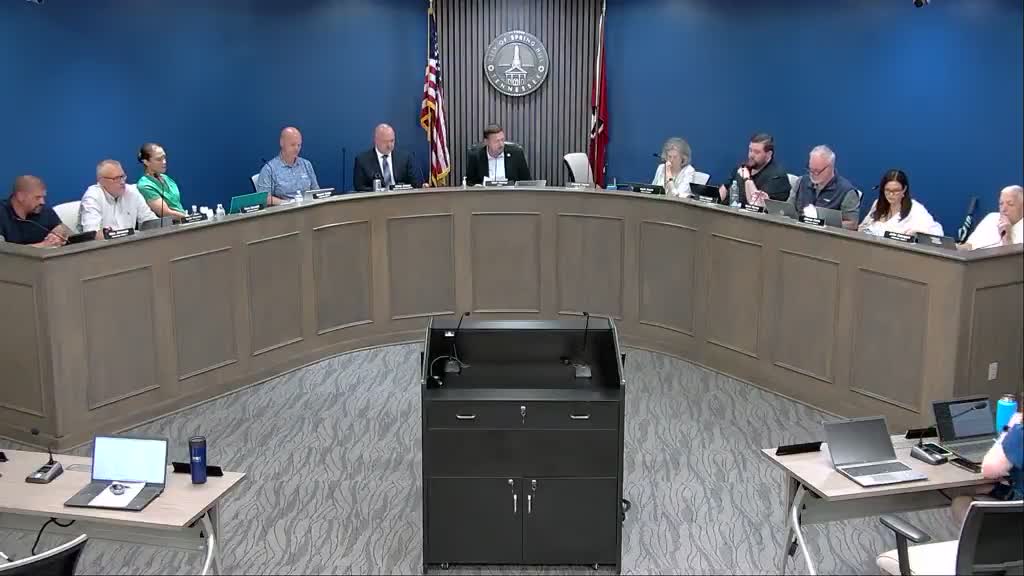
The Spring Hill Board of Mayor and Aldermen acknowledged the state-certified tax rate and advanced the city’s fiscal 2025–26 budget and tax-rate ordinances during the meeting.
The board first approved Resolution 25-129 acknowledging receipt of the certified tax rate from the state comptroller’s office by a 9–0 vote. Finance Director Missy Holden explained the certificate is a procedural part of the four-year reappraisal process and said the certified rate acknowledgment does not itself set the city’s levy. Holden told the board that the reappraisal increases assessed values on the Williamson County side and that, if the city maintains the current rate, the result will be higher city property tax bills for many property owners.
At first reading, the board approved Ordinance 25-12, which would set the city tax rate on the Williamson County side at 0.739 per $100 of assessed value and maintain 0.739 on the Maury (Murray) County side. Holden said that change would increase the city’s tax levy on the Williamson County side by about $3.7 million and represent about a 38% tax increase when compared to the prior levy. The ordinance received an 8–1 vote on first reading.
The board then approved first reading of the annual budget ordinance, Ordinance 25-13, by a 9–0 vote. Holden told the board the higher assessment produced more revenue than her earlier estimate: the levy produced roughly $3.7 million more than budgeted and left an estimated general-fund surplus of about $300,000. She recommended preserving that surplus and noted the board may later approve budget amendments.
Why it matters: Although the certified-rate acknowledgement itself is a procedural step, Holden and several aldermen warned that social-media posts saying the tax rate is “staying flat” may mislead homeowners. Because assessed values rose after reappraisal, keeping the nominal tax rate the same increases property tax bills on the Williamson County side. Alderman Kanapari (Kanapari) raised the social-media concern and asked staff to ensure clarity for residents.
What the board discussed and decided: Alderman Kanapari asked whether social posts saying the rate is flat would mislead homeowners; Holden said the certified-rate resolution must be acknowledged regardless and that the later ordinance will determine the levy. When Kanapari asked whether the levy would produce $3.7 million in new revenue, Holden confirmed that number and the approximately 38% increase on the Williamson County side. She also noted the comptroller had suggested a lower rate (0.5353) as an option, but the board moved forward with the rate of 0.739 on first reading.
Next steps: The tax-rate and budget ordinances were approved on first reading. The tax-rate ordinance requires final reading before it becomes law; the budget will proceed through the second reading and final adoption process. Staff said they will circulate ordinance language and additional documentation for public review before final votes.
Votes and formal actions (at this meeting): Resolution 25-129 acknowledging the certified tax rate, approved 9–0. Ordinance 25-12 (first reading adopting the tax rate) approved 8–1 on first reading. Ordinance 25-13 (first reading adopting the annual budget and tax rate for FY 2025–26) approved 9–0 on first reading.