Get Full Government Meeting Transcripts, Videos, & Alerts Forever!
Get email alerts on the Cannabis Cultivation topic
No spam. Unsubscribe anytime.
Planning commission approves Poverty Flats Ranch commercial cannabis permit; neighbors raise road, safety and water concerns
Summary
The Planning Commission on May 22 adopted a mitigated negative declaration and approved a major use permit for Poverty Flats Ranch (UP23-09 / PL25-68), allowing up to 5.69 acres of outdoor cannabis canopy at 10535 High Valley Road in Clear Lake Oaks, subject to water-monitoring, drought management and fire-safety conditions.
The Lake County Planning Commission on May 22 approved a major use permit and a mitigated negative declaration for Poverty Flats Ranch, a proposed commercial cannabis operation at 10535 High Valley Road in the Clear Lake Oaks area. The permit authorizes up to 5.69 acres of outdoor canopy (247,800 square feet) and includes a drought management plan, water monitoring and other conditions recommended by staff.
Staff presentation: Assistant planner Max Stockton summarized the project scope and environmental review. The application requests three A Type 3 and A Type 2 licenses and one A Type 13 self-distribution license; the parcel is approximately 196.7 acres and the cultivation areas were sited to minimize slope and vegetation removal. Stockton said identified impacts in the initial study area (aesthetics, air quality, biological resources, cultural resources, geology/soils, hazards and wildfire, hydrology and water quality, noise, transportation and utilities) can be reduced to less-than-significant with the proposed mitigation measures and conditions.
Key mitigations and project features: the applicant's hydrology report estimates project water use at 11.2 acre-feet per year (about 3.65 million gallons). The project plans for up to roughly 79,000 gallons of storage and a minimum of 12,500 gallons reserved for fire suppression; applicants propose 15,000 gallons to meet rural fire needs. The operation would be fenced (6-foot tall fencing around canopy areas), use ground- and roof-mounted solar (5.5 kW system proposed to power outdoor cultivation), include a backup generator only for emergency use, and install parking and site security consistent with county rules. The draft mitigated negative declaration and conditions require water-monitoring, drought-management and annual reporting; the project must meet state water quality requirements including the Water Board cannabis general order and secure any required CDFW lake/streambed agreements.
Applicant and technical presentations: Applicants Kurt and Bobby Barthel described the property as a multigenerational family ranch and said they intended to proceed only with required county, state and tribal approvals. Civil/transportation consultant Praj White (engineer) and water-resources consultant (Northpointe) presented analyses concluding groundwater recharge exceeds the modeled project demand (consultant estimated 31 acre-feet recharge for the basin versus about 16 acre-feet demand for two nearby projects) and that the project would add a small number of trips (roughly 6'14 daily trips at peak season) to High Valley Road. White summarized standard rural-road capacity guidance (AASHTO/Caltrans) and told commissioners a typical peak-hour effect from this project would be negligible relative to roadway capacity.
Public concerns and agency comments: dozens of public comments, both written and oral, focused on cumulative road-safety and fire-evacuation risks on High Valley Road, impacts to the nearby East Lake Elementary School, water availability and well effects, and the legal risk of transporting cannabis across federal lands. Commenters including Maria Khan, Randy Wilk and others described increased traffic, oversized trucks stuck at the Horseshoe Bend hairpin, lack of shoulders or sidewalks, high speeds near the school and multiple crashes on the road in recent years. Several commenters asked the county to pause or deny new permits until road and emergency access issues are addressed. County staff noted that Public Works submitted agency comments on the project and that an indemnification addressing transport across federal land was included in application materials and will be signed as part of the permit process; staff confirmed the indemnity does not confer protection from federal enforcement.
Tribal and environmental review: staff said tribal consultation occurred and two tribal mitigation measures are included (tribal sensitivity training and inadvertent discovery protocols); CDFW and the Regional Water Board provided comments on the CEQA document that the project addresses in its conditions.
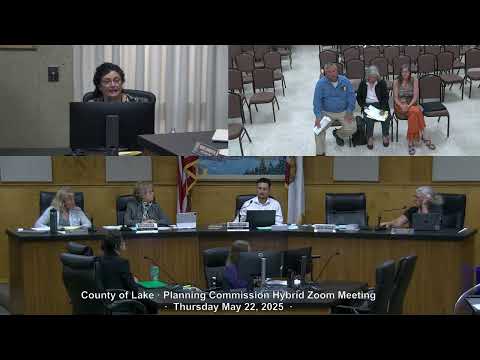
Commission action: the Planning Commission voted to adopt the mitigated negative declaration (IS2329) and to approve Major Use Permit PL25-68 / UP23-09 with the staff-recommended findings and conditions. Conditions require water monitoring and reporting, implementation of the drought management plan, a minimum fire water supply (conditioned at 12,500 gallons minimum with applicant-proposed 15,000 gallons indicated), compliance with the Water Board cannabis general order and CDFW stream-lake permit requirements, and annual inspections and reporting.
Neighbors urged the Board of Supervisors to address High Valley Road safety and maintenance as cumulative development continues; commissioners recorded the concern on the public record and several asked staff and the Board to prioritize road management. The applicant and consultants said they will implement the monitoring and mitigation measures and noted the family intends to operate organic cultivation methods.
Ending: the commission's approval is subject to the standard seven-day appeal period to the Board of Supervisors. The permit documentation requires follow-up reporting and inspections; staff will monitor compliance under the conditions of approval.