Get Full Government Meeting Transcripts, Videos, & Alerts Forever!
Get email alerts on the Zoning Drive Throughs topic
No spam. Unsubscribe anytime.
Planning commission tables proposed changes to drive-through rules after broad discussion of traffic, aesthetics and large-site exceptions
Summary
Commissioners closed the public hearing and voted 6-0 to table indefinitely a staff proposal that would have prohibited buildings with drive-throughs from being adjacent to one another; commissioners asked staff to research alternative approaches including distance limits, caps per acreage and special-use permit options.
The Prosper Planning and Zoning Commission on May 20 reopened a public hearing on proposed zoning ordinance amendments intended to limit adjacent drive-through facilities, then after extended discussion voted 6-0 to table the item indefinitely so staff can return with refined options.
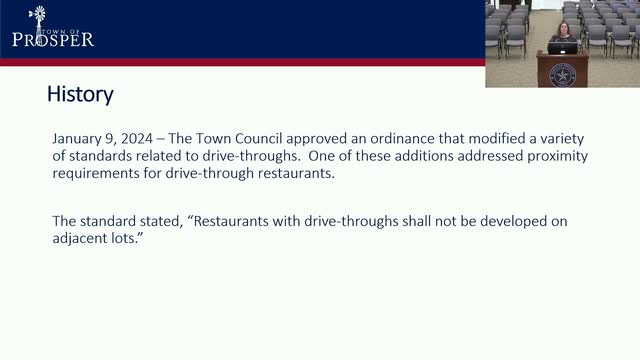
The proposal under consideration would have removed language that targeted restaurants specifically and instead prohibited two buildings with drive-throughs from being adjacent to one another; staff said the draft language would require a building without a drive-through to separate any two buildings that have drive-throughs.
Why it matters: Commissioners and staff said the goal is to avoid traffic congestion, preserve roadway function and protect community character. But commissioners said the draft was overly broad and could produce unintended outcomes on large, multi-tenant sites such as grocery-anchored developments where a pharmacy, a restaurant and other services with pick-up windows coexist without causing roadway backups.
Key points from the discussion Planning staff reviewed the town’s outreach (comparisons with Frisco, Celina and McKinney) and described how the proposed language treats adjacency (side-to-side or back-to-back). Commissioners raised three consistent themes: (1) different drive-through uses generate different traffic impacts (pharmacies and banks produce different stacking patterns than high-volume fast-food restaurants), (2) large pad-site developments such as grocery-anchored centers may require a different approach than small pad sites along arterial frontages, and (3) screening and internal circulation can mitigate impacts but do not address all concerns.
Suggested alternatives discussed by commissioners included distance-based limits between order/stacking points, limits on the number of drive-throughs per acreage (a model used in Frisco for pad sites), requiring special-use permits for certain drive-through uses, or encouraging internalized access so drive-through traffic does not spill onto arterial roads.
Action taken After discussion, the commission voted unanimously to table the ordinance amendment indefinitely and asked staff to research other cities (including communities more similar to Prosper in character), evaluate distance or density-based approaches, and consider permitting options such as SUPs or modified pad-site rules. Staff also was asked to map the town’s remaining undeveloped commercial frontage so commissioners could see where these rules would likely apply.
Next steps Planning staff will return with refined language and examples from comparable jurisdictions and will show a map of remaining undeveloped commercial frontage for the commission’s review before the item is rescheduled for public hearing.