Get Full Government Meeting Transcripts, Videos, & Alerts Forever!
Get email alerts on the Community Redevelopment topic
No spam. Unsubscribe anytime.
Ocala trains CRA committee members on grant review procedures, Sunshine Law and conflicts
Summary
City staff and the city attorney briefed Community Redevelopment Agency (CRA) subcommittee members on procedural rules for quasi‑judicial grant reviews, the Sunshine Law’s meeting requirements, conflict-of-interest steps and quorum/attendance concerns for Ocala’s four CRA subareas.
Ocala — City staff and the city attorney instructed members of the city’s Community Redevelopment Agency (CRA) subcommittees on procedural, legal and ethical rules for reviewing CRA grant applications and conducting hearings.
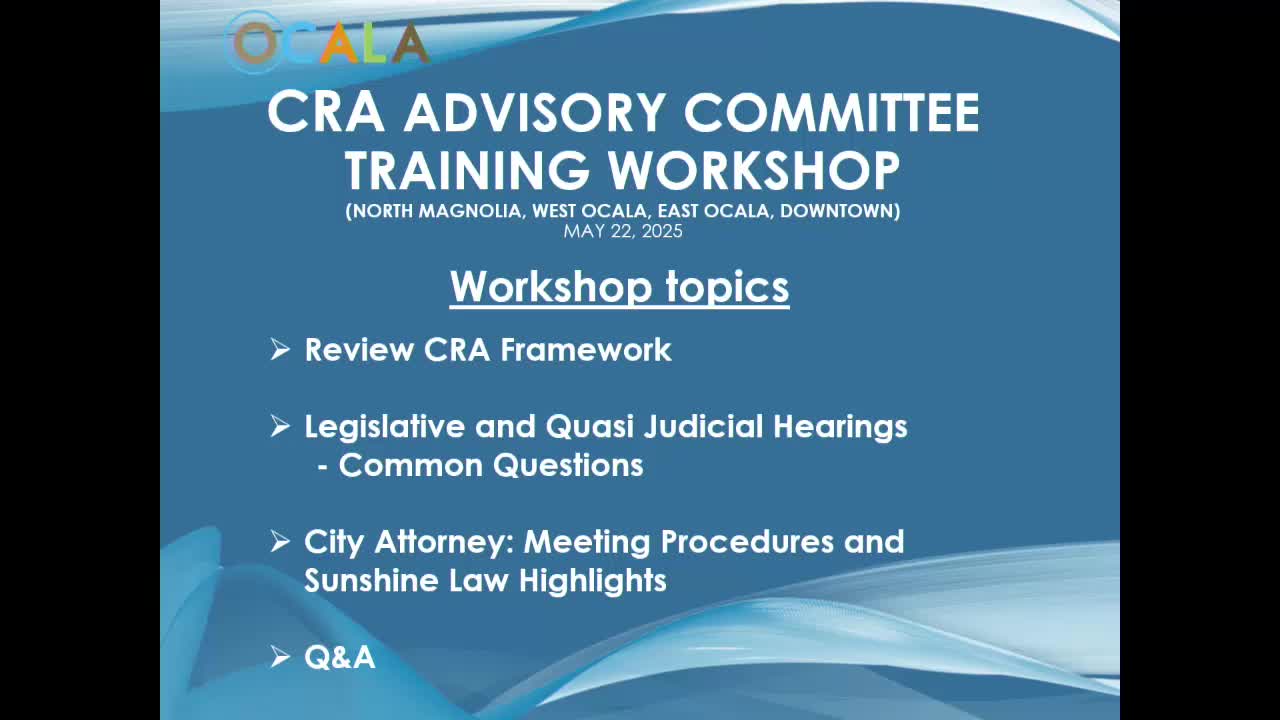
The training, led by Growth Management Director Jeff Rumb and City Attorney Will Sexton, covered CRA structure and timelines, the difference between legislative and quasi‑judicial actions, limits on outside communications (ex parte), what constitutes competent substantial evidence for a recommendation, and Sunshine Law requirements for public meetings. Rumb told attendees, “every time you see CRA, think Brownfields,” and encouraged committee members to treat the training as applicable to both CRA and brownfields work.
Why it matters: CRA subcommittees recommend awards of public grant funds and advise the CRA board (City Council acting as the CRA). Proper procedure matters because recommendations that lack required notice, impartiality or evidentiary support can be appealed or subject to legal challenge; Rumb also warned of recent state legislative pressure that could affect CRAs’ authority.
City staff summarized Ocala’s CRA framework and timelines: City Council serves as the CRA agency and has created four subareas — Downtown, North Magnolia, West Ocala and East Ocala. Rumb said Downtown and North Magnolia CRAs expire in 2038, while West Ocala and East Ocala expire in 2045. Most subcommittees are seven members, with West Ocala composed of nine members. Rumb explained quorum rules for routine business: four members are required for a seven‑member committee and five for a nine‑member committee.
The training distinguished legislative actions (changing laws or policies) from quasi‑judicial actions (applying established criteria to individual applications). Rumb described CRA grant recommendations as quasi‑judicial in nature because committees apply review criteria to specific applications and then forward recommendations to the CRA board. He emphasized that quasi‑judicial recommendations must be based on “competent substantial evidence” developed during the public hearing — staff reports, sworn testimony and documented exhibits — and not on independent research or outside contacts.
On outside communications and fairness, Rumb and Sexton warned members against ex parte contacts about agenda items. Rumb said the best response to approaches from applicants or neighbors is to decline comment and ask them to present testimony at the advertised hearing. Sexton summarized the Sunshine Law’s core requirements for public bodies: the meeting must be open to the public, there must be advanced public notice, and minutes must be kept. He said the law exists to ensure both transparency and fairness: "the public has to be able to participate," and the public must be able to review what occurred at prior meetings.
Sexton explained practical implications: while committee members may speak informally about non‑committee matters, they must avoid discussing committee business outside a public meeting or engaging in private online dialogues (email, social media, text) about items likely to come before the committee. On social media specifically, Sexton urged members not to engage in threaded comment exchanges about agenda items and suggested directing contacts to present remarks at the public hearing instead.
The city’s current practice for site visits was raised: staff said one representative from the committee will perform a site visit and report back at the public hearing. Sexton and staff recommended documenting the date, time and designated representative to reduce the risk that an unannounced inspection could be interpreted as an impermissible ex parte contact. Rumb and staff said they will review whether the site‑visit process needs formal changes.
Attendance, quorum and remote participation also drew discussion. Rumb stressed the operational impact of missed meetings, noting that delays in committee action postpone grant awards and project timelines. He said staff and City Council have been asked to study options to improve attendance and quorum reliability and that staff will return to council with recommendations. Sexton noted that under Florida law, remote participation by phone is permitted for listening only in most cases but does not count toward a quorum or allow a remote member to vote; temporary pandemic-era waivers that allowed remote voting have ended.
On conflicts of interest, Sexton advised members to review agendas as soon as they receive them and to consult legal staff early if they suspect a potential conflict. He described conflict determinations as fact‑specific and urged members to reach out before the meeting so staff and counsel can provide guidance or, if necessary, delay action until the conflict is resolved.
No formal votes were recorded during the training session. Staff closed by reiterating that committee members should use staff and legal counsel as resources on procedural questions, conflicts and Sunshine Law concerns.
The session concluded with staff offering written FAQs and the promise that proposed process changes — including possible approaches to address chronic absences and to improve legal counsel presence at committee meetings — would be brought to City Council for consideration in the coming weeks.