Get Full Government Meeting Transcripts, Videos, & Alerts Forever!
Get email alerts on the Schools Budget Facilities topic
No spam. Unsubscribe anytime.
Wake County school leaders seek $40.3M in local funding, warn of federal grant losses and outline facilities action plan
Summary
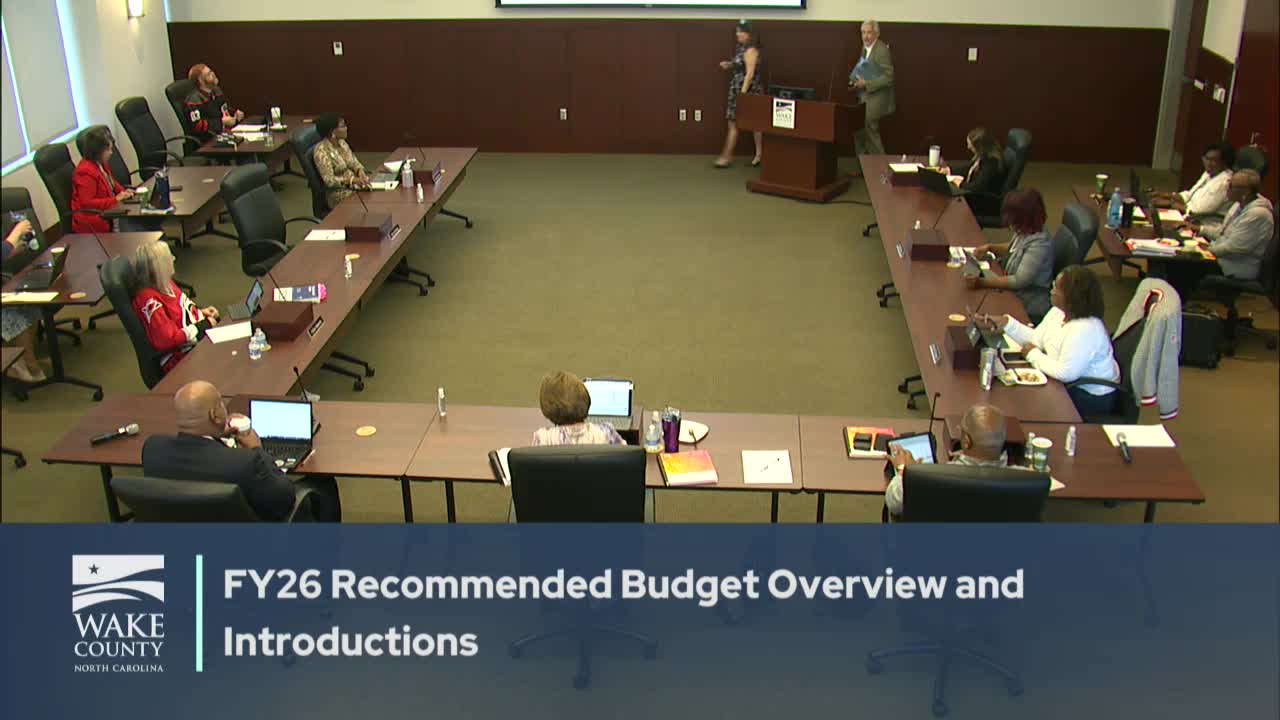
Wake County Public School System representatives told county commissioners on May 22 that the district’s proposed FY25‑26 budget requests roughly $40.3 million in additional local funding and warned that federal grant terminations and uncertainty in the state budget could force program reductions.
Wake County Public School System leaders told the Wake County Board of Commissioners on May 22 that the system’s FY25‑26 proposed budget includes a local request of about $40,300,000 and that the district faces significant near‑term risks from federal grant terminations and uncertain state legislative action.
“...we quickly determined that we would have over $60,000,000 of additional funding needs for next year of local funding,” David Nieder, a school district finance representative, said during a question‑and‑answer portion of the county’s budget work session. Nieder explained that the school system trimmed and repurposed existing budgets—without cutting core maintenance funding after board direction—to arrive at a proposed package the district presented to the county.
Nieder and Wake County Public Schools Superintendent Dr. Taylor (identified in the presentation only as "Dr. Taylor") told commissioners the district is monitoring federal and state funding closely. Nieder said the district still expects an 8% federal funding component is at risk; he described that 8% as roughly $175,000,000 of a $2.2 billion operating budget and said two multi‑year federal grants totaling about $30,000,000 have already been terminated, displacing staff and reducing capacity to support students.
Charter funding: the district told commissioners that roughly $74,000,000 in local funding currently flows through the Wake County school budget to charter schools (about 18,700 charter students). Nieder said that figure is expected to rise to about $82,000,000 next year as charter enrollment grows; because state law requires local funding to flow to charters, additional county appropriation requested by the Board of Education increases the portion that must pass through to charter schools.
Facilities and maintenance: Superintendent Dr. Taylor and senior operations staff presented a detailed review of maintenance‑and‑operations (M&O) challenges after commissioners and public commentators raised concerns about HVAC failures, school closures and lost instructional time. Dr. Taylor said the district has an elevated number of urgent and emergency HVAC work orders and that aging facilities—many built before 2005—have increased reactive work compared with preventative maintenance.
“We know our staff is gonna have experience on older equipment, but as we get new equipment, that's gonna create a problem,” Dr. Taylor said of modern, digitally controlled HVAC systems. He said the district has been increasing preventive work where possible, hiring a recruiter to fill maintenance positions and using contractors when needed, while developing a multi‑part action plan that includes reallocating existing resources, reclassifying certain positions to match market pay and improving supervision of contract work.
District decisions and board directions: Nieder said the school board directed staff to remove a proposed reduction to school maintenance and operations from the superintendent's proposed budget. Board members also directed removal of a proposed shift of dental‑insurance premiums from employer to employee. The district retained limited local funding to provide a one‑year transition for several high schools forecast to lose Title I status if federal Title I allocations fall, listing East Wake, Southeast Raleigh, South Garner, Knightdale High School and SCORE Academy in Phillips as affected sites; the board’s proposed budget included a local bridge for those priority high schools.
Vacancies and staffing: district presenters said classified vacancy months are concentrated in transportation and custodial/maintenance; transportation accounted for about 1.8 percentage points of the system’s 6.3% vacancy rate. Dr. Taylor said the district is adding square footage faster than it has added maintenance staff over the last decade and emphasized the need to align personnel with facility growth.
Action plan and timeline: Dr. Taylor described a set of near‑term and longer‑term actions the district will undertake: reallocate internal local funding where feasible, examine the capital program for potential reallocation, reclassify and market critical maintenance positions to match competitive wages, expand internship and apprenticeship partnerships (Wake Tech and Vernon Malone programs were cited) and strengthen contract oversight. The district said some measures (training on work‑order use, vendor oversight) can be accomplished this summer; others (realigning budgets and reclassifying positions) will span the next budget cycle.
Appeals and legal: commissioners asked whether the district will appeal the two terminated federal grants; Dr. Taylor and supporting staff said district attorneys are pursuing appeal options for both grants.
What commissioners asked: commissioners questioned details on the 3% compensation assumption used in the superintendent’s proposed budget (staff said the 3% was an early estimate used for planning; legislative compensation proposals varied in the Senate and House), asked for clarification on charter‑school flow‑through funding, and asked whether school closures and HVAC failures are systemic or isolated problems. Dr. Taylor said no school lost multiple days of instruction this year due to closures but that individual schools sometimes lost partial days when systems failed; he emphasized the district’s commitment not to place students or staff in unsafe conditions.
Ending: Several commissioners asked staff and the school district to provide follow‑up information: more detail on the district's kinship and child‑welfare staffing requests, the costs and timelines for the M&O action plan, and exact figures the county could shift to increase the board of education’s local appropriation. The commissioners and school staff agreed to continue working off‑line before the June 2 adoption vote.