Lifetime Citizen Portal Access — AI Briefings, Alerts & Unlimited Follows
D.C. committee reviews bill to expand enforcement powers under consumer-protection law
Loading...
Summary
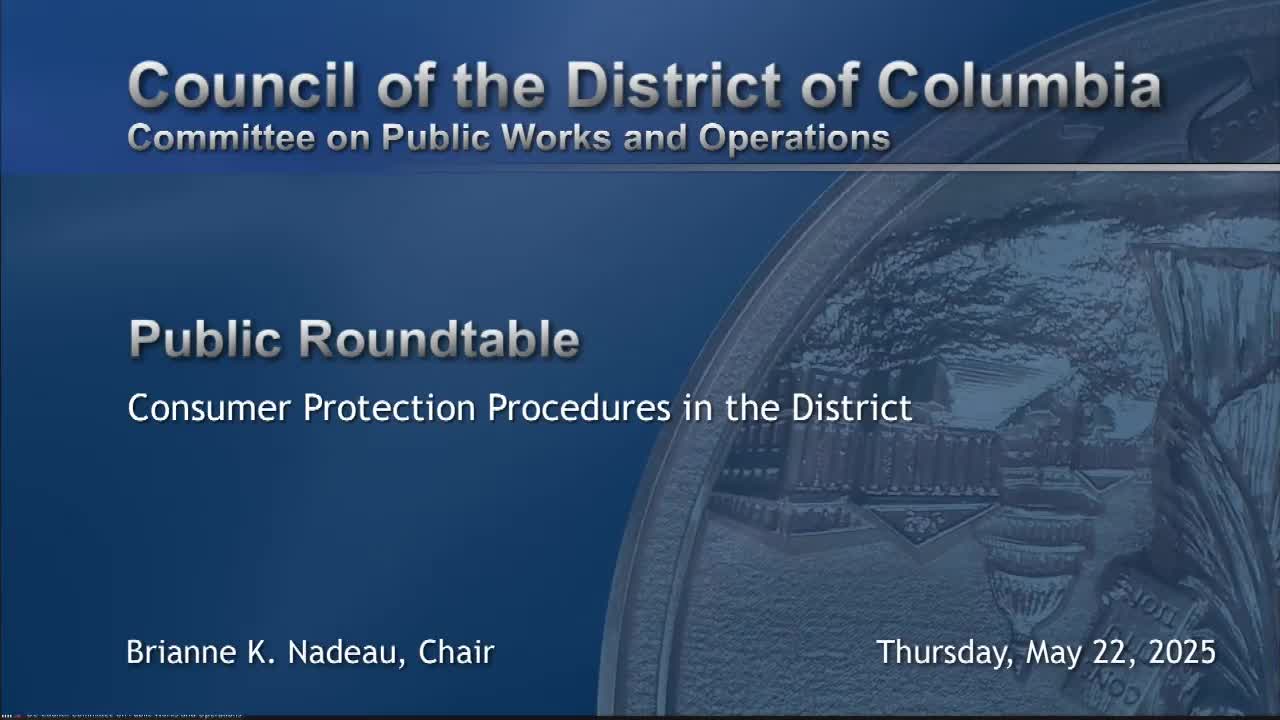
Councilmember Brianna Do, chair of the Council’s Committee on Public Works and Operations, opened a May 22 roundtable on the District’s Consumer Protection Procedures Act by saying, “Today we will discuss consumer protection procedures in the District Of Columbia.”
Councilmember Brianna Do, chair of the Council’s Committee on Public Works and Operations, opened a May 22 roundtable on the District’s Consumer Protection Procedures Act by saying, “Today we will discuss consumer protection procedures in the District Of Columbia.”
Adam Teitelbaum, director of consumer protection at the District of Columbia Office of the Attorney General (OAG), testified in support of Bill 26‑174, the Enhancing Consumer Protection Procedures Amendment Act of 2025. Teitelbaum said the bill would “modernize, strengthen, and clarify the district's consumer protection laws” and give enforcement agencies tools to pursue deceptive or unfair business practices more effectively.
Why it matters: OAG and a parallel administrative agency, the Department of Licensing and Consumer Protection (DLCP), enforce the Consumer Protection Procedures Act (CPPA). Teitelbaum told the committee that since 2023 OAG has secured judgments totaling nearly $80,000,000 under the CPPA, and that clarifying and expanding enforcement authority would both speed investigations and increase deterrence against bad actors.
Key provisions described by the witness include granting OAG authority to use pre-suit interrogatories and subpoenas in investigations, explicitly covering charitable solicitations under the CPPA, prohibiting retaliation against consumers who report violations or assist investigations, clarifying that unlawful transactions are actionable under the CPPA, and strengthening administrative tools for DLCP (including cease-and-desist powers). Teitelbaum said some proposed remedies that courts could order in OAG cases would include injunctions, asset freezes, receivership and, in “appropriate circumstances,” dissolution of an entity. He said those remedies would align CPPA remedies with authority in the Nonprofit Corporation Act and the Tenant Receivership Act.
Teitelbaum outlined how the bill is intended to increase OAG’s effectiveness without proportionally increasing staff by limiting procedural delays and improving investigatory tools. He said OAG receives about 10,000 complaints in a year through mediation and intake channels, and that the office’s mediation work returned approximately $1,200,000 to consumers last year. On the formal enforcement side, he said OAG typically has 60–75 active matters at any time, with 10–15 active litigation matters and that the office opens roughly 10–20 new investigations a year.
On penalties and cost recovery, Teitelbaum described provisions that would (1) make clear courts can award reasonable costs and fees incurred by OAG during investigations (including pre‑suit work) if liability is established, and (2) set minimum and maximum statutory penalty ranges to enhance deterrence. He said the bill’s minimums (as discussed in the roundtable) are intended to put a floor under penalties so violations are not treated merely as an incidental cost of doing business; the transcript records proposed minimum penalties of $500 for a first violation and $1,000 for subsequent violations, with maximums discussed in committee (noted in testimony as $5,000 and $10,000 respectively).
Committee members asked about specific enforcement areas the CPPA reaches. Teitelbaum said landlord‑tenant matters, certain utility fee disputes (including third‑party door‑to‑door vendors that mislead consumers), restaurant service fees and “greenwashing” claims are all within the CPPA’s scope when the conduct relates to a consumer transaction. He described a pending or remanded recyclability case brought by a nonprofit (Earth Island) against a beverage company that raised questions about whether representations about recyclability fall within the CPPA; the D.C. Court of Appeals, he said, later endorsed a broader construction of the CPPA that allows deception concerning recyclability to proceed. Teitelbaum emphasized the CPPA’s broad reach: “consumer transactions cover everything,” including housing payments and retail purchases.
The witness described how DLCP and OAG divide work: OAG focuses on formal litigation and broad enforcement that can provide restitution, injunctive relief and penalties; DLCP provides nimble, administrative remedies for licensing and brick-and-mortar compliance, such as issuing notices of infraction and conducting in-person enforcement. Teitelbaum said the agencies coordinate regularly and refer matters to each other when appropriate.
Teitelbaum also raised information‑sharing as critical for multi‑state cases, noting that the bill would clarify OAG’s ability to share investigative materials with other law enforcement and attorney‑general offices. He said that coordination has been essential in recent parallel enforcement actions involving vaping and nicotine products.
Next steps: Chair Do said the committee will hold a public hearing on Bill 26‑174 at a later date to take testimony from additional agencies, stakeholders and public witnesses. Teitelbaum and OAG expressed support for further stakeholder input and for the bill’s clarifying language and enforcement expansions.
The roundtable concluded after roughly an hour of testimony and questions; the committee did not take a vote on the bill during the session.