Get Full Government Meeting Transcripts, Videos, & Alerts Forever!
Get email alerts on the Utilities Water Metering topic
No spam. Unsubscribe anytime.
Santa Barbara Water Commission backs ordinance to detach long‑inactive water and sewer services
Summary
The commission recommended forwarding an ordinance to allow the city to remove meters and inactive connections that have been closed at least one year, replacing the reserve capacity charge program that began in 2013. Commissioners approved the staff recommendation unanimously.
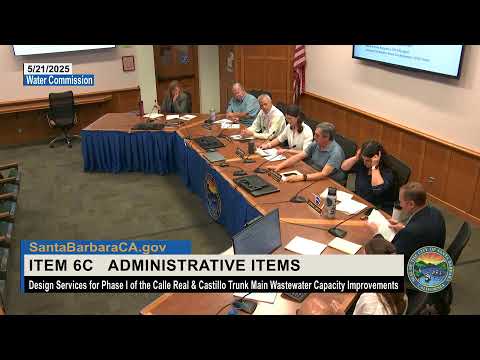
The Santa Barbara Water Commission voted May 22 to forward to the ordinance committee a proposal to allow the city to detach long‑inactive water and wastewater service connections and to retire the cityreserve capacity charges program.
Staff told the commission the detachment program would target utility accounts that have been closed for at least one year and still have a meter or service line in place. Staff said removing unused meters reduces maintenance costs, lowers leak risk and provides a visible signal to prospective buyers that active service is not available at a property. Staff recommended retiring the reserve capacity charges in the annual fee resolution (effective July 1) and introducing an ordinance (Chapter 14.1 of the Municipal Code) to allow detachment; the ordinance is scheduled for ordinance committee June 17, city council introduction July 29 and possible adoption Aug. 5.
Why it matters: Under the citycode today, accounts that close stop receiving monthly service charge bills but the physical meter and service remain. Staff described cases in which new owners attempting to reactivate service discovered large accrued reserve capacity charges; staff said the reserve charge program has caused confusion and surprise for some property buyers. The proposed approach gives owners either (a) an opportunity to reactivate service and pay going forward without retroactive charges, or (b) an option to have the meter and associated city infrastructure removed so ratepayers stop maintaining unused assets.
Details of the proposal: Staff said the ordinance would apply to accounts closed at least one year. Before detachment, the city will mail written notice to the last known account holder and — with administrative procedures to be developed later — may provide additional notice (for example, door hangers or certified mail). Owners would have 30 days after notice or until the one‑year inactivity anniversary (whichever is later) to reactivate service and avoid detachment. If a service is detached, the owner must pay all connection and capacity charges to reestablish service; reestablishment would be treated as a new connection. Staff presented sample current fees: a common 5/8‑inch residential water capacity charge of $10,827, sewer capacity charge of $3,955, and an installation fee of about $4,615 for a new 5/8‑inch meter; staff said those numbers vary by meter size and account type.
Commission questions and staff responses: Commissioners asked how many unused assets exist (staff: about 600 unused assets total, roughly 460 closed at least one year, out of roughly 27,000 connections, or about 1.6%), whether notices will include estimated reactivation costs (staff: that can be added to administrative procedures), and how the city will prioritize removal work (staff: coordination with water main replacement and street construction to avoid redoing recent paving). Staff and commissioners discussed operational costs: pulling a meter is relatively quick, whereas full disconnection of service lines could be scheduled to accompany main replacements or significant street work to limit construction impacts.
Legal and administrative notes: Staff said they will retire the reserve capacity charges through the annual fee resolution update and will return to the commission with recommended administrative procedures if the ordinance is approved by council. The commissionrecommended forwarding the ordinance to the ordinance committee for consideration.
Outcome: The commission moved and seconded the staff recommendation and voted unanimously in favor. The commission requested that administrative procedures include robust notice methods and prioritization rules (for example, treating single‑residence primary meters differently from secondary irrigation meters).