Get Full Government Meeting Transcripts, Videos, & Alerts Forever!
Get email alerts on the Land Use Parking topic
No spam. Unsubscribe anytime.
Oregon City delays vote on state-mandated parking reforms, asks staff to seek variance
Summary
City commissioners held an extended public hearing on state Climate Friendly Equitable Communities (CFEC) parking rules and tabled first reading of ordinance 25-1006 to June 4, directing staff to pursue a possible reduction to the required half-mile transit buffer with the state agency that wrote the rules.
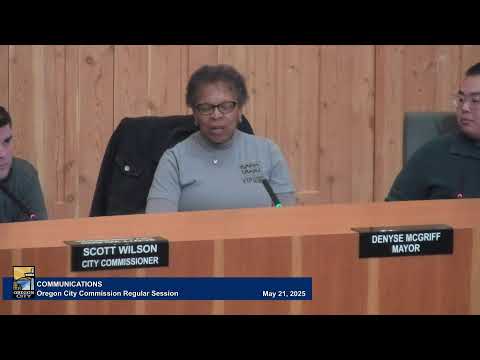
Oregon City commissioners on Wednesday delayed action on proposed code changes required by Oregon’s Climate Friendly Equitable Communities rules, voting to table the first reading of ordinance 25-1006 to their June 4 meeting and directing staff to pursue a possible variance or modification with the Department of Land Conservation and Development (DLCD).
The ordinance would amend multiple chapters of the city code to bring Oregon City into compliance with state administrative rules that, among other changes, remove some local parking minimums near frequent transit, add more flexible shared-parking provisions, and require new landscaping, lighting and electric-vehicle infrastructure standards for parking.
City planning manager Pete Walter told the commission the state rules are “very detailed” and largely prescriptive, leaving limited local discretion. Consultant Brian Davis of Studio Davis said the city evaluated three compliance options and recommended an approach (option 3) that preserves local control where possible while meeting state minimums. He described option 3 as the most practical for Oregon City because it relies on managed parking tools the city already uses, such as meters and permits.
Commissioners spent more than two hours questioning staff and the consultant about how the rules would apply on Oregon City’s sloped terrain and in existing residential neighborhoods. A principal disagreement centered on how to measure the state’s required transit buffer: the state sets a half-mile “frequent transit corridor” where parking minimums must be removed, but Oregon City staff proposed using a walk-shed (sidewalk network) measurement rather than a straight-line radius to narrow the corridor in places that are undevelopable or lack sidewalks.
Mayor Denise McGriff and several commissioners expressed concern about potential spillover parking into adjacent neighborhoods if the buffer is too large, and about whether TriMet service and other transit capacity are sufficient to make the change workable. Commissioners asked staff to explore whether DLCD will consider a reduced buffer for “geographically constrained” sections of the city and to report back at the June 4 meeting.
After public testimony and further deliberation, the commission voted to table the ordinance to June 4 and asked staff to pursue a reduction or other modification with DLCD before the June 30 state deadline for adopting CFEC-related changes.
What happens next: staff will continue outreach and legal review, work with DLCD staff on the walk-shed vs. straight-line buffer question, and return to the commission at the June 4 meeting.