Get Full Government Meeting Transcripts, Videos, & Alerts Forever!
Get email alerts on the Redevelopment topic
No spam. Unsubscribe anytime.
Committee moves to advance TIF, CID and sales‑tax exemption talks for proposed Black & Veatch headquarters redevelopment
Summary
City staff and Black & Veatch presented a conceptual plan May 20 for a mixed‑use redevelopment centered on a new Black & Veatch headquarters and the Finance, Administration and Economic Development Committee voted to direct staff to prepare a public‑hearing resolution and begin negotiations on TIF, CID and EDRB financing.
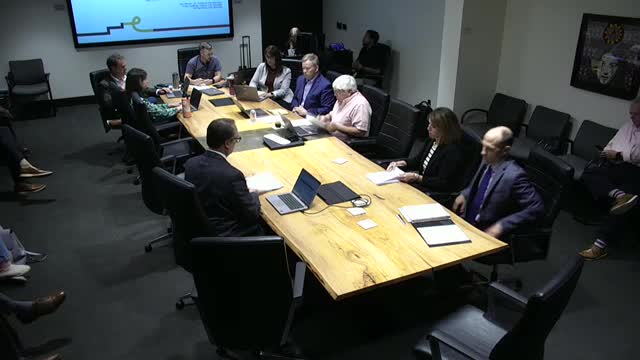
City staff and Black & Veatch representatives presented a conceptual plan on May 20 for the “Overland Park Plaza 2” redevelopment district that would center a new Black & Veatch world headquarters within a mixed‑use redevelopment of the College Boulevard corridor. The Finance, Administration and Economic Development Committee voted unanimously to direct staff to prepare a resolution scheduling a public hearing on creation of the district and to work with the developer on CID, TIF and economic development bond negotiations.
The developer and staff described the project as a multi‑phase, mixed‑use district. Black & Veatch’s first‑phase proposal is a new headquarters building of roughly 600,000+ square feet, surrounded by a walkable grid of public streets, structured parking, retail and a public park the company would dedicate to the city. Representatives estimated full master‑plan buildout at about $1.12 billion, with roughly 78% private investment and 22% reimbursable/public investment in infrastructure and parking. The proposal requests approximately $227 million in tax‑increment financing (TIF) and a proposed community improvement district (CID) of roughly $19.8 million; Black & Veatch is also seeking economic development revenue bond (EDRB) authority to secure sales‑tax exemption on construction materials.
Kurt Peterson, assistant to the city for real estate matters, and Jack Messer, assistant city manager, told the committee that the proposal emphasizes place‑making: narrower, pedestrian‑scaled streets, public open space and structured parking in place of large surface lots. Peterson said the bulk of the public financing sought is targeted at parking structures and public infrastructure required to enable a pedestrian‑oriented district. “Structured parking is the backbone of the public–private partnership that’s proposed,” Peterson said, explaining that the cost to build multi‑level parking and the timing of reimbursements under pay‑as‑you‑go TIF financing are the main financial challenges.
Megan Hoffman, Black & Veatch director of real estate and facilities, described the company’s desire to retain and attract talent: Black & Veatch employs about 2,200 people in Overland Park and the company said it wants a headquarters that reflects its global work in sustainable infrastructure. “Black & Veatch needs a new, amazing world headquarters that reflects who they are,” Hoffman said.
Committee members asked detailed financial and policy questions: how the district boundary and inclusion of adjacent properties (including a nearby Galleria parcel) affect shared increment; whether public access to structured parking outside business hours could be included; the level of CID sales tax (committee members suggested 2% is high and asked staff to explore lower rates consistent with other local CIDs); and the portion of property tax increment the city would rebate. Staff also noted a policy exception was requested for use of architectural and engineering fees in the TIF calculation and that the applicant asked for a higher share of incremental return than usual; those elements will be part of further negotiation.
The committee’s motion asked staff to prepare the district creation resolution and to work with the developer on the CID petition, project plan and a redevelopment agreement for later review. Peterson and city staff said individual project areas inside the district will be presented separately as project plans and development agreements as the work is designed and financed; the committee’s vote does not itself authorize any reimbursements or final approvals.
The committee voted unanimously to recommend that the governing body proceed to schedule a public hearing and to authorize staff negotiations; subsequent steps include formal project plans, financial feasibility analysis and public hearings before the council.