Get Full Government Meeting Transcripts, Videos, & Alerts Forever!
Get email alerts on the Agency Finance Budget topic
No spam. Unsubscribe anytime.
SFMTA CFO says fiscal picture cautiously stable; agency still faces multi‑year deficit and will use hiring freeze and controls to limit gap
Summary
CFO Breema Horger told the board the agency's fiscal year 2024–25 deficit narrowed slightly to about $3 million as of March, credited hiring freezes and non‑personnel spending controls, but warned of a projected $322 million gap in 2026–27 that will require a mix of revenue and expenditure measures and regional collaboration.
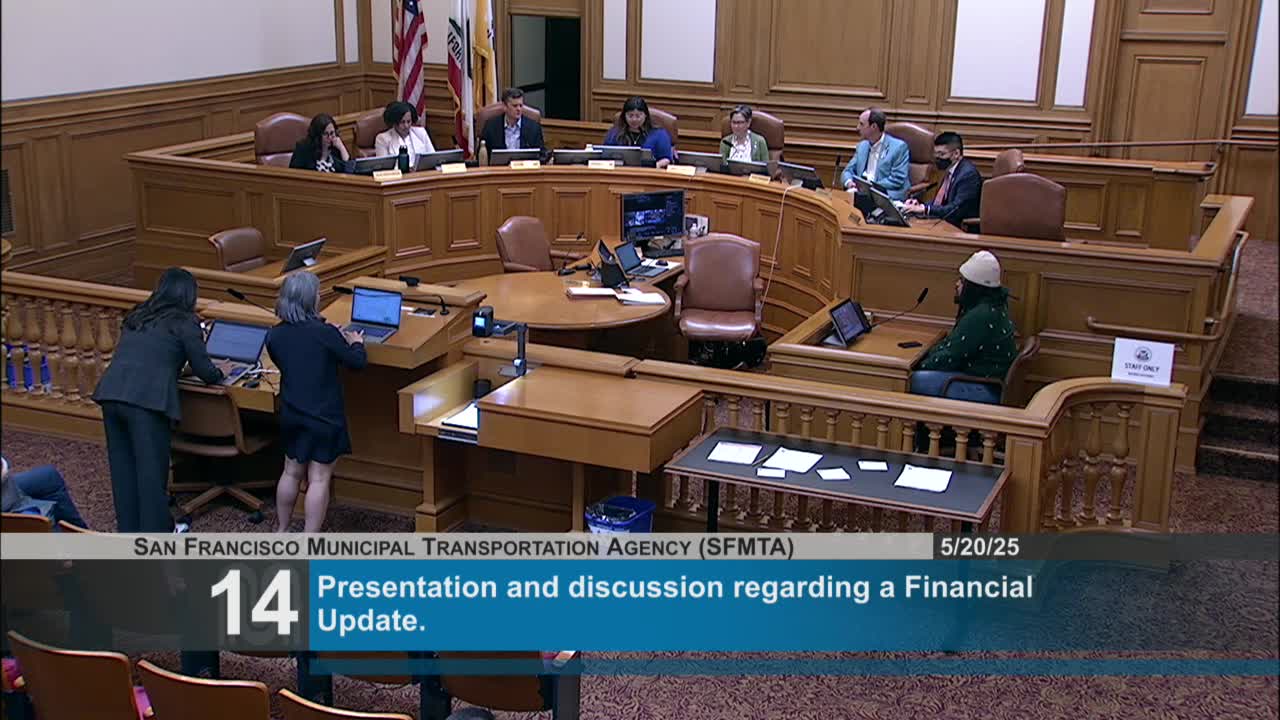
San Francisco Municipal Transportation Agency Chief Financial Officer Breema Horger gave the board a fiscal update on Tuesday, saying the agency’s projected deficit for fiscal 2024–25 improved slightly from a prior estimate and that staff would continue cost controls, but also reiterated a multi‑year funding shortfall that will require a mix of actions.
Horger reported that the agency’s estimated deficit for the year is about $3 million as of March — an improvement from a previously projected $4 million shortfall — driven in part by fare‑compliance gains and controlled hiring and nonpersonnel spending. She told the board the agency’s transit fare compliance effort has generated the equivalent of roughly $4.6 million in additional revenue compared with the prior year net of passenger growth.
On the expenditure side Horger said nonpersonnel services are over budget primarily because of claims and litigation, workers’ compensation and other categories not subject to tight operational control. The agency has imposed a hiring freeze and required divisions to submit corrective action plans on professional‑services and materials‑and‑supplies spending.
Horger reiterated a previously identified out‑year gap, pegged at roughly $322 million in 2026–27, and said staff are working on multiple scenarios including further cost containment, regional revenue measures and capital‑expenditure prioritization. She said the controller and the Muni Funding Working Group continue work on revenue options and that the agency will press regional partners to support measures that allocate funding to Muni.
Horger flagged state and federal uncertainties — including changes in cap‑and‑trade proposals in the governor’s May revise — as additional risk to future capital funding. She told the board the finance team will return in summer with a revised five‑year projection and an analysis of how the service reductions approved in April will affect the out‑year gap.
Ending: The board asked staff to continue scenario planning, to provide detailed summer updates on the fiscal year close and on the 2025–26 budget and to continue working with regional partners on revenue solutions.