Get Full Government Meeting Transcripts, Videos, & Alerts Forever!
Get email alerts on the Personnel Separation Cjis topic
No spam. Unsubscribe anytime.
Milwaukee commission upholds separation of City Attorney IT specialist over CJIS clearance
Summary
The Milwaukee Board of City Service Commissioners voted to affirm the Department's decision to separate Antoine Young from the Office of the City Attorney after hearing evidence that Young could not obtain required Criminal Justice Information Services (CJIS) clearance.
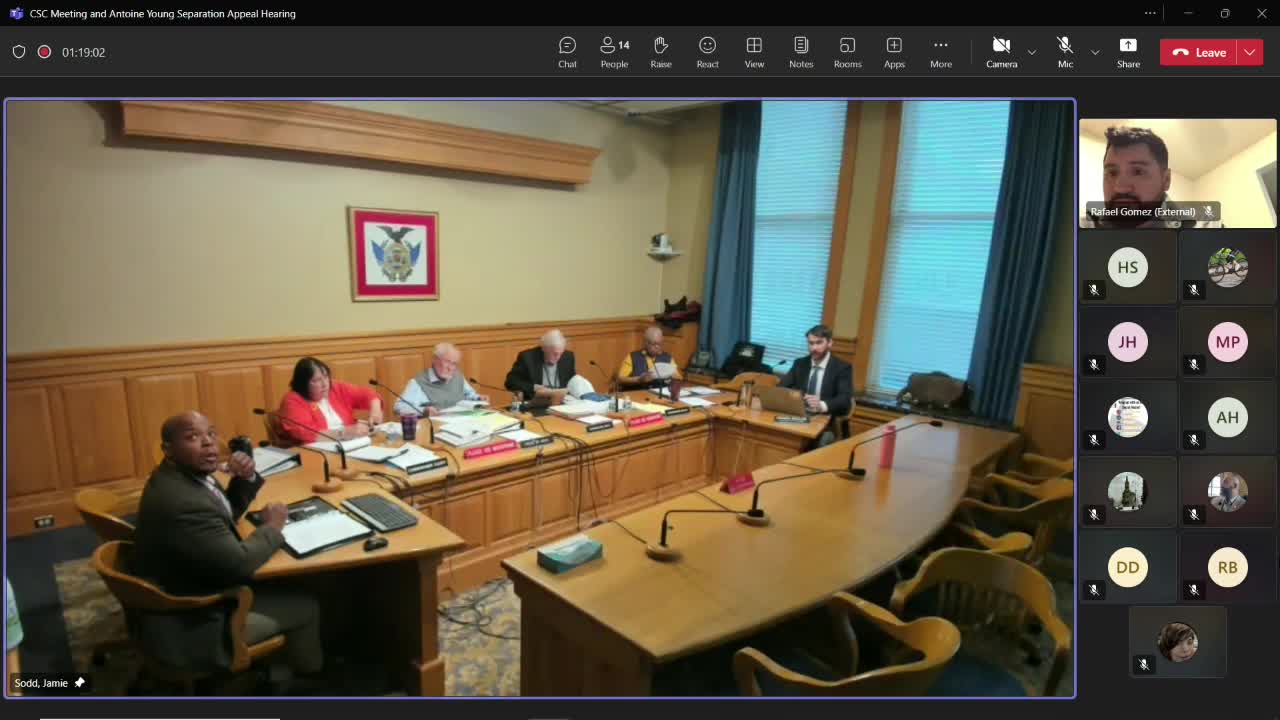
The Milwaukee Board of City Service Commissioners voted May 20 to affirm the Department of Employee Relations' separation of Antoine Young, a business systems coordinator in the Office of the City Attorney, after a multi-day hearing on whether Young could obtain Criminal Justice Information Services (CJIS) clearance required for parts of his job.
The commission found that the department’s decision was reasonable based on testimony and documentary evidence showing Young did not obtain CJIS clearance during repeated checks and that access to CJIS data and unescorted physical entry to certain police facilities are central to the position he held. President Frank Bach presided over the hearing and the final vote.
Why it matters: The office’s technology and prosecution work rely on staff who can access criminal justice records governed by federal CJIS rules and on building access sponsored by the Milwaukee Police Department. Commissioners were asked to weigh competing claims — whether the department exhausted alternatives and complied with the Wisconsin Fair Employment Act before separating Young.
In the hearing, Deputy City Attorney Naomi E. Sanders described the limits officials faced and clarified the city’s legal framework: “Under the Wisconsin Fair Employment Act, the two things that we can consider are convictions and charges pending conviction,” she told commissioners when explaining how conviction and pending-charge information can factor into employment decisions.
Young testified he performed his duties without prior discipline after an earlier personnel action and said he was not given a meaningful chance to reapply or pursue alternatives to separation. “I acted within the law and everything I did was legal, and I walk around as an innocent man,” Young told the commission in his testimony.
City attorney and department testimony described the CJIS audit cycle and the department’s view that the audit raised questions the office could not answer in the affirmative while Young lacked CJIS clearance. The CJIS materials and audit questionnaire were entered as evidence. Commissioners also heard testimony about internal communications and prior informal complaints; some witnesses said they had become aware of Young’s conviction history before case review but could not recall exact sources.
The commission discussed but declined to go into closed session for final deliberations. After deliberation in open session the chair called the roll; Commissioners Miller, Smith and Cleary and the chair voted to affirm the department’s separation decision. The commission’s written decision will be issued and made part of the official record.
What comes next: Commissioners noted Young may apply for reinstatement or other open and competitive city positions; because the separation was not formal discipline under the commission’s rules, he is not subject to the usual one-year waiting period for reapplication. Department of Employee Relations staff offered to assist Young with questions about hiring and reinstatement procedures.
Background: The hearing examined whether Young’s inability to obtain CJIS clearance — related to prior criminal convictions in the record before the commission — made him unable to perform central functions of the business systems coordinator role, which includes managing department servers, ensuring application licensing compliance and assisting ordinance enforcement staff with specialized software. The CJIS security policy and related audit requirements were central pieces of the department’s case.