Get Full Government Meeting Transcripts, Videos, & Alerts Forever!
Get email alerts on the Transit Safety Speed Cameras topic
No spam. Unsubscribe anytime.
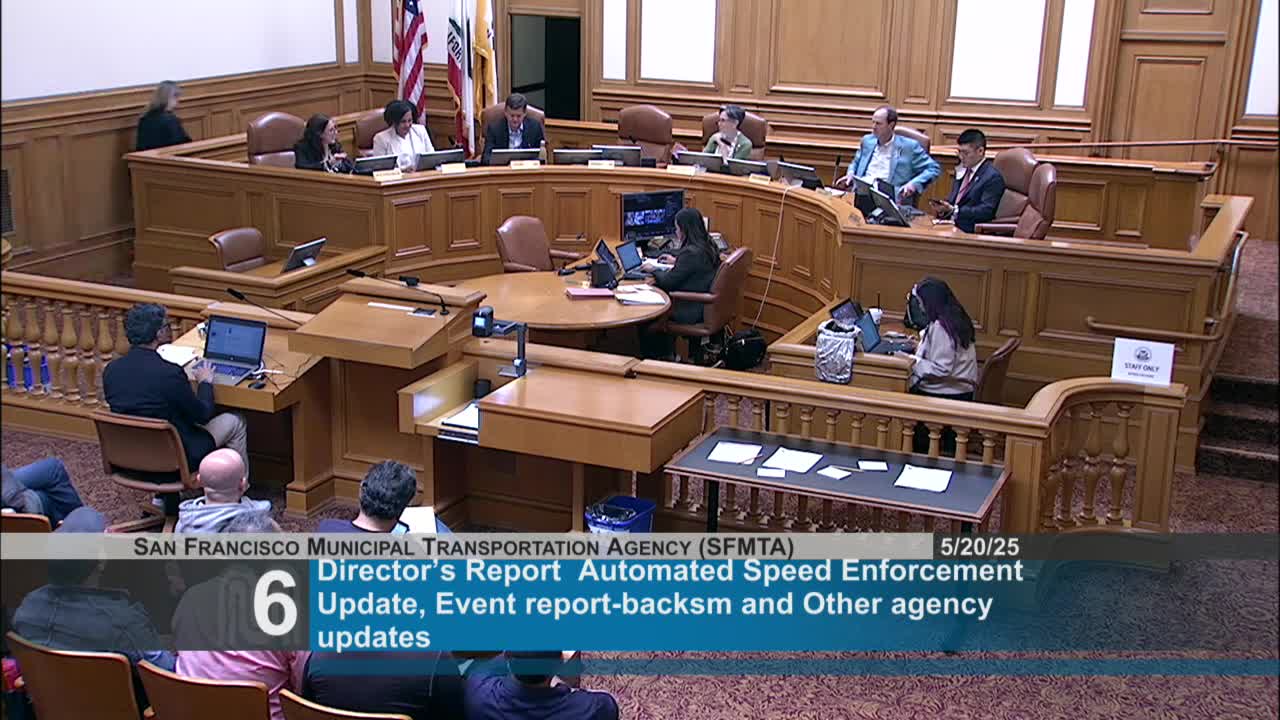
SFMTA director highlights El Taraval award, fix‑it week gains and speed‑camera rollout; warns citations will follow citywide activation
Summary
SFMTA Director Julie Kirschbaum reported on the El Taraval project award, subway ‘‘fix‑it week’’ maintenance results, bike month activities and the phased activation of automated speed cameras; staff said warnings began in April and citations will start after a 60‑day warning period completes for all cameras.
San Francisco Municipal Transportation Agency Director Julie Kirschbaum on Tuesday told the board the agency has won a regional construction management award for the El Taraval improvement project, outlined the results of a large maintenance ‘‘fix‑it week’’ and previewed the citywide automated speed‑camera program now issuing warnings at 21 locations.
Kirschbaum said the El Taraval project received the Construction Management Association of America Northern California Project Achievement Award in the $15 million–$99 million infrastructure category and praised staff and contractors for completing the multi‑phase light‑rail upgrades on time and within budget.
The director emphasized ongoing work to improve transit reliability and safety. ‘‘We completed more than 28 maintenance and repair projects in the subway, more than 1,900 staff hours,’’ she said, noting overhead catenary, track welding, debris removal and other repairs. Kirschbaum cited reduced delay metrics: ‘‘In March 2025 our moderate delays were down 63% and our long delays were down 69%.’’
On speed enforcement, Kirschbaum said the city began issuing warnings in March and April and that 21 camera locations were live in warning mode. ‘‘We issued more than 30,000 warnings in April,’’ she said, and added that warnings are triggered for vehicles traveling 11 mph or more above posted limits. Kirschbaum said the agency had preliminary approvals from the utility PG&E to activate remaining camera sites and expects the 60‑day warning period to begin in early June once all cameras are online; citations would follow after that consolidated warning window.
Shannon Hake, the speed‑camera program manager, told the board staff intentionally will keep all cameras in warning mode until the last camera completes its 60‑day warning period. ‘‘Because our cameras are coming online at different times, it would be very confusing for a driver to drive by one camera and get a warning and a different camera and get an actual citation,’’ Hake said.
Board members and public commenters urged faster activation of citations in some corridors and asked about interim enforcement by the police. Directors discussed engineering complements (larger speed signs, pavement markings) on corridors that are generating the most warnings, notably Fulton Street near Arguello where Kirschbaum said that location had the highest daily warnings in April.
Kirschbaum also reviewed bike‑month outreach and city bike‑lane mileage — she said the city has delivered ‘‘more than 30 miles of bike lanes citywide, including 51 miles of protected bike lanes’’ — and thanked community partners for events that drew thousands of students. Public commenters raised concerns and suggestions about signage and outreach for speed cameras, bicycle infrastructure, and subway accessibility.
The director’s report was informational; no board action was required.
Ending: The board directed staff to continue community outreach, to circulate the camera‑warning messaging materials, and to return to the board with activation dates and additional engineering steps for corridors with high rates of speeding warnings.