Get Full Government Meeting Transcripts, Videos, & Alerts Forever!
Get email alerts on the Environment topic
No spam. Unsubscribe anytime.
Tryon Creek Watershed Council seeks state capital funding to explore West Willamette watershed collaboration
Summary
The Tryon Creek Watershed Council told the Lake Oswego City Council it has applied for state capital funding to study expanding watershed-council coverage across the West Willamette region, a project that would convene stakeholders from Forest Park to West Linn and Wilsonville if funded.
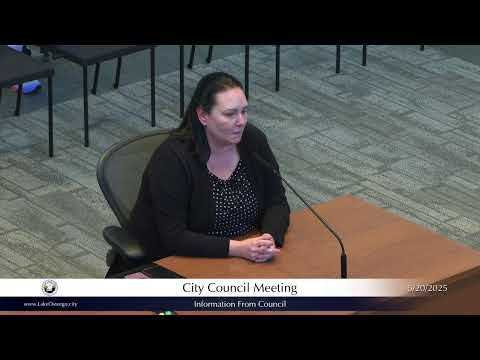
Alexis Pardon Castro, executive director of the Tryon Creek Watershed Council, briefed the council on a proposed West Willamette Watersheds Collaboration and a capital projects request submitted to the state legislature.
The proposal would fund community engagement and a planning process, beginning this summer if capital funding is awarded, to explore options for expanded watershed-council coverage across a wide area: north of Lake Oswego through the west side of Portland (including Forest Park), and south to West Linn and Wilsonville. The effort would seek to address gaps where smaller drainages currently lack organized watershed-council attention.
Pardon Castro described two organizational options under consideration: a single merged and expanded watershed council or a network model that would distribute funding across smaller local watershed groups, modeled on the Upper Willamette structure. The councils work across jurisdictions to support habitat for native fish, including salmon, and to coordinate projects on privately and publicly owned land.
The capital request, Pardon Castro said, included letters of support from the City of Lake Oswego, Portland City Councilor Olivia Clark and the mayors of West Linn and Wilsonville; the councils are also coordinating with Tualatin, West Multnomah and Clackamas soil and water conservation districts and other community groups. If funded, stakeholder engagement would begin as soon as this summer, she said.
Pardon Castro asked the council to remain informed and indicated staff and volunteers would follow up with more detailed plans and invitations to participate in upcoming engagement work.