Get Full Government Meeting Transcripts, Videos, & Alerts Forever!
Get email alerts on the Annexation topic
No spam. Unsubscribe anytime.
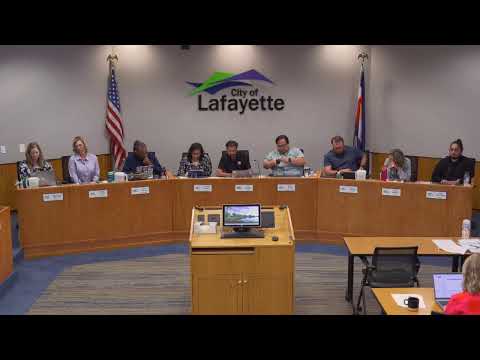
Lafayette council finds Gateway Lafayette annexation eligible after contentious public comments
Summary
The Lafayette City Council voted unanimously May 20 to find the Gateway Lafayette annexation application eligible under Colorado law, a procedural step that allows the developer to continue toward sketch-plan and PUD review despite heavy public opposition focused on open space, wildlife, water and subsidence concerns.
The Lafayette City Council voted unanimously May 20 to find the Gateway Lafayette annexation application eligible under the Colorado Municipal Annexation Act, a procedural determination that clears the way for later site-plan and zoning hearings but is not final approval of development.
The eligibility finding covers about 77.5 acres at the southwest corner of Baseline Road and North 119th Street — roughly 24.5 acres north of Baseline and 53 acres south. The applicant, identified in the hearing as Cairo Residential, and its legal counsel argued the petition meets statutory requirements including ownership consent, contiguity and a community-of-interest with the city. Jake Mitchell, the city’s planning manager, told council staff had received the annexation application in early March and had completed required public notices and an annexation impact report.
The public hearing drew dozens of residents who urged council to block development and preserve the property as open space. Speakers raised ecological and practical concerns, including the site’s role as a wildlife corridor and wetland, potential groundwater and water-supply limitations, and geologic hazards tied to historical coal mining beneath the parcel. Several residents asked the city to pursue joint open-space acquisition with Boulder County and Erie instead of annexation for development.
Supporters of preserving the land noted the parcel’s designation in Lafayette planning documents as important for open space and argued the 2019 pre-annexation agreement between the city and the property owner — which asked the owner to seek Lafayette annexation rather than asking other towns — had influenced the property’s future designation in the comprehensive plan. Opponents countered that the comp plan designation does not obligate the council to approve development and urged council to resist the application when it reaches final hearings.
Applicant representatives said they plan neighborhood meetings and additional technical studies and that annexation eligibility is only the first step toward a sketch-plan PUD submittal. Attorney Charlie Smith (Polsinelli) walked council through the statutory tests — ownership, contiguity, community of interest and other statutory elements — and said the application satisfies each element.
Council members framed the night’s vote as a narrow, legally required fact-finding step. Council discussion emphasized the distinction between an eligibility finding and later land-use approvals that will require additional studies, public hearings, and Planning Commission review. Mayor Mongeau and councilors noted the large number of public comments and the importance of continued neighborhood engagement as the project advances.
Next steps: if no legal challenge arises over the eligibility determination, the applicant would proceed with a sketch-plan PUD application and the city’s formal review process, which includes neighborhood meetings, technical studies and separate public hearings before the Planning Commission and City Council. The council’s eligibility vote does not authorize construction or development on the site.
Votes and formal action: Council approved Resolution No. 2025-30, “making certain findings of fact regarding eligibility for annexation” (Gateway Lafayette). The motion passed unanimously; the vote on the resolution was recorded as unanimous in open session. The action is explicitly a procedural eligibility finding under state law and is not a final annexation or zoning decision.
What it means: An eligibility finding establishes that the annexation petition meets the narrow statutory requirements for the Municipal Annexation Act and allows the applicant to proceed into the city’s land-use entitlement process. It does not bind council to approve any future zoning, PUD or infrastructure approvals for the property.