Get Full Government Meeting Transcripts, Videos, & Alerts Forever!
Get email alerts on the Comprehensive Plan Intensity topic
No spam. Unsubscribe anytime.
Pitkin County staff present data showing “intensity” from large homes, prompt questions on methodology and policy levers
Summary
Pitkin County planning staff and outside consultants presented preliminary findings May 20 showing that large homes in unincorporated Pitkin County generate outsized economic activity, vehicle trips and building emissions relative to their share of the housing stock.
Pitkin County planning staff and outside consultants presented preliminary findings May 20 showing that large homes in unincorporated Pitkin County generate outsized economic activity, vehicle trips and building emissions relative to their share of the housing stock.
The presentation, led by planning staff and consultant teams working on the Vision 2050 comprehensive plan update, summarized three parallel studies (economic, transportation and climate) intended to quantify “intensity” — defined as activity tied to large residential buildings rather than population growth alone. Staff emphasized the work session was informational and no action was requested.
The white paper and presentation aim to translate the Community Growth Advisory Committee’s qualitative concerns into measurable baselines that can inform the comprehensive plan and future land‑use code changes. "Intensity is real, is quantifiable, and it is distinct from growth," staff member Hannah Hunt said during the presentation.
Why it matters: Staff and the consultant teams said intensity can produce outcomes not aligned with existing infrastructure and services when activity concentrates in rural parts of the county. That misalignment raises questions about climate impacts, traffic, local labor demand and where the county should allow or discourage certain kinds of residential activity.
Key findings presented
- Definition and scope: The studies focus on homes the teams identified as "large," using 5,750 square feet as a working threshold in the white paper. The consultants said they quantified two sorts of impacts: on‑site jobs and operations tied directly to a residence (construction, maintenance, landscaping, year‑round service) and off‑site jobs and wealth‑management activities that support high‑end residential real estate.
- Economic measures: Consultants reported that on‑site construction/operations jobs represented about 13% of Pitkin County’s employment in 2022 (a decline from 2010), while off‑site, residential‑support industries accounted for about 37% of jobs and had grown since 2010. The team said large homes (reported in the study as "just over 14%" of single‑family units in unincorporated Pitkin County in the economic analysis) generate more of the construction/operations jobs than the remaining smaller homes.
- Transportation impacts: The transportation study reported that residential land uses account for more than half of daily trips in unincorporated Pitkin County. As house size rises, the portion of trips made to a residence by employees (construction, maintenance, landscaping) increases substantially; the presentation said the largest homes can generate nearly ten times more employee trips than the smallest cohort. The consultants said large homes (14% of the housing stock in one slide) accounted for nearly 20% of daily residential trips and nearly 25% of residential vehicle miles traveled.
- Climate and energy use: A utilities‑data‑based analysis of several hundred county residences showed energy use and associated greenhouse gas emissions increase with larger square footage. One slide stated large homes represented about 26.4% of the housing stock while contributing nearly 45% of residential building emissions; the consultants also identified "amenity loads" (pools, spas, extensive HVAC/humidity systems) as important drivers of higher per‑square‑foot energy use.
Questions raised about methods and next steps
New Planning Commissioner Joseph Mason, who joined the commission this meeting, pressed consultants for more methodological detail and cautioned against comparing extreme size cohorts without reporting sample sizes and standard errors. "I would not be at all surprised to see if these two values were not statistically significantly different from one another," Mason said, urging publication of observation counts and error estimates in an appendix.
Commissioner Suzanne Kaske (also a member of the county work group that earlier reviewed the topic) and other commissioners described local, anecdotal observations that align with the white paper — for example, landscapers’ counts of daily vehicle trips at large properties. Staff said the white paper is preliminary and that final studies and technical appendices will accompany the draft comprehensive plan.
Policy options discussed
Staff and the work group have begun identifying a menu of tools to manage intensity, including regulatory changes, redistribution or relocation strategies, performance standards and, potentially, mitigation fees. Examples discussed: a tiering system that increases requirements as square footage grows; building performance standards scaled to home size; and limits or caps tied to exterior energy use (referenced as the BTU cap enacted last year). Staff emphasized preference for managing intensity through land‑use and building‑code tools before relying on mitigation fees.
Commissioner discussion also emphasized that the policy response could target uses and activities (for example, limits on commercial‑scale events or unlicensed commercial activity taking place in residences) rather than square footage alone, because smaller dwellings can produce high intensity if operated as short‑term rental businesses or event venues.
Next steps and public process
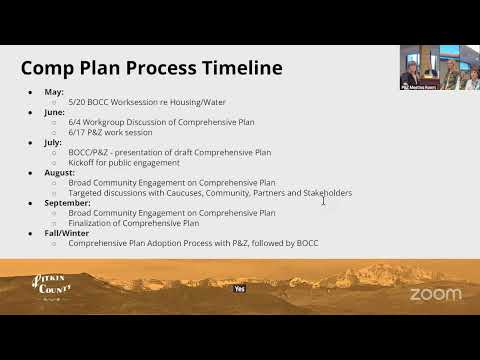
Staff said the county will continue refining the studies and methodology and will present a draft comprehensive plan for joint review with the Board of County Commissioners in July. Broad public outreach on the draft plan is planned for late summer, with the Planning and Zoning Commission responsible for adopting the comprehensive plan under state statute and the BOCC subsequently reviewing the document under recent state legislation.
A note on data and limitations
Presenters and commissioners repeatedly described the white paper as a baseline and work in progress: consultants used assessor, utility and survey data, but staff acknowledged additional technical documentation, sample sizes and statistical measures should be published in forthcoming appendices to make the analysis more defensible to technical reviewers and the public.
Ending
Commissioners thanked staff and consultants for the presentation and asked for follow‑up technical documentation; several commissioners offered to meet with consultants offline to review statistical methods. No policy changes were adopted at the May 20 meeting; the comprehensive plan update process will return to the commission and the BOCC for future hearings and decisions.