Get Full Government Meeting Transcripts, Videos, & Alerts Forever!
Get email alerts on the Appropriations topic
No spam. Unsubscribe anytime.
Connecticut committees approve FY25 Small Cities CDBG allocation plan totaling $13.96 million
Summary
Connecticut’s appropriations, commerce and housing committees approved the Department of Housing’s fiscal year 2025 Small Cities Community Development Block Grant allocation plan on July 30, 2025. The plan allocates $13,960,891 for July 1, 2025–June 30, 2026, emphasizing preservation of existing affordable housing and infrastructure to enable new housing.
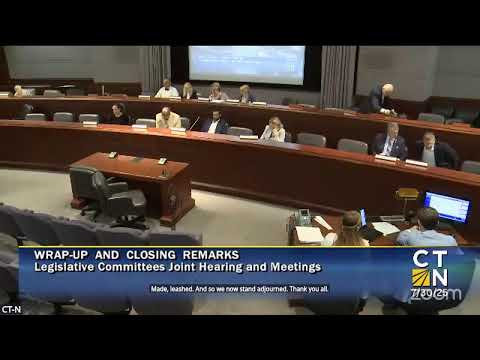
Connecticut’s appropriations, commerce and housing committees approved the Department of Housing’s fiscal year 2025 Small Cities Community Development Block Grant (CDBG) allocation plan on July 30, 2025, following a public hearing and detailed questions from committee members.
The plan allocates $13,960,891 for the program year running July 1, 2025, through June 30, 2026, and directs the state CDBG Small Cities program to prioritize preservation of existing affordable housing and public infrastructure projects that enable new affordable housing activity. Mike Santoro, director of policy research and housing support at the Connecticut Department of Housing (DOH), told members the allocation is “determined by HUD by formula” and that, once HUD approves the state submission, DOH expects to receive contract documents and make awards to communities within about 30 days of that contract.
The plan matters because CDBG small‑cities funds serve nonentitlement municipalities—communities the federal government does not treat as direct grantees—and are often the primary federal source for public housing modernization, homeowner rehabilitation, and infrastructure in smaller towns. Santoro said DOH’s administration will emphasize quick turnover so awarded projects can move to construction late summer or early fall once HUD executes the contract.
DOH officials, including Miguel Rivera, director of housing and community development, described program rules and local practices. Rivera said CDBG for small cities is a competitive program with published rating and ranking criteria. He also described routine technical assistance and a prequalified list of consultants that municipalities may use; the state may use roughly 1% of total allocation for technical assistance to grantees. Rivera said the program caps soft and administrative costs at 20% of an award, with the state receiving about 3% of that amount and the remainder covering local soft costs (architectural, engineering, environmental testing, consultant fees).
DOH answered multiple detailed questions from committee members:
- Why so few applications: Santoro and Rivera said DOH received only five applications this cycle because they have emphasized that municipalities apply when projects are “ready to proceed” — meaning required design, environmental reviews and contracting are in place so construction can begin quickly after award. Rivera said DOH directly outreaches to the roughly 129 eligible small cities and towns and runs workshops to help with application readiness.
- Carryover funds and administration: Santoro explained carryover includes administrative carryover and programmatic carryover (unspent awards or recycled program income). He said DOH carried over about $455,000 in administrative funds and about $8,000,000 in program-level authorizations or program income, of which roughly $3,000,000 originated from the now‑ended Neighborhood Stabilization Program (NSP) and has been reprogrammed into CDBG. Santoro said the program receives roughly $317,000 in new federal administrative funds in a typical year but expects to spend closer to $877,000, drawing on carryover to meet administration needs.
- What CDBG may and may not fund: Santoro clarified that “CDBG funding cannot be used for new housing construction” but can fund infrastructure that supports new construction and can fund public housing modernization, homeowner rehab and accessibility improvements. He said projects using public housing modernization funds must meet Section 504 and ADA requirements.
- Revolving loan activity: Rivera described that revolving loan activity is typically used for homeowner rehabilitation: a municipality can receive a block of CDBG dollars (for example, $400,000–$500,000) and make individual loans of roughly $30,000–$50,000 to homeowners; repayments are recycled locally.
- Prevailing wage and Buy America impacts: DOH staff warned that recent state prevailing wage increases and the federal Build America, Buy America (BABA) preferences have raised project costs and, in some cases, led applicants to decline federal funding. Rivera said some projects have experienced millions in increased costs when combined with other leveraged funds and that the department keeps a contingency “nest egg” to avoid project failures. Members raised this as a reason for the program’s cautious use of carryover funds.
- Target households and metrics: Santoro said CDBG small‑cities activities primarily serve households at or below 50% of area median income (AMI) and that the department’s broader emphasis in the coming period is on households at 30% and 50% of AMI. Santoro gave a statewide example for a family of four: statewide AMI of about $124,600 (statewide figure cited by DOH staff), 80% AMI ≈ $99,680 and 50% AMI ≈ $62,300; DOH noted regional AMI figures vary and it will provide published tables.
Committee members also pressed DOH on monitoring, project timelines and the length of projects; Santoro said DOH monitors regularly, enforces HUD expenditure deadlines and can provide contract‑start dates in appendix E for specific projects.
Votes and next steps
The three committees voted to approve the FY25 Small Cities CDBG allocation plan by voice and roll‑call votes before adjourning. Commerce approved the plan on a roll call (18 yes, 0 no, 2 absent). The Housing Committee approved it (10 yes, 0 no). The Appropriations Committee approved it on a 45‑0 roll call (45 yes, 0 no, 9 absent). DOH will submit the plan to HUD for review and, subject to HUD approval and contract execution, award funds to municipalities and expect communities to begin contracting and construction soon after.
DOH officials said they will publish the department’s performance reports and beneficiary data per federal requirements and can provide committee members the PERs and regional AMI charts on request.