Get Full Government Meeting Transcripts, Videos, & Alerts Forever!
Get email alerts on the Land Use Zoning topic
No spam. Unsubscribe anytime.
Commission asks staff to revisit 10 p.m.–5 a.m. hours restriction in corridor zoning after businesses avoided sites
Summary
Deputy development staff said an existing 10 p.m.–5 a.m. restriction in corridor and corridor-transitional zoning has deterred potential commercial tenants for a decade; commissioners asked staff to return with data and options to modify hours for corridor areas while retaining protections for residential areas
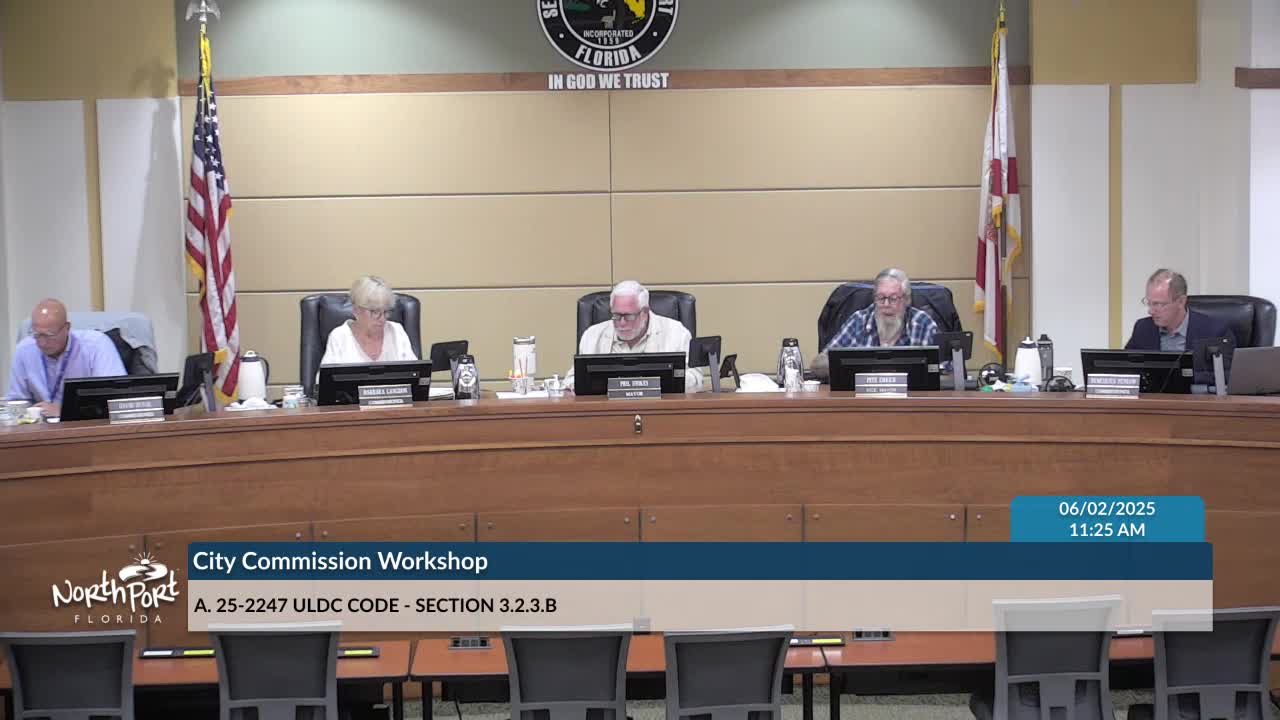
Laurie Barnes, deputy director of development services, told the commission at the June 2 workshop that a 10 p.m.–5 a.m. limit on business operations in corridor and corridor-transitional (CT) zones — a restriction carried from the prior Unified Land Development Code era — has discouraged some prospective tenants from locating in the city’s corridor properties.
Barnes said developers told staff that, with the curfew in place, potential end users such as restaurants and entertainment venues declined to pursue corridor parcels. “Think about a restaurant. What restaurant is going to be closed up, cleaned up, no outdoor cleanup, no deliveries by 10PM?” Barnes asked commissioners.
Staff and commissioners reviewed the history: the 10 p.m. restriction existed under the previous neighborhood-commercial rules and was folded into the new Unified Land Development Code (ULDC). Commissioners noted that in some corridor locations the zoning sits immediately adjacent to single-family homes and that any change must balance attracting businesses with protecting residential quality of life. The city’s noise ordinance remains enforceable for late-night disturbances.
Discussion explored options: leave the hours unchanged; extend the curfew one or two hours (for example to 11 p.m. or midnight); allow waivers or conditional approvals for specific business models; or permit more permissive hours in corridor (non-transitional) zones while keeping stricter limits in CT zones. Staff noted the ULDC currently contains language that prohibits waivers for the business-hours restriction; changing that would require code amendment.
Commissioners offered varied views. Commissioner Langdon and others urged caution because the ULDC is new and the rezoning process was lengthy; Langdon said he was “way more reluctant on the transitional corridors” but open to adjusting corridor zoning. Vice Mayor Emerich and other commissioners favored exploring a modest extension so sites do not remain vacant for years. Public commenter Debbie McDowell urged the commission to “protect our established neighborhoods and keep the existing hours of operation in place,” noting the commission had earlier agreed to those hours when adopting the ULDC.
Outcome: commissioners gave staff consensus direction to return with options and supporting data — including a zoning map, a list of affected parcels, examples of business models and pros/cons for hour changes — rather than to adopt any amendment at the workshop. Barnes said staff will prepare refined options and bring them back to the commission at a future workshop or agenda item.
Next steps: staff to assemble affected-parcel maps, quantify the number and type of lost opportunities referenced by developers, propose specific hour-change alternatives (for corridor and CT zones separately) and include noise-ordinance implications and possible waiver procedures for commission review.