Get Full Government Meeting Transcripts, Videos, & Alerts Forever!
Get email alerts on the Affordable Housing topic
No spam. Unsubscribe anytime.
Council approves city support for Habitat Pelican Place townhomes, Edward White senior housing and CRA loan program changes
Summary
The council unanimously approved CRA and city funding to support Habitat for Humanity’s Pelican Place (40 affordable for‑sale townhomes), restored ARPA funding for the St. Petersburg Housing Authority’s Edward White senior housing project, and updates to the CRA affordable housing loan program to add ADU incentives and other changes.
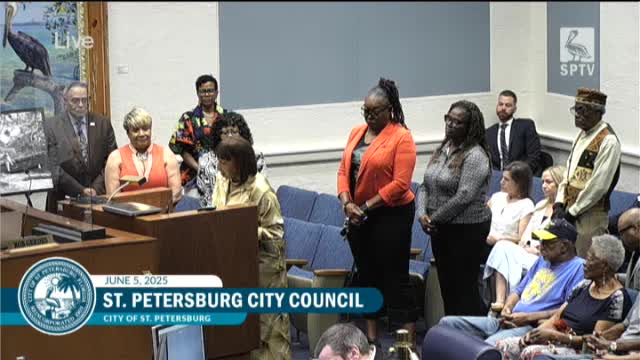
St. Petersburg City Council voted June 5 to back multiple affordable‑housing actions, approving combined Community Redevelopment Agency (CRA) and city support for Habitat for Humanity’s Pelican Place development, restoring previously reallocated ARPA funds for the St. Petersburg Housing Authority’s Edward White senior project, and adopting amendments to the CRA’s Affordable Housing Redevelopment Loan Program to expand eligible project types.
Habitat for Humanity Pelican Place
Council approved a funding package to support Habitat for Humanity’s Pelican Place, a planned 40‑unit for‑sale townhome community on Eighteenth Avenue South near Tangerine Plaza. According to city staff, the total project cost is about $15.6 million and the development targets households at 80% of area median income (AMI) or below. The city’s support was presented as a combination of a donated city parcel (appraised at $1,430,000) plus additional cash subsidy. Administration said total city support (including the land value) would be about $3.6 million — roughly $90,000 per unit — and that the cash portion the applicant requested to close the financing is approximately $2.2 million. Project features include a mix of two‑ and three‑bed units (many with an extra den), 0% Habitat mortgages for buyers, capped closing costs and homebuyer education.
Mark Van Loo, presenting for the city, said the South Side CRA Citizens Advisory Committee had recommended the funding unanimously and administration supported the request. Habitat CEO Mike Sutton described expected monthly carrying costs for buyers including principal (0% interest), HOA and taxes and estimated total monthly housing costs near $1,200 per month for buyers after taxes and HOA are included; he said HOA fees are designed to be modest (around $100/month) and the HOA will retain Habitat guidance and a reserve structure during early years.
Council Member Deborah Fig Sanders moved approval; the motion passed unanimously in a roll call vote.
CRA affordable housing loan program amendments
Council also approved a resolution modifying the CRA’s Affordable Housing Redevelopment Loan Program to clarify award categories, expand eligible projects to include new construction of affordable accessory dwelling units (ADUs), update application requirements, and adjust award amounts and affordability periods.
Key changes adopted include: - A land‑acquisition reimbursement for single‑family affordable homebuilders (reimbursing up to half of land acquisition cost, with minimums tied to development thresholds). - Incentive payments for affordable single‑family homes (e.g., $10,000 developer incentive for qualifying buyers and an additional $5,000 incentive when the buyer is an existing renter within the South St. Petersburg CRA at closing). - A new ADU incentive structure allowing property owners to receive payment toward construction of an affordable ADU; small projects under $15,000 would carry a 5‑year affordability period, $15,000–$40,000 a 10‑year period, and projects above $100,000 will be brought back to council for review. Administration said permit data and current proposals showed an average ADU project cost near $250,000; the CRA Citizens Advisory Committee advised leaving a per‑project cap off the books initially to observe demand and community benefit.
Council Member Fig Sanders moved the resolution; it passed with unanimous support.
Edward White senior housing — St. Petersburg Housing Authority
Council also restored earlier city funding for the Edward White Hospital renovation project being developed by the St. Petersburg Housing Authority (SPHA). The project will renovate the former Ed White Hospital building to include the SPHA administrative offices on the ground floor and 71 affordable rental units restricted to roughly 60% AMI for seniors above. The council was asked to replace approximately $5.9 million in ARPA funds that had been reallocated in 2024; administration said SPHA is now shovel‑ready and needs the funding in order to close construction financing and move construction of the housing portion into a July start. SPHA’s Michael Lundy testified that the project will also include leased health‑care space and on‑site management to coordinate services for residents.
Council Member Fig Sanders moved approval; the resolution passed unanimously.
What the approvals mean
Administration and project proponents said the Habitat units will be sold with 0% Habitat mortgages and homebuyer education requirements; Habitat retains first right of refusal on resale and includes an equity‑share provision to limit speculative gains and retain long‑term affordability. SPA’s Ed White project will deliver senior rental supply and on‑site services; the council’s restored funding replaces the earlier ARPA allocation and enables project financing to proceed.
Council members emphasized the need to prioritize long‑term affordability, outreach to CRA residents for homebuyer recruitment, and careful design of HOA and reserve structures so units remain sustainable for lower‑income buyers. Council Member Brandy Gabbard specifically praised Habitat’s pledge to actively recruit South St. Petersburg CRA residents as buyers.
Ending: Funding approvals passed unanimously and administration will proceed with grant/loan agreements and finance closings. Staff said they will return to council with required loan documents and program implementation details as the projects move to construction.