Get Full Government Meeting Transcripts, Videos, & Alerts Forever!
Get email alerts on the Downtown Homelessness topic
No spam. Unsubscribe anytime.
Downtown residents and businesses press St. Petersburg council for more enforcement, outreach after rise in visible homelessness
Summary
Multiple downtown residents, businesses and neighborhood leaders told City Council during open forum that enforcement of City Bill 13-65 and more outreach staff are needed after assaults, property complaints and a recent fatality in the downtown core.
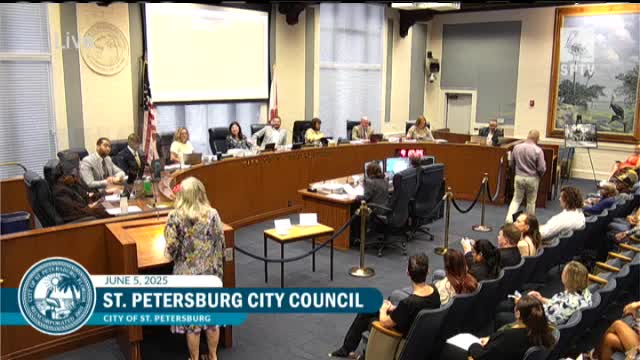
A string of public commenters at the St. Petersburg City Council meeting on June 5 urged the city to step up enforcement of a recent ordinance and to expand outreach and policing in the downtown core after repeated safety and quality-of-life complaints.
The speakers — condominium presidents, business managers, nonprofit leaders and residents — described repeated incidents of street-level disorder, threats to employees and customers, and what they said was uneven enforcement of City Bill 13‑65.
“Individuals living on the streets are in temporary hotel housing, exhibiting behaviors that reflect deep unmet needs,” said Karen Carmichael, president of the Sage condominiums and of the Downtown Neighborhood Association. “This is no longer a housing issue. It’s a public safety issue. It’s a public health issue, and it’s a community quality of life issue for residents, for tourists, for business owners, for families, and for those who are in need of essential mental health services.”
Jason Mathis, CEO of the St. Petersburg Downtown Partnership, told the council downtown’s population and visitations have grown rapidly — “In 02/2010 there were 3,000 units in Downtown Saint Pete. In 02/2025 there are almost 20,000 units in Downtown Saint Pete” — and called for a coordinated program to keep downtown clean and safe. “Downtown really is an economic engine for Saint Petersburg,” Mathis said.
Several downtown business managers and employees described threats or assaults. Veronica Whaley, who said she lives at 221 First Avenue North, described multiple threats, break‑ins and alleged harassment by people living on sidewalks near her restaurants and said officers told her they could not act because of legal constraints tied to shelter availability and registration requirements she referenced as “House Bill 13 65.” Carrie Amboga, who identified herself as a resident at 225 First Avenue North, told council that the ordinance has not been enforced and called for public reporting of enforcement metrics and a timeline for action.
Employees and managers at Central Avenue businesses including She’s So Crispy described thefts of tips and physical threats that they said made them afraid to go to work. “We don’t feel safe at all,” said a staff member. “We have coming around the business…people are coming out behind the truck. I had to go in the restaurant in the morning because somebody broke in.”
Speakers acknowledged programs and personnel already in place, including PATH and CALL outreach teams and added late‑evening police and PATH units downtown, but several said staffing and capacity lag demand. “We need more boots on the ground. We need more clinicians, more outreach teams, more consistent engagement,” Carmichael said.
Council members and staff did not take an immediate policy vote during open forum. Several council members later referenced the public comments during deliberations on related agenda items and thanked speakers for bringing detailed accounts to the dais. Vice Chair Hanowitz and other council members said they want further briefings and follow‑up; Council Member Driscoll asked administration to prepare a fuller briefing for the Economic & Workforce Development Committee later in July that would allow for a deeper conversation on job creation, housing and complementary strategies.
The speakers’ requests included: stronger and more consistent enforcement of City Bill 13‑65; expanded PATH/outreach capacity; a “clean and safe” program described by multiple business leaders as a package of cleaning crews, safety ambassadors and a homeless liaison team; and public reporting on enforcement and program performance. Council members and staff said they would coordinate follow‑up briefings and committee discussion as requested.
The council did not adopt any new ordinance or funding at the June 5 meeting as a direct result of the open forum comments; the session functioned as public testimony to inform later agenda items and committee work.
The accounts provided at open forum reflected multiple perspectives: owners and managers of downtown restaurants and high‑rise condominiums, a downtown nonprofit leader and a college provost who described incidents near Williams Park and at campus facilities. Those speakers emphasized both harm to residents and visitors and the need for scalable outreach and enforcement solutions that balance public safety and service for people experiencing homelessness.
Council members asked administration to return with more detailed options and data in committee, including enforcement metrics and staffing plans, so the council can evaluate program costs and tradeoffs alongside other city priorities.
The council’s broader downtown work — including recent staffing additions and PATH evening coverage — will continue while members consider longer‑term programs requested by downtown stakeholders.
Ending: The council did not adopt final action on the concerns raised during open forum; instead members directed staff to continue analysis and to present more detailed proposals to committees in coming weeks so council can consider funding and policy options.