Get Full Government Meeting Transcripts, Videos, & Alerts Forever!
Get email alerts on the Rules And Procedures topic
No spam. Unsubscribe anytime.
San Mateo council studies changes to rules on public presentations, event attendance and travel allocations
Summary
At a July 20 study session, City Clerk Martin McTigert presented proposed amendments to the City of San Mateo's council rules and procedures covering event attendance limits, presentation-material deadlines, organized-presentation rules, agenda order and a new council travel allocation model. Council provided feedback; no action was taken.
SAN MATEO, Calif. — The San Mateo City Council on July 20 held a study session on proposed amendments to its rules and procedures, hearing a staff presentation and public comment but taking no formal action.
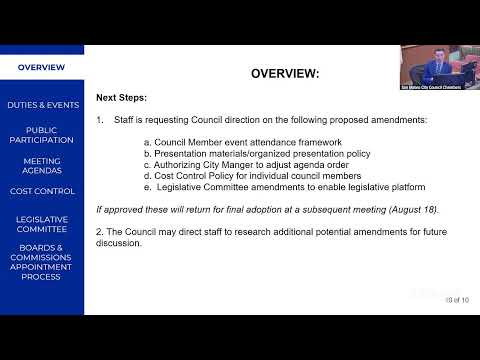
City Clerk Martin McTigert outlined proposed changes that would (1) set an attendance framework for outside events to limit potential Brown Act issues by generally limiting official attendance to two council members with priority given to the mayor or deputy mayor and a relevant council liaison; (2) require presentation materials for meetings be submitted at least one business day before a meeting; (3) clarify eligibility and administration of organized presentations (five-minute group presentations) and require at least one presenter to be present in-person or virtually; (4) authorize the city manager to adjust agenda order before packet publication in response to anticipated public interest; and (5) create a standardized individual allocation model to track and control council travel and related expenses.
The proposals are intended to improve Brown Act compliance, ensure equitable treatment of speakers and organized groups, and provide clearer internal processes for staff and the public.
"We're recommending a submission deadline of at least 1 business day prior to the council meeting," McTigert told the council, explaining the change is to give staff time to review materials for relevance and jurisdiction. He said staff would treat individual and organized presenters the same for display materials and would stop a video at the speaker's allotted time if it exceeded their speaking slot.
Public commenters raised concerns about fairness and transparency. One resident urged the council to "tread lightly" on organized presentations, saying they can advantage developers or organized interests over residents with limited time and suggested presentation materials be submitted for the public record. Dave C., speaking for the nonprofit Ethics San Mateo, praised the effort to adopt a more enforceable code of conduct but urged clarity on group identification rules and stronger conflict-of-interest enforcement, saying the council should create an appeals process if the city attorney finds a conflict.
Council members discussed practical implementation details. Multiple members asked staff to ensure neighborhood and off-calendar events are entered into the city's event tracker so the clerk's office can manage attendance and reduce Brown Act risk. Council members requested that the event tracker also indicate whether the city attorney has advised an event is subject to Brown Act limits.
On travel and expense controls, McTigert described a model in which each council member would receive an equal annual allocation tied to the city's budget process; the clerk's office would track expenses and report regularly to the council. He said some exceptional trips (for example, formal sister-city delegations or special appropriations) would remain subject to separate council approval and not count against an individual member's allocation. McTigert cited the council's existing annual contribution to the San Mateo Sister City Association as an example of a separately approved item (staff cited $15,000 as an example of prior practice).
On boards and commissions, staff reiterated current language that allows automatic reappointment when a majority of the council agrees, but said that process can be adjusted and staff will verify commissioners' interest before recruitment. Council members asked for a pre-recruitment study session or discussion item listing expiring terms, suggested providing interview questions to appointment subcommittees in advance and discussed whether higher-profile commissions should allow more than two council members on interview subcommittees.
McTigert also proposed limiting advisory-body referrals to the legislative committee to items raised by the council or city manager, noting outside bodies rarely bring items forward in practice. For legislative advocacy, staff proposed a legislative platform developed with council input; once adopted, it would allow staff to respond quickly to urgent legislation in alignment with that platform, with full council approval required for adoption or modification.
No motions or votes were taken; the item was presented as a study session and staff asked for council feedback and direction. Multiple council members expressed general support for items a through e (attendance framework, presentation materials deadline, organized-presentation guidance, manager-authorized agenda adjustments, and the cost-control allocation model) while requesting refinements: better event-tracker coverage (including neighborhood meetings), a clear marker for Brown Act applicability, the option to prioritize attendance by district for geographically specific events, advance distribution of interview and application questions for commission recruitments, and continued staff tracking and reporting of travel expenditures.
The session closed with staff saying the proposed amendments, adjusted per council direction, would be returned for possible adoption on a future consent calendar.