Get Full Government Meeting Transcripts, Videos, & Alerts Forever!
Get email alerts on the Signage Master Sign Programs topic
No spam. Unsubscribe anytime.
Council approves Riverland master sign program amendment after council seeks limits on digital and temporary banners
Summary
The City Council approved a first-reading amendment to the Riverland master sign program (Ordinance 25-31). Council members questioned digital sign size and temporary banner allowances and asked staff and the applicant to clarify standards before second reading.
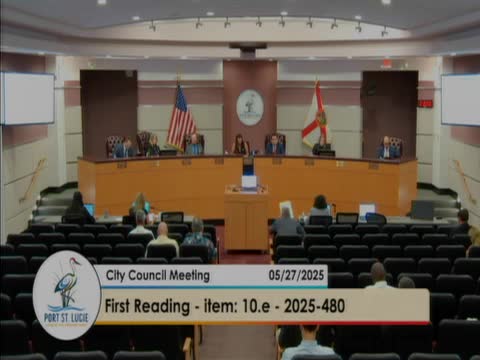
An amendment to the Riverland Master Sign Program (Ordinance 25-31) cleared first reading on May 27 after council members raised questions about digital signage, temporary banners and how the program would operate once private property owners and POAs assume control.
Daniel Robinson of the Planning and Zoning Department told council the amendment consolidates categories, adds nonresidential sign regulations for Riverland’s first commercial areas and updates wayfinding and temporary sign provisions. “The proposed master sign program amendment removes the requirement for that review board,” Robinson said, describing changes intended to streamline review as the development moves from build-out to property-owner oversight.
Council members expressed concern that the amendment could create a precedent by allowing larger digital signs and broader use of temporary banners in areas visible to the public. One councilor asked where digital, changeable-copy signs would be allowed and noted they appeared to be larger than institutional signs normally permitted. Robinson said the digital signage language mirrors the Tradition master sign program and is intended for the development’s commercial parcels. “If I'm correct, the verbiage doesn't allow any moving, pictures or anything. It is just 3 lines of, words, letters, text,” Robinson said, describing operational limits on animated content.
City staff and the applicant also discussed temporary nonresidential banners, feather flags and model-home exemptions. Council member remarks highlighted uncertainty about whether the city’s sign code already allows certain temporary flags and whether the master sign program should include explicit timeline limits and hurricane‑season structural guidance for temporary materials.
Lena Goldstein, speaking for the applicant, said the master sign program was drafted after reviewing neighboring DRI programs and working with the city attorney’s office to address issues staff had seen in other developments. Goldstein said the applicant expects a property-owner association to manage many fine-grained decisions after the ordinance is adopted and that the city’s ordinance must remain general to avoid constitutional content-based restrictions.
Elizabeth (city counsel) clarified that the master sign program functions like a PUD for signage — a regulatory framework the city adopts that typically leaves detailed aesthetic control to private POA rules and leases.
Council members voted to approve Ordinance 25-31 on first reading. Several members asked staff to return with clarified standards (for example, explicit limits on digital-copy content and proposed time limits or removal requirements for temporary banners) before second reading so the council can resolve precedent and public‑right‑of‑way concerns.