Get Full Government Meeting Transcripts, Videos, & Alerts Forever!
Get email alerts on the Transmission Line topic
No spam. Unsubscribe anytime.
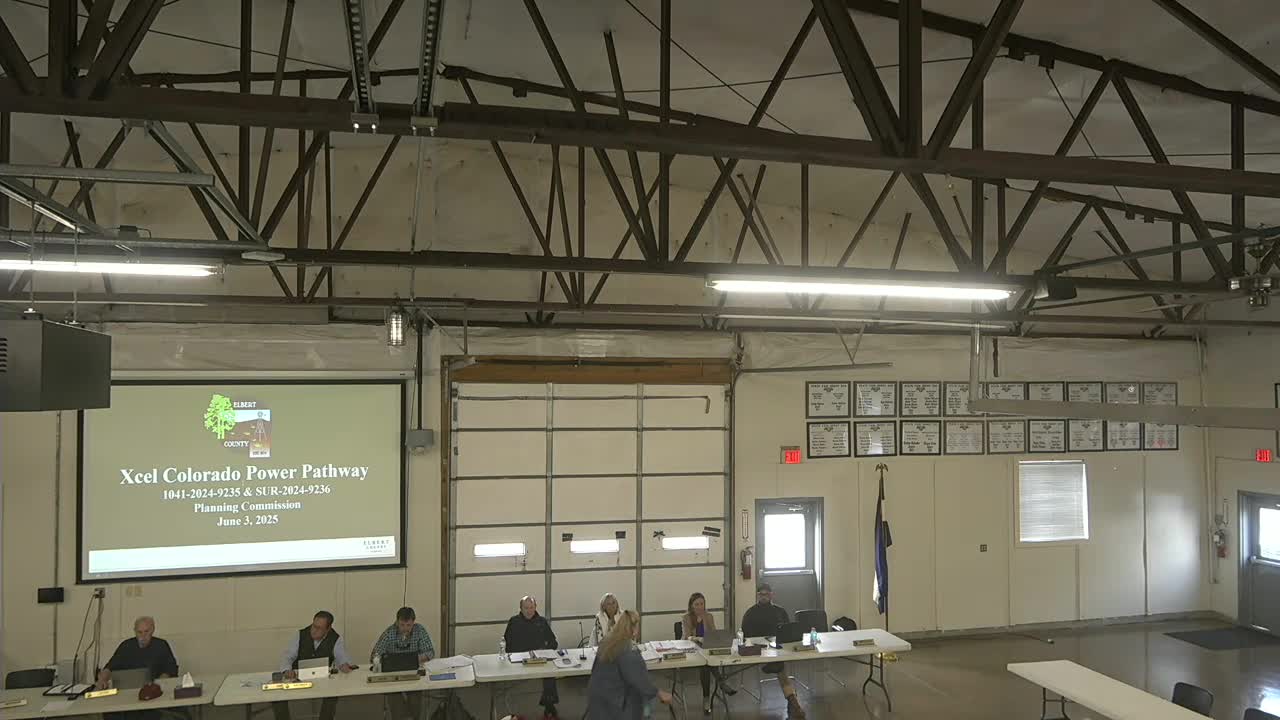
Elbert County planning commission recommends denial of Xcel Energy Colorado Pathways permits after hours of testimony
Summary
The Elbert County Planning Commission voted 9-0 to recommend denial of Xcel Energy's 1041 and Special Use by Review permits for the Colorado Pathways transmission line through Elbert County after hours of testimony, technical questioning, and staff findings that permit packets remained incomplete.
The Elbert County Planning Commission voted 9-0 on May 27 to recommend denial of Xcel Energy's major 1041 permit (1041-2024-9235) and its Special Use by Review (SUR-2024-9236) for the Colorado Pathways transmission project through Elbert County. The motions, carried in separate roll calls, concluded a board-only discussion after public comment had closed and after multiple hours of technical questioning of the applicant and staff.
The recommendation to deny the permits follows extensive questioning by commissioners on route selection, eminent domain, environmental and wildlife surveys, fire mitigation, local economic benefits, and the state statutes cited by the company for condemnation authority. Staff and several commissioners told the commission the SUR and 1041 packets remained incomplete for Elbert County review, and that agency referral issues were unresolved.
Why it matters: The Colorado Pathways project is a multi-segment transmission build Xcel and partners have advanced through the state Public Utilities Commission (PUC). County land-use approval is required for the route through Elbert County even though the PUC process determines that there is a statewide need. A recommendation for denial from the planning commission is advisory to the Board of County Commissioners (BOCC); the county and applicant have a July 10 procedural timeline they referenced during the meeting.
What the planning commission heard
Commissioners and community members raised repeated concerns about visual impacts and the accuracy of the applicant's visual simulations (KOPs). Commissioners said one simulation near Highway 86 under-represented nearby residences, and that short-distance visual impacts were not clearly shown.
On the project's purpose and routing, Parker Rosack, identified in the hearing as a senior manager of transmission engineering for the applicant, said segment 5 was designed to bring generation and redundancy from the southeastern part of the state into the Front Range and to provide alternate pathways if outages occur. Rosack acknowledged the route was chosen after balancing many factors and said the project team had studied hundreds of route miles and that parallel or adjacent routing was sometimes infeasible because of existing encroachments, conservation easements and other constraints.
The applicant also testified about grid planning context: Rosack and other company witnesses said the project supports replacement and integration of inverter-based resources (solar and wind) as legacy thermal units retire, and they described an ongoing clean energy solicitation process to replace retiring generation in coming years. The applicant said parts of the overall Pathways program have been constructed in other counties and that permitting, land acquisition and construction scheduling typically overlap.
Eminent domain and land-rights status
Commissioners pressed the company on condemnation. An applicant representative said the company has filed condemnation cases on 13 Elbert County landowners. Across Elbert County, the applicant reported it has easements on roughly 27 properties, is negotiating with a small number (about eight) of additional owners, and that approximately 48 properties in the county are affected by the route (figures stated by the applicant during the hearing). The applicant described standard negotiation steps: notice of intent, final offer letters, appraisal offers at company expense and continued attempts to settle outside court where possible.
Commissioners asked the applicant to identify the statutory authority for eminent domain. The applicant cited Colorado statutes relating to rights-of-way and eminent domain for utilities, referencing Title 38 (articles 4 and 5) and related citations the company supplied in the hearing transcript (the representative referenced CRS citations including, by transcript, section numbers read as "Title 38, articles 4 and 5" and specific mentions of statute numbers the applicant said they would provide).
Environmental, wildlife and cultural resource issues
Commissioners and referral agencies asked about natural-resource surveys. The applicant said it uses consultants (the packet materials identify Tetra Tech) to conduct natural-resource and cultural-resource reviews. For species protections, the applicant told the commission that targeted, pre-construction surveys and seasonal avoidance measures would be conducted where access permits; examples included raptor, burrowing owl and mule deer considerations and timing windows. The applicant said some resource-specific surveys occur closer to construction and depend on landowner access and survey seasonality.
Cultural-resource records searches were described as completed in the routing process; the applicant said sensitive archaeological resource details are protected from public circulation but that the project team would design around identified resources where avoidance is necessary.
Fire risk, mitigation and local emergency services
The commission heard repeated questions about wildfire risk and how the company would coordinate with local fire districts. The applicant said it maintains statewide wildfire mitigation planning for its facilities, has shared wildfire mitigation materials with the county, meets with local fire districts and is open to additional coordination. Company representatives said they would comply with lawful fee schedules or mitigation requirements established by fire districts in accordance with Colorado statutes, and that some requests from districts could be considered through negotiation if they align with state law.
Local impacts, taxes and fees
Commissioners questioned the applicant about local economic benefits and taxes. The applicant said the project produces tax revenue and estimated a 2% construction-fee amount under Elbert County's code; the company provided an Elbert County construction-cost estimate for the portion of the project in the county at $127,488,931 and told the commission a 2% SUR/construction fee calculation of that estimate equals roughly $2.5 million (figure provided by the applicant). Commissioners noted they had county treasurer figures that differed from some company property-tax statements and asked the applicant to confirm current tax data.
Other technical and schedule details
- The applicant said the full Pathways build is a multibillion-dollar program; the figure cited in the hearing for total program cost was roughly $1.7 billion (applicant-provided program estimate). - The applicant reported a total of about 275 transmission structures for the broader route (projectwide) and typical structure spans near 950 feet, numbers provided in the hearing. - The applicant described an Elbert County construction window beginning in 2026 (the company stated a Q3 2026 start in county construction) and completing in 2027 (completion projected in mid-2027 subject to permitting and land-rights timing).
Formal action
The planning commission took two separate recorded votes requesting denial and moved both recommendations forward to the BOCC. The motions and results recorded during the hearing were: - 1041 permit (1041-2024-9235): Motion to recommend denial carried on a roll-call vote, 9 ayes, 0 nays. Commissioners voting aye on the recommendation were Diana Edstrom, Dan McCallum, Kyle Denardo, Nicole Hunt, John Gresham, Didi Schott Grace, Van Sands, Robert Polodick and Kevin Kirkwood. The motion as presented found the application failed to demonstrate compliance with applicable Elbert County zoning approval criteria cited at the hearing. - Special Use by Review (SUR-2024-9236): Motion to recommend denial carried on a roll-call vote, 9 ayes, 0 nays. The same nine commissioners recorded aye votes.
What the recommendation means
A planning commission recommendation is advisory to the Board of County Commissioners, which will consider the record and the planning commission's action. The applicant and county referenced an internal procedural timeline that contemplates BOCC consideration; the applicant also noted that if local land-use applications are denied, the company may evaluate options available under the PUC process and state law, including potential appeals. The applicant stated that it prefers to settle land-rights issues voluntarily but will file condemnation actions when negotiations do not produce agreements and when land rights are needed to support schedule and construction milestones.
Next steps and outstanding items
Commissioners and staff listed outstanding items they expect answered before final BOCC action: signed fire-protection agreements from local fire districts (required for a complete SUR packet by Elbert County standards), updates to tax and construction-cost documentation, final natural-resource surveys where access permits, and resolution of several referral-agency questions. County staff told commissioners the SUR was missing required, completed forms from some fire districts and described those absent items as part of the basis for incompleteness.
Ending
The commission's unanimous recommendation for denial will be transmitted to the Board of County Commissioners with the hearing record, staff reports and referral responses. The BOCC will review the planning commission's recommendation and the outstanding agency and application issues before making a final county decision. The applicant indicated it will continue to pursue land-rights negotiations and to coordinate with Elbert County agencies as the process continues.
Speakers quoted or referenced in this article include Parker Rosack (senior manager, transmission engineering, applicant); Tom Hamilton (JLL Valuation Advisory Services); Elbert County planning commissioners Diana Edstrom, Dan McCallum, Kyle Denardo, Nicole Hunt, John Gresham, Didi Schott Grace, Van Sands, Robert Polodick and Kevin Kirkwood; and multiple applicant representatives and county staff who provided testimony in the public hearing and staff referral responses.