Get Full Government Meeting Transcripts, Videos, & Alerts Forever!
Get email alerts on the Transmission Infrastructure topic
No spam. Unsubscribe anytime.
Elbert County planning commission hears public opposition, staff recommends denial for Xcel Energy transmission route
Summary
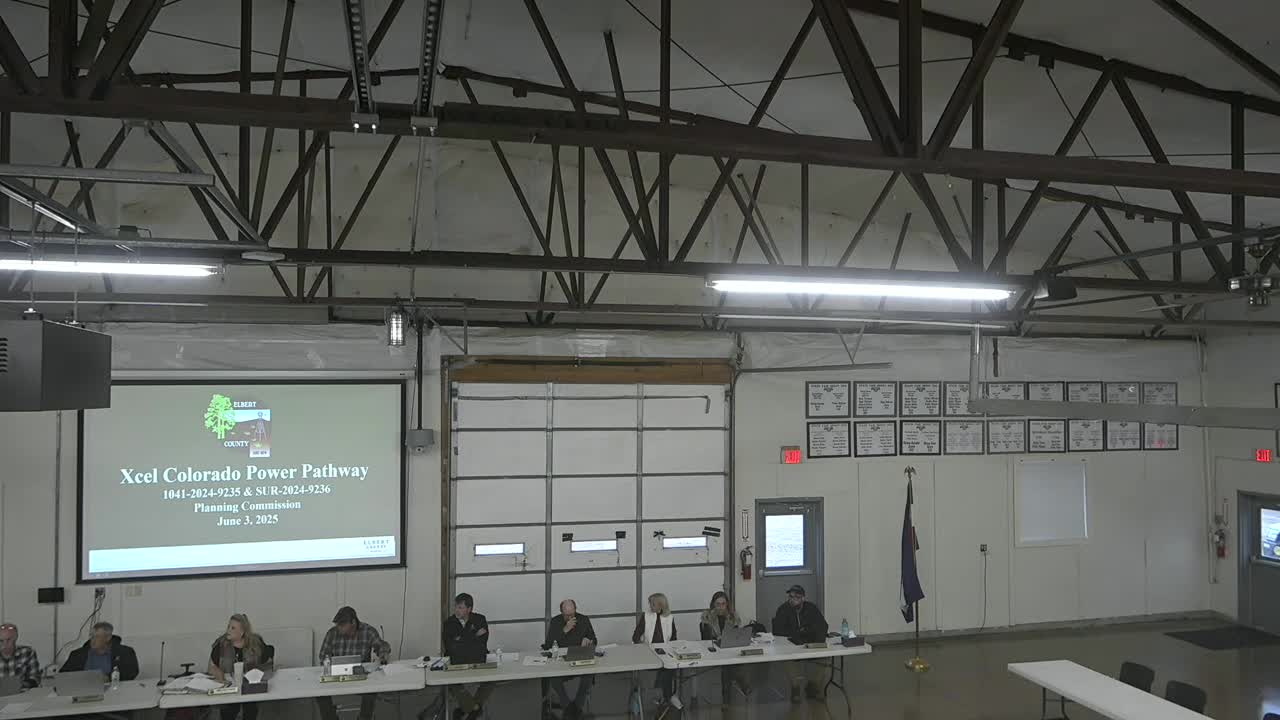
Elbert County planning commissioners on June 3 heard hours of public comment on Xcel Energy’s proposed segment of the Colorado Pathway transmission project and from staff received a formal recommendation to deny the company’s permit applications.
Elbert County planning commissioners on June 3 heard hours of public comment on Xcel Energy’s proposed segment of the Colorado Pathway transmission project and from staff received a formal recommendation to deny the company’s permit applications.
Stephanie Blachoviak, a certified land-use planner with SWCA Environmental Consultants contracted by Elbert County, told the commission that staff found multiple approval criteria for the county’s major 1041 permit and special-use review were not adequately addressed. "Staff recommends the Planning Commission make a recommendation of denial for the Excel Colorado Power Pathway major 1041 permit application," Blachoviak said, and repeated that recommendation for the county SUR (special use review) application.
Why it matters: The project would place about 48 miles of new 345-kilovolt, double-circuit transmission line across largely agricultural and rural-residential zones in Elbert County. Staff told commissioners that unresolved items—chiefly signed fire-prevention agreements with local volunteer fire districts, a sufficient analysis of wildfire risk and the potential fiscal burden for local emergency services—left the county unable to find several statutory approval criteria met.
What staff said: Blachoviak summarized technical elements of the application and the county review. The submitted route crosses primarily A (agriculture) and RA (residential-agriculture) zoning and would use typical monopole steel structures 105 to 140 feet tall within a 150-foot-wide right of way. Staff reported the applicant identified roughly 275 new steel poles in-county, about 310 acres of temporary construction disturbance and about 97 acres of permanent disturbance (figures given by staff as approximate). Blachoviak said the applicant had not provided signed fire-prevention and safety agreement forms from Kiowa and Big Sandy fire protection districts; staff described unresolved comments from the county OEM (Office of Emergency Management), CDPHE (Colorado Department of Public Health and Environment) and county public works on road use and air-quality permitting.
What the applicant said: Andrew Holder, director of community relations and local government affairs for Xcel Energy Colorado, and other company subject-matter experts presented the project and defended the route and project benefits. "This is a $1,700,000,000 investment for a double circuit 345 kilovolt transmission line," Holder said. Company presenters said the line is intended to improve statewide grid reliability, that the route was selected after a multi-year routing and siting study, and that Xcel has performed multiple public meetings and stakeholder outreach in Elbert County. The applicant also noted an anticipated local impact fee (staff estimated about $2.5 million) and regular property-tax payments by the utility.
What residents told commissioners: More than three dozen members of the public spoke. Common themes were wildfire risk, emergency-response capacity, visual impacts, declines in property values, and concern about eminent-domain proceedings and negotiating leverage. Speakers recounted a long local outreach process and numerous community meetings and repeatedly urged the commission to follow staff’s recommendation.
Representative public comments included:
- Peggy Patzkowski, who said the route would "destroy the view shed for many miles in all directions," and described long-term noise and quality-of-life effects she expects near towers and easements.
- Eric Giblets said landowners face legal and financial pressure, and criticized Xcel for using eminent-domain litigation: "Excel will tell you that 44% of the land owners have signed lease options with them. We tell you that that is because most of them cannot afford legal representation to oppose excels use of force and imminent domain," he said.
- Multiple speakers with firefighting experience and volunteers described limited local firefighting capacity and warned that transmission infrastructure can complicate aerial and ground suppression efforts.
Technical and regulatory points raised at the hearing:
- Fire protection: County staff and numerous public commenters said the county has not received signed fire-prevention and safety agreements from Kiowa and Big Sandy fire protection districts and remains without the level of analysis staff requested to evaluate fire behavior and the effect on local suppression capacity. Staff cited sections of the Elbert County Zoning Regulations (ECZR article 2B and 2H, and article 17/"county 1041 regulations") that require proof of fire protection as part of the SUR application.
- Outstanding referral comments: Staff listed unresolved referral comments from NRCS (wetland easement crossing concerns), CDPHE (air-quality questions), Elbert County Public Works (road-use and development agreements), and cores such as Core Electric and local school districts (proximity and safety). The applicant said in its response letter it had addressed many referral comments and met with agencies, and that some agreements (for example, road-use agreements) are in progress.
- Undergrounding: Many members of the public urged burying the line. Xcel representatives said undergrounding 345 kV transmission is technically and economically different from burying lower‑voltage distribution lines and pointed to regulatory findings in the CPCN (PUC) record that undergrounding the entire route is not a prudent use of ratepayer funds; they also noted undergrounding introduces other environmental and construction impacts (transition stations, excavation footprint) and would shift costs.
- Health and EMF questions: Xcel referenced PUC-required magnetic-field and noise studies included in its regulatory filings, and presented graphics showing modeled magnetic-field levels decline to background at right-of-way edges. Some residents cited recent journal and epidemiology reports and asked for fuller local study; staff and the applicant said federal, state and PUC safety standards and prior CPCN review inform the technical analysis.
Procedural outcome and next steps: Commissioners declined to decide the merits that night and voted to continue the hearing to a continuation meeting at 6 p.m. on June 4 so commissioners can ask additional questions and receive more responses from the applicant and staff. The motion to continue was moved, seconded and approved by the commission.
Context and balance: The Colorado Pathway is a multi-segment, statewide transmission program that the applicant and the PUC have said will increase grid reliability across multiple counties. At the same time, Elbert County staff applied local standards in recommending denial, citing gaps in the application’s local public-safety, road-use and agency coordination documentation. Commissioners must now weigh county code standards and local public-safety concerns against the applicant’s larger grid-reliability arguments and the CPCN issued by the Colorado Public Utilities Commission.
What’s next: The planning commission will reconvene on the scheduled continuation date for additional questions and evidence. Any recommendation the commission makes will be forwarded to the Elbert County Board of County Commissioners for a final decision. The applicant said material shown in the evening’s applicant presentation that was not previously in the packet will be posted to the public record.
Ending: Commissioners and staff stressed that the hearing is a quasi‑judicial review and that their recommendation will reflect whether local approval criteria in the Elbert County Zoning Regulations are met. Community members urged denial; the applicant urged the commission to consider statewide grid reliability and local mitigation commitments. The commission continued the record and will reconvene to allow further inquiry before making a recommendation to the Board of County Commissioners.