Get Full Government Meeting Transcripts, Videos, & Alerts Forever!
Get email alerts on the Public Records Fees topic
No spam. Unsubscribe anytime.
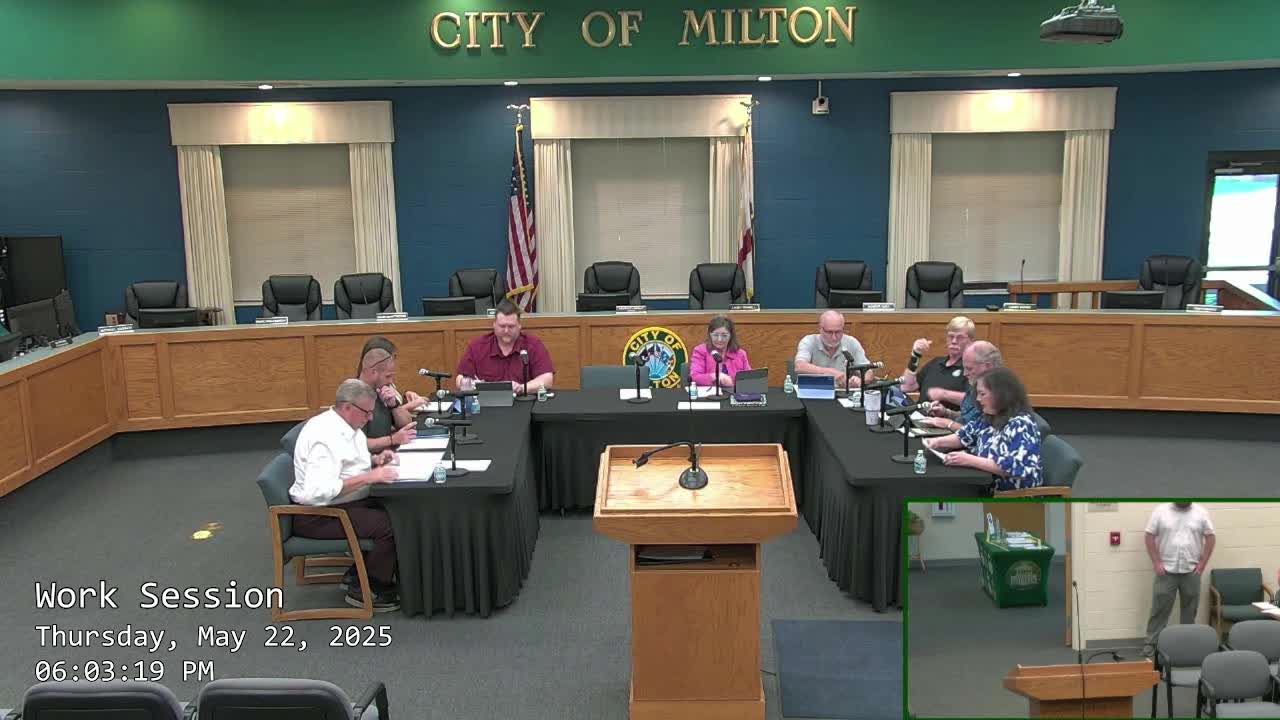
Milton council coalesces around $25 hourly cap for public-records requests
Summary
City councilors asked staff to return a marked-up public-records policy capping charges at $25 per hour after a 30‑minute free review window, and to require written requester authorization before staff proceeds when estimated costs exceed the cap.
The Milton City Council directed staff to return a marked-up public-records policy that would set a $25 hourly cap for labor on records requests after the first 30 minutes free, and require written requester authorization before staff proceeds when estimated costs would exceed the cap.
The change came after council members and members of the public described past invoices they said were prohibitively high. “It was $2,788 and it was right at the beginning of, the controversy about the new sewer plant,” said Pam Mitchell, a member of the public, referring to an invoice she received for requested grant materials. Molly, the city clerk, described the city’s request system and said the software NextRequest allows direct communication with requesters to narrow scope and avoid unnecessary charges.
Council discussion focused on balancing access to records with the real internal cost of fulfilling broad requests. Councilmember Lee said he wanted to ‘‘put a cap on it, so that no member of the public gets a $1,700 fee ever again or a $2,700 fee.’’ Other councilmembers suggested the hourly cap should apply to the lowest-cost employee able to fulfill the request, and that a full-day cap (an eight-hour cap equating to about $200) could be used as a limit beyond which staff must notify and receive written authorization from the requester.
City Clerk Molly explained that high bills typically arise when IT must extract years of emails or when multiple employees’ files are included in one request. She said most city records are subject to retention schedules and often older material has already been deleted, which limits scope in some cases. Multiple councilmembers and residents urged staff to include inspection rights in the updated policy so requesters may review records and reduce copying costs.
Councilmembers and staff reached a working consensus that staff should draft a revised public-records policy implementing the $25 hourly cap (first 30 minutes free), requiring staff to contact requesters before proceeding on work that will exceed the cap or a defined total-estimate threshold, and to return the marked-up policy at the next council meeting for formal approval. No formal roll-call vote was recorded in the work session minutes.
The policy revision will also clarify that, where possible, the lowest-cost employee capable of performing the search will be used and that media/drive costs will be charged at actual cost. Staff said they will return a revised policy and suggested periodic review of the policy at a stated future date.
The council’s discussion included references to sample policies from Destin, Fort Walton Beach and Gulf Breeze and the state statutes governing public records and retention schedules. Members emphasized that the goal was to prevent prior large invoices that residents said deterred public-records use while preserving staff capacity to carry out essential city work.
Councilman Spears said, “So we'll bring back a marked up, policy for you at $25 per hour after 30 minutes of service,” summarizing the direction to staff.
If adopted, the draft will be returned for formal adoption and will include procedures for staff to contact requesters with written cost estimates when a request is estimated to exceed the threshold.