Get Full Government Meeting Transcripts, Videos, & Alerts Forever!
Get email alerts on the Open Meetings Quorum topic
No spam. Unsubscribe anytime.
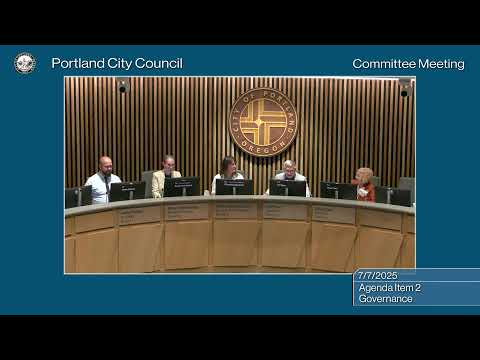
Governance committee weighs limits of Oregon public meetings law: tours, joint meetings and social media
Summary
Portland’s governance committee discussed how Oregon’s new public meetings rules affect committee field trips, overlapping committee meetings and councilors’ social media interactions during a July 7 meeting; city attorney staff advised caution where a quorum could prompt notice requirements or be viewed as deliberation.
Portland’s governance committee discussed how recent Oregon public-meetings rules apply to on-site inspections, joint committee meetings and social-media communications at its July 7 session.
The guidance presented to the committee explains that on-site inspections or tours may be attended by a quorum so long as participants avoid deliberation and do not receive information that would lead decision making, a City Attorney’s Office attorney said. The committee’s debate focused on what kinds of interactions would cross the line into a meeting that must be publicly noticed.
The document under review is a do’s-and-don’ts list prepared by the City Attorney’s Office to help councilors comply with state law, including statutory changes tied to House Bill 2805. The document’s author, an attorney in the City Attorney’s Office, told the committee: "you're allowed to do those with a quorum so long as there's no deliberations." Committee members asked for clarifications and suggested the material be circulated to all council offices.
Why it matters: councilors said the new rules create friction with customary practices — including committee field trips and informal information-seeking among colleagues — and that uncertainty could chill ordinary communications or require more formal notice and participation options for the public.
What committee members asked and what staff advised
- On-site inspections/tours: Councilors asked whether committee tours of facilities count as on-site inspections that a quorum may attend. The City Attorney’s Office attorney said tours are allowed with a quorum provided participants do not deliberate or receive briefing information that would steer decision making; if participants discuss policy during the tour, that could constitute a public meeting that should have been noticed.
- Joint committee meetings: Members explored whether two committees can meet together. Legal staff advised that if a quorum of the full council or a quorum of a committee will be present and the conversation addresses council business, the gathering will likely need to be noticed as a public meeting (for example, as a full-council work session) so the public can attend.
- Social media and serial communications: Several councilors raised concerns about social-media interactions and whether tags or sequential messages among councilors could be treated as prohibited serial communications under the law. A committee member said the statute’s complaint-driven enforcement mechanism creates a persistent legal risk and urged coordination with the League of Oregon Cities on potential challenges.
Committee next steps
Members suggested circulating the do’s-and-don’ts list to all council offices and adding clarifying footnotes (for example, explaining when an on-site inspection requires public notice). The chair said the document would be shared more broadly and that the City Attorney’s Office would accept feedback for revisions.
The committee scheduled its next governance meeting for July 21 and asked staff to return with options for formalizing guidance into the committee’s governance materials.
Sources and context
The discussion cited House Bill 2805 and referenced the Oregon Government Ethics Commission (OGEC) as part of the enforcement and interpretive environment. Committee members and staff repeatedly emphasized that the law is new and being interpreted in real time, and they recommended training for councilors on public-meetings requirements.