Get Full Government Meeting Transcripts, Videos, & Alerts Forever!
Get email alerts on the Housing And Development topic
No spam. Unsubscribe anytime.
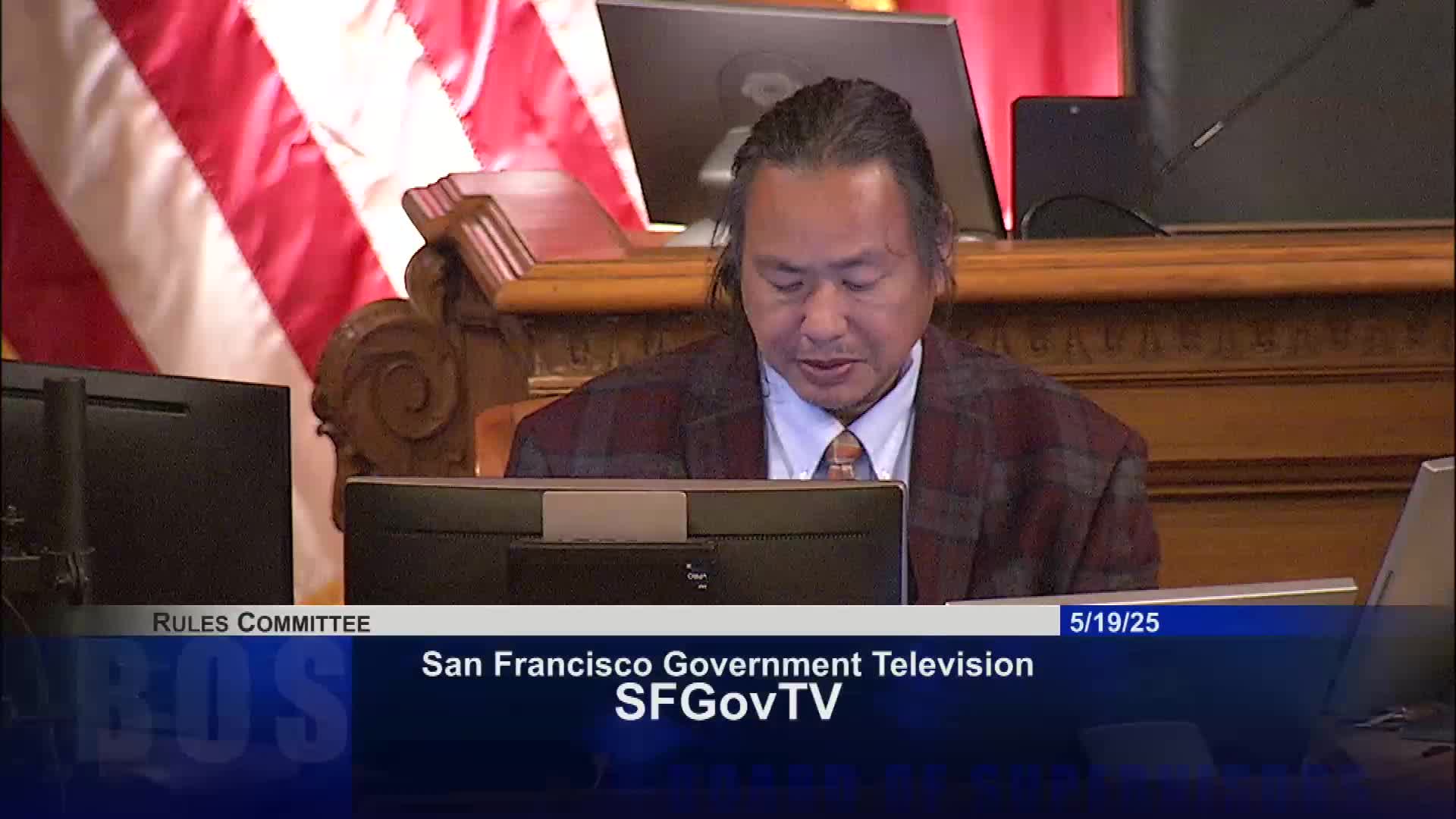
Rules Committee backs ordinance to form Downtown Revitalization Financing District under AB 2488
Summary
The San Francisco Board of Supervisors Rules Committee voted unanimously to send an ordinance to the full board that would establish and define the board of directors for a Downtown Revitalization and Economic Recovery Financing District enabled by state law AB 2488.
The San Francisco Board of Supervisors Rules Committee voted unanimously to send an ordinance to the full board that would establish and define the board of directors for a Downtown Revitalization and Economic Recovery Financing District enabled by state law AB 2488.
The ordinance, sponsored by Supervisor Dorsey and co-sponsored by Mayor London Breed and other supervisors, would create a separate district board to oversee a financing plan that can divert incremental property tax generated by office-to-residential or commercial-to-residential conversions back to those projects for up to 30 years. The committee vote to transmit the ordinance to the full board passed without objection.
The district would apply to a defined downtown boundary and is intended to incentivize adaptive reuse projects by returning incremental tax revenue to developers who opt into the program. Jacob Bentliff of the Office of Economic and Workforce Development (OEWD) told the committee that preliminary consultant analysis identified roughly 50 commercial properties within the proposed district that could be suitable for conversion and estimated the potential to produce about 4,400 housing units.
Under the ordinance, the district’s board of directors would be a separate public entity subject to the Brown Act and the local Sunshine Ordinance. The board would be composed of five members and one alternate: three board of supervisors members (one designated alternate) appointed by the president of the Board of Supervisors, and two community members nominated by the president and appointed by the board through the rules committee process. Members would generally have four-year terms, with one supervisor and one community member initially appointed to two-year terms to stagger terms.
OEWD and the district board would be responsible for drafting and holding two public hearings on a district financing plan and presenting that plan to the Board of Supervisors for adoption; only after the board adopts the plan could the district board hold a final hearing and formally form the district. Projects must opt into the program by the end of 2032, Bentliff said.
The clerk of the board would provide administrative and clerical support for the district; Alyssa Samara and Dr. Edward Diasus from the Clerk’s Office told the committee the office expects an initial annual cost of roughly $130,000 to administer the board. That estimate assumes approximately four meetings per year and covers staffing, interpretation and translation, meeting broadcasting, noticing and other administrative work. The clerk’s office said the ordinance allows the district to reimburse administrative costs, but revenue would not be available until projects reach final completion — a gap estimated by staff at three to five years — so the clerk’s office plans a budget request in June to advance startup funding.
Supervisor Sauter cited a recent study saying the district could convert about 49 buildings and generate roughly $15,500,000 per year in incremental tax revenue if conversions proceed. Committee members and public commenters, including Mark Babson of Emerald Fund, Erica Macleod of SPUR, and Brianna Morales of the Housing Action Coalition, expressed support for the ordinance and for using the financing tool to spur conversions and downtown recovery.
The committee recorded the motion to approve the ordinance and send it to the full board with a positive recommendation; Vice Chair Cheryl, Member Dorsey and Chair Walton voted aye and the motion passed without objection.
Next steps outlined by staff include the Board of Supervisors adopting a resolution of intention (noted for the upcoming Budget & Finance Committee hearing) and, if transmitted and adopted, formation of the district board within the timeline set by the ordinance. The committee also discussed tracking departmental time for later reimbursement and continued coordination among OEWD, the Clerk’s Office and the Controller’s Office to scope administrative burdens and costs.