Get Full Government Meeting Transcripts, Videos, & Alerts Forever!
Get email alerts on the Infrastructure Dams topic
No spam. Unsubscribe anytime.
Big Creek Dam 30% design estimates ~$185 million; staff pauses 60% work pending studies
Summary
Newport City staff and HDR consultants presented a 30% design update for the Big Creek Dam replacement project at a council work session, saying new geotechnical and seismic findings and material cost increases have pushed the project's total project estimate to about $185 million.
Newport City staff and HDR consultants presented a 30% design update for the Big Creek Dam replacement project at a council work session, saying new geotechnical and seismic findings and material cost increases have pushed the project's total project estimate to about $185 million. Verena Winter, project manager for HDR, led the presentation and warned that technical challenges are translating directly into higher costs.
The update matters because the Big Creek reservoirs are the city's only drinking water source and both dams are classified by the Oregon Water Resources Department Office of Dam Safety as 'potentially unsafe' (the upper dam is classified as unsafe), the consultants noted. Winter said the classification and seismic risk are driving design choices; Adam Toothman, HDR's structural engineer and engineer of record, described a roller‑compacted concrete dam chosen because concrete has historically performed better in high seismic areas.
The consultants said the 30% package includes major project components: dam cross sections, intake and outlet layouts, temporary and permanent access roads, stream restoration upstream to the treatment plant, and a revised cost estimate based on the 30% design. Winter said the package delivered to the city in January included roughly 150 drawings and supporting reports outlining assumptions and analyses.
Cost and contingencies. HDR's updated accounting separates a hypothetical construction contract from additional contingencies and non‑contract costs. The firm's 30% estimate produced a notional construction contract amount of about $122 million; after adding a design contingency (10%) and a procurement/contract strategy allowance (5%), HDR presented a construction award estimate near $140 million. A 10% construction contingency raised that number to about $154 million, and HDR added roughly 20% for non‑contract costs (construction oversight, permitting, potential land acquisition, legal and additional environmental work) to arrive at a total project estimate HDR reported as about $185 million. HDR said the figure is a planning‑level estimate and carries a typical plus/minus range at this design stage.
Design drivers and risks. Toothman and other HDR staff said two technical areas account for much of the cost increase: (1) high seismic loads across the site, and (2) poorer‑than‑expected foundation rock on the dam's right abutment that requires deeper excavation and more concrete. Toothman said the right side of the site has layered, weaker rock that requires a larger footprint and added material to spread seismic loads. Winter and Jeff Allen, HDR's constructability engineer and cost estimator, also cited dewatering challenges, rising concrete‑input costs and supply issues (for example, reduced availability of fly ash) as upward pressures on cost.
"We are running into a few technical challenges which, directly translate into the cost," Winter said. Toothman added that because much of the dam will be built down to "good rock," parts of the structure would be underground in the finished condition, increasing excavation and material needs.
Data gaps and next steps. HDR described remaining geotechnical gaps, especially on the right abutment, and recommended further targeted borings; consultants said more drilling is possible but seasonally constrained by slope stability and winter conditions. HDR also emphasized that the construction estimate is time‑dependent: the firm escalated historic estimates to a mid‑construction date in late 2027 when preparing its figures and noted typical annual escalation assumptions (HDR suggested 3% as a representative long‑term escalation rate).
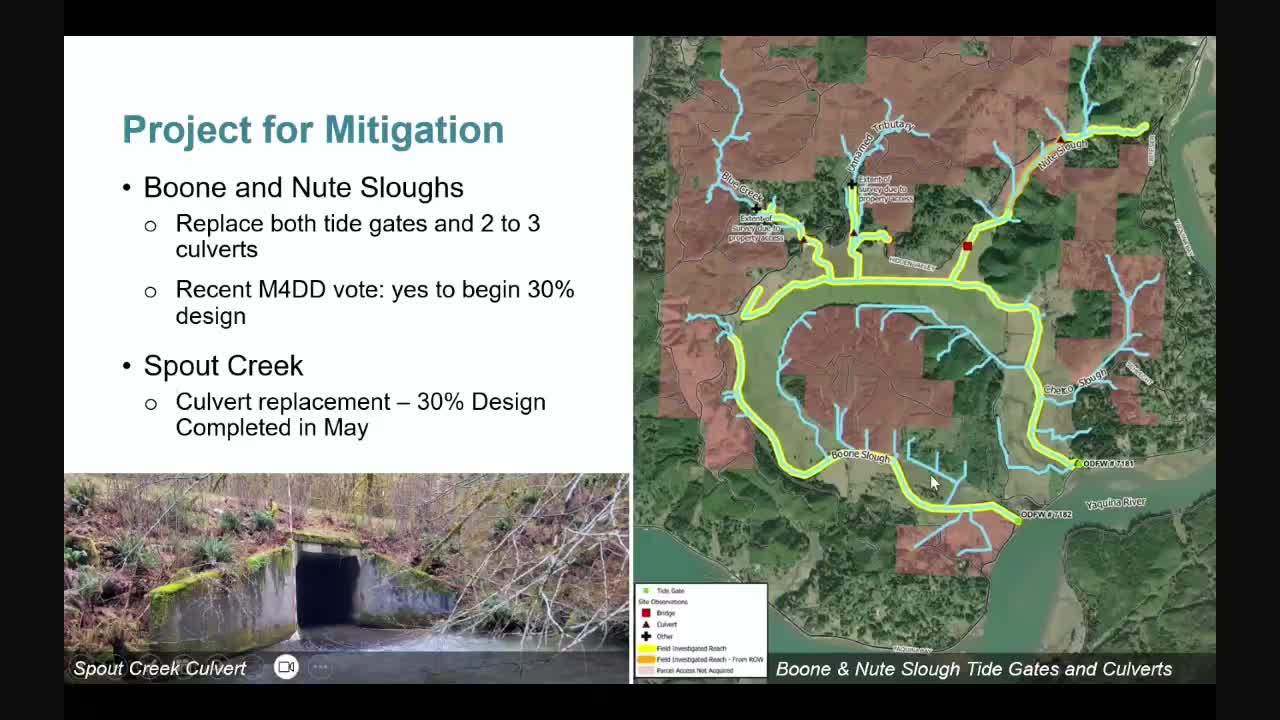
Environmental and regulatory issues. The consultants said they are coordinating with the Oregon Department of Fish and Wildlife (ODFW) on required in‑stream flow determinations, which influence final dam height and total storage. Winter said the team plans to seek a fish‑passage waiver for the existing dam and mitigate elsewhere in the watershed; the team identified two mitigation projects discussed with ODFW and local landowners'replacement work at Boone and Newt Slough and a culvert replacement on Spout Creek. Winter said ODFW has confirmed a mitigation target length (6.38, as discussed during the presentation) focused on cutthroat trout, steelhead, coho and Pacific lamprey.
Permitting. HDR said the project will require NEPA (federal) review and coordination with a range of federal and state agencies; consultants said they are near a complete federal permit package but will not delay ongoing environmental and fish‑passage work because those items are on the project's critical path.
Access and property impacts. Consultants described a new permanent access alignment that will replace portions of existing Big Creek Road that will be inundated by the replacement reservoir. Winter said affected property owners will instead rely on an access route via 30th and Harney; the new permanent access is planned as a gravel road similar to current conditions but routed around the reservoir footprint.
Other items. The team said there is no hydroelectric scope included in the 30% estimate (HDR prepared a memo outlining why turbines were not cost‑effective given seasonal flow patterns), though space in the valve‑house design could accommodate future equipment if the city wanted to reconsider.
Procurement and funding. HDR and Jeff Allen discussed procurement options and recommended evaluating earlier contractor involvement (CMAR/CMGC) to address high‑risk items such as foundation conditions and dewatering. Allen said early contractor involvement can reduce growth through construction by addressing risk with the contractor before award. The city has issued two RFPs: one to develop a funding strategy (HDR noted Stantec was engaged for funding strategy work) and another for an alternatives analysis that will revisit whether a concrete dam remains the best long‑term solution; HDR said both RFPs are expected to complete by year end.
Staff direction. City staff told the council they will pause active work toward a 60% dam design while the in‑stream flow number, the alternatives analysis, and the funding strategy are completed. Winter said environmental, fish‑passage and material‑sourcing work will continue because those items are on the critical path and a pause there would cause additional schedule delay.
What was not decided. There were no formal council votes recorded in the session on construction contracting, procurement method, or construction funding. Staff said state grant funds support design work (HDR referenced a state appropriation that HDR estimated could carry the city approximately to 60% or further), but the city has not secured construction funding.
The presentation and discussion concluded with council members and staff agreeing to return to the council with results of the in‑stream flow work, the alternatives analysis, and the funding strategy before authorizing further design expenditures or a procurement approach.