Lifetime Citizen Portal Access — AI Briefings, Alerts & Unlimited Follows
Office of Employee Appeals asks for funding for electronic filing, cites rising case complexity
Loading...
Summary
The Office of Employee Appeals told the committee its FY26 proposal would fund a vacant senior administrative assistant and requested one‑time funding to modernize case tracking and support legal training, saying appeals are more complex and hearings longer.
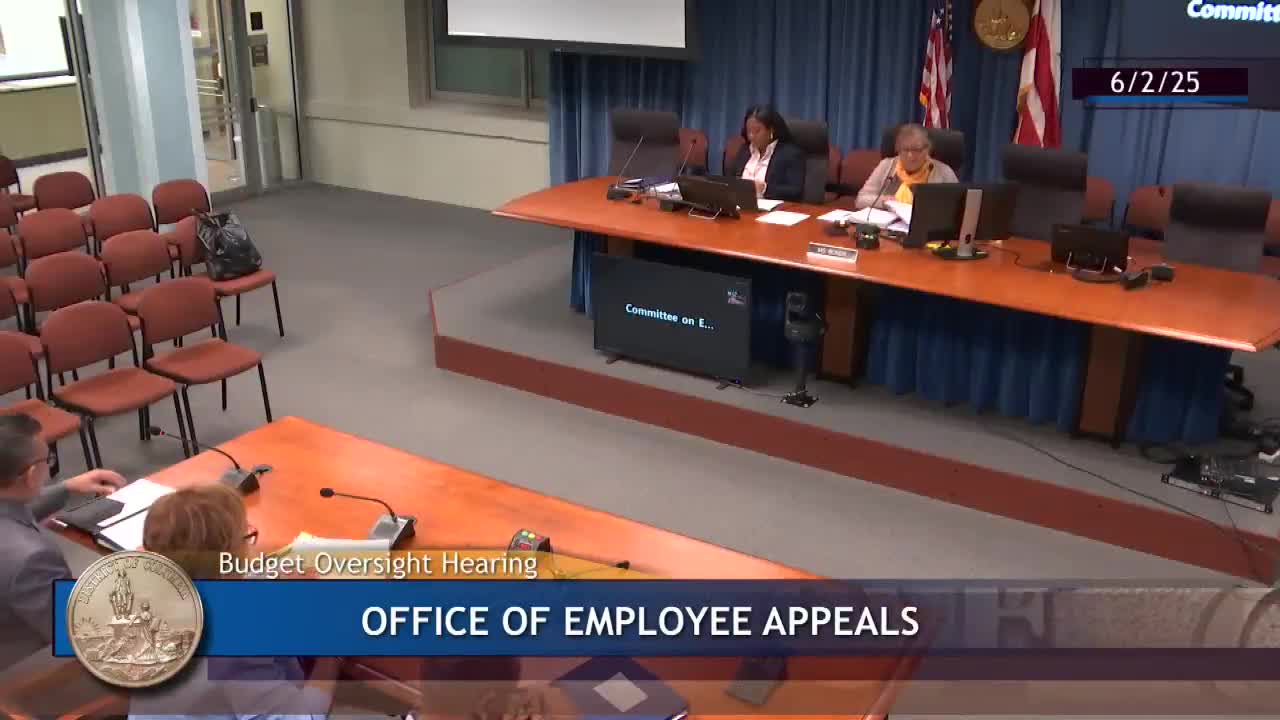
Sheila Barfield, executive director of the Office of Employee Appeals, told the Committee on Executive Administration and Labor that OEA’s FY26 proposed operating budget is $2,541,732 with 14.5 FTEs and that the agency seeks one‑time funds to upgrade its case tracking to full electronic filing.
Barfield said OEA’s mission is to issue impartial decisions for D.C. government employees on adverse actions and other employment disputes. She told the committee OEA submitted enhancement requests: one to fully fund a vacant senior administrative assistant position and another for $253,000 in one‑time funding to obtain full electronic filing capability; a smaller $30,000 one‑time request would fund legal training. Barfield described current stopgap measures — e‑mail transmission for parties who provide email addresses — and said full electronic filing would reduce postage, speed decision issuance and provide real‑time case updates.
Barfield told the committee that appeals are growing more complex and evidentiary hearings are lasting longer, which increases court reporting costs and staffing needs. OEA’s largest recurring contract is court reporting services; the agency expects to fully use its FY25 allocation of $45,000 for court reporting because hearing length and frequency have increased. She also described efforts to issue a quarterly newsletter and to require an email address when parties file if the electronic filing system is established.
Why this matters: OEA adjudicates personnel appeals for the district workforce; modernization and staffing changes could affect the speed and cost of adjudication and the ability of employees and agencies to receive timely decisions.
What the committee recorded: Committee members probed whether law required mailed notices; Barfield said statutes do not explicitly require first‑class mail and that OEA currently uses email when parties provide addresses. Councilmembers asked about mediation, court reporting, FTE allocations across adjudication, administration and mediation, and the costs and procurement model for services used by OEA.
Ending: Barfield said the agency will continue to press for electronic filing and training capacity and that recruitment for a senior administrative assistant is paused under the mayor’s hiring freeze but will be pursued for FY26.