Get Full Government Meeting Transcripts, Videos, & Alerts Forever!
Get email alerts on the Utilities topic
No spam. Unsubscribe anytime.
Allegany County staff propose new nonresidential utility‑rate structure, ask commissioners to consider with next week's budget adoption
Summary
County staff recommended recalculating minimum water/sewer charges for nonresidential accounts, creating usage tiers for large industrial accounts and phasing in changes to limit year‑one increases. They asked commissioners to include the changes with adoption of the utility budget at next week's business meeting.
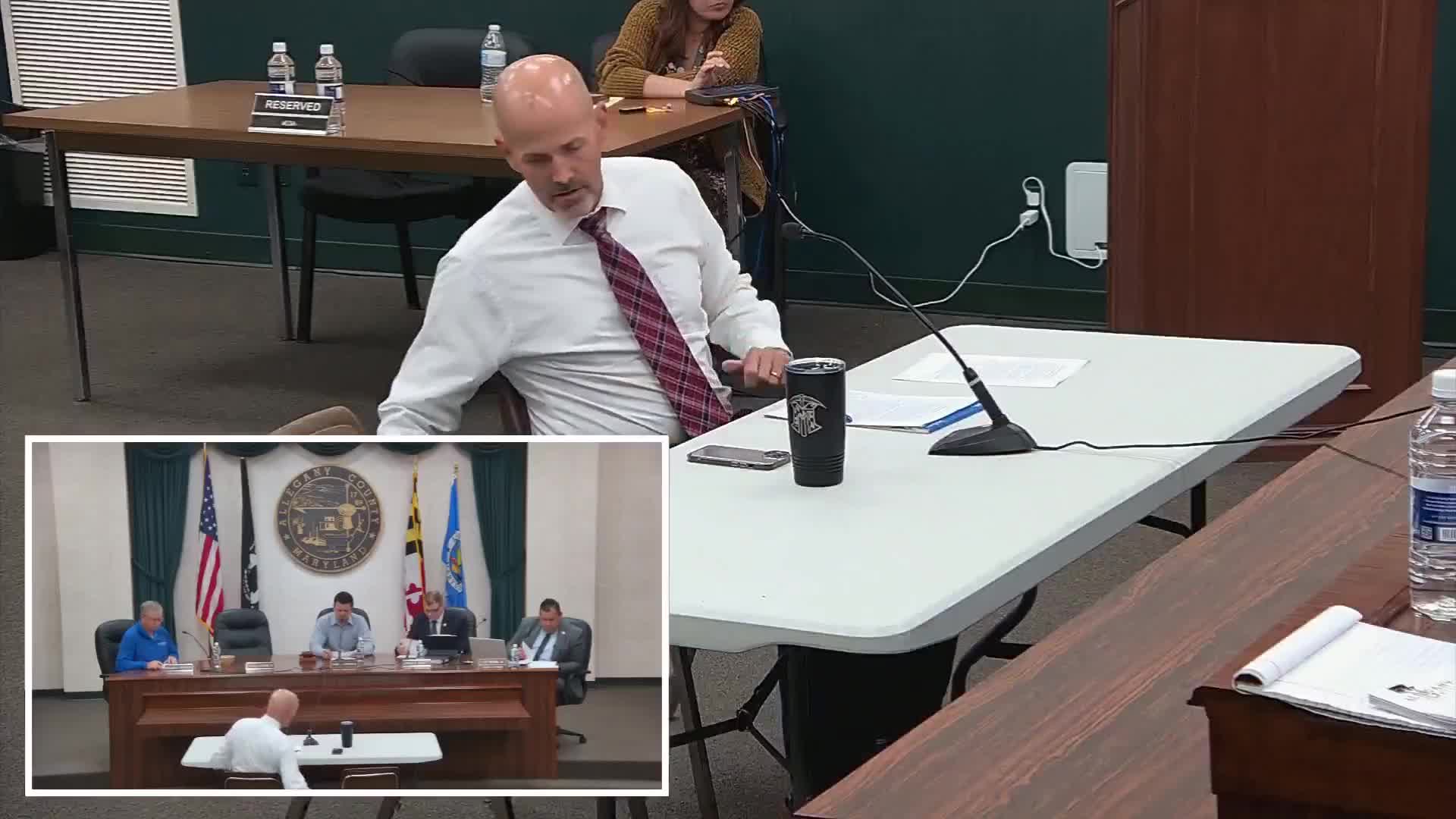
County staff presented recommendations to change how Allegany County bills nonresidential water and sewer customers, asking commissioners to consider adopting the measures as part of the utility budget expected next week. Adam (county staff) said nonresidential accounts make up about 10% of the county's utility accounts and that current billing contains inherited inconsistencies from prior arrangements with municipalities.
Adam outlined the proposed approach: use actual annual usage divided by a fixed household-equivalent to assign minimums (Frostburg uses 38,000 gallons; county households average about 40,000 gallons), reduce the water-side minimums and split them so part is billed on the sewer side, and create three tiers for larger industrial users (under 750,000 gallons, 750,000–10,000,000 gallons, and over 10,000,000 gallons). For the highest two tiers he proposed phasing in 25% of calculated minimums in the first fiscal year. He said apartments and town homes would continue to be assigned minimums per dwelling unit (for example, eight apartments = eight minimums) and noted that sewer is not metered in many cases while water is.
Adam and staff said the approach aims to align nonresidential prices with residential and municipal price‑per‑thousand rates and to remove billing inconsistencies inherited from the Crescent Town system. The presentation included an example: a Frostburg commercial customer whose annual usage equaled 12 of Frostburg's minimums; under the county's proposed change, some commercial accounts could see notable increases in year one (the largest example found was an increase equivalent to 12 water minimums).
Staff asked commissioners to consider the recommendations when they adopt the utility budget at next week's business meeting; no formal vote was taken at the work session. Adam said economic development staff reviewed the proposals and had no major objections; staff also proposed benchmarking final price‑per‑thousand levels against the cities of Frostburg and Cumberland to keep rates comparable.
Discussion-only items included the data basis for the household equivalent (Frostburg: 38,000 gallons; county: about 40,000 gallons), the phased implementation that limits near-term impacts, and the recognition that few customers would be affected but some could see substantial first-year increases. Commissioners did not request additional changes at the work session and directed staff to include the recommendations with the utility budget for formal consideration and adoption at the upcoming meeting.
Staff said they were available for follow-up questions before budget adoption.