
County budget staff recommend $186.7 million in carryforwards; general fund uses $28.5 million
Get AI-powered insights, summaries, and transcripts
Subscribe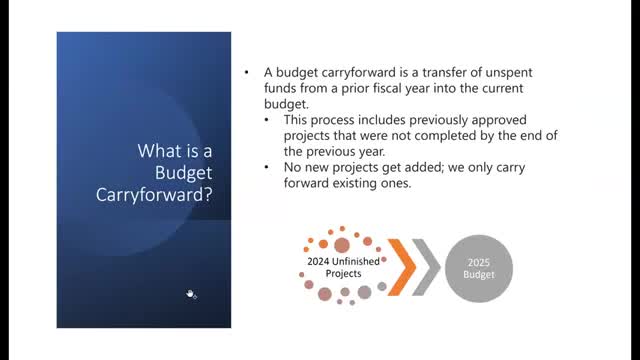
Summary
Budget & Finance staff presented the proposed first 2025 budget amendment to carry forward unfinished projects from 2024. Total carryforward expenditures across funds amount to $186,708,762 with net use of fund balance of $153,952,364; the general fund carryforward request is $28.5 million.
Budget and Finance staff explained the county’s proposed first budget amendment for fiscal year 2025, which would carry forward unspent appropriations for multiyear projects and previously approved items from 2024.
Mark Fluth, a capital projects/budget administrator, told the Board: "What is a carry forward? This is a transfer of unspent funds from last year into this year. These are previously approved projects, that were not completed by the end of last year." Staff described the department‑led review process and criteria used to determine which projects to carry (contract status, active spending, whether work is underway, fund‑balance availability and feasibility of continuing the project as originally authorized).
The amendment lists roughly 130 projects totaling $186,708,762 in expenditures with approximately $32.8 million in offsetting revenue, yielding a net use of fund balance of $153,952,364 across funds. In the general fund alone proposed carryforwards total about $28.5 million, with a projected unrestricted general fund balance after amendment of approximately $114.7 million (after accounting for required reserves). Staff flagged that the capital facilities fund included proceeds from Certificates of Participation that affected totals this year and reminded commissioners that CIP projects are rescored annually and the department reviews multiyear projects each budget cycle.
Staff also presented a shorter list of projects not recommended for carryforward (roughly $6.7 million in the general fund and $2.9 million in capital facilities), explaining reasons such as changed priorities, low activity, or funding/resource constraints. Examples discussed in detail included a Justice Center crawl‑space mold mitigation (additional remediation discovered after initial access), a reflection‑garden shade structure at the animal shelter (approved in 2023 but deferred for scope/timing), and a coroner generator request (staff said the existing generator currently meets life‑safety needs and replacement was not recommended this cycle).
Staff described steps to improve carryforward management: formalizing policy, clarifying project expectations for managers, regular status reporting during the year, and prioritizing completion of existing projects rather than starting new projects when capacity is constrained.
Ending: The amendment will be published for legal notice and scheduled for public hearing and adoption on June 24. Staff offered to provide commissioners with additional project‑level detail on any line item before the hearing.