Get Full Government Meeting Transcripts, Videos, & Alerts Forever!
Get email alerts on the Telecommunications Tower Waiver topic
No spam. Unsubscribe anytime.
Council unanimously denies AT&T waiver for tower near state highway after safety, access and future road-widening concerns
Summary
The Livingston Parish Council voted unanimously to deny AT&T's request for waivers from telecom setback requirements for a proposed monopole sited near a state highway; councilmembers cited safety, fall radius skepticism, lack of notarized neighbor approvals and potential future right-of-way widening costs.
The Livingston Parish Council on Thursday voted unanimously to deny AT&T's request for deviations from local setback rules for a proposed wireless monopole sited near a state highway.
AT&T representatives said the tower would close a known service gap, support FirstNet for first responders and include fixed backup batteries and a generator. Matt Adams, an AT&T representative, said the project would relieve congestion on nearby towers and provide "more reliable 911 call routing" and service for residents and businesses.
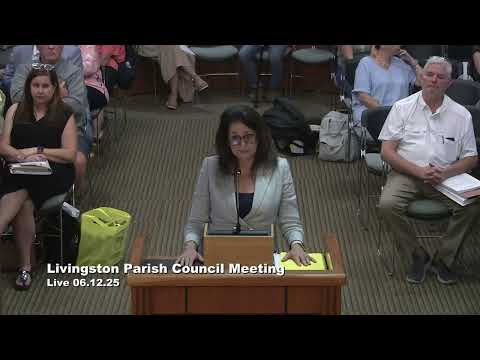
Laura Carlisle, outside counsel for AT&T, told the council the company had submitted an engineering "fall letter" from a certified engineer showing the monopole is designed to collapse inward on failure and cited wetlands constraints that limited siting options. She said the applicant had attempted to gather letters of no objection from adjacent property owners and had received two but that parish staff had required notarized affidavits.
Council members from multiple districts raised safety and right-of-way concerns. Councilman Goff said he could not rely on a zero-foot fall radius and noted the proposed location was close to a state highway and might interfere with future road-widening plans. Several members asked whether AT&T would be willing to relocate the tower at the company's expense if the parish or state later widens the road; AT&T representatives said they lacked authority to make that commitment immediately and that wetlands and mitigation costs constrain siting options.
Planning staff told the council the Planning Commission had recommended approval contingent on the waivers and receipt of certain items (notarized property-owner affidavits and DOTD access permit). Parish staff said they had the DOTD permit but had not received the notarized affidavits; one non-notarized letter had been submitted.
After public comment from nearby residents and the parish president urging protections for the right-of-way and for the parish not to bear relocation costs, Councilman Mangus moved to deny the waiver; the motion was seconded and the council voted to deny the deviation request unanimously.
Why it matters: Council members said they supported improved wireless service but not at the price of placing infrastructure too close to a state highway or without clear assurances about neighbor notification and future relocation costs. The denial means AT&T may return with a revised site, additional information (notarized affidavits), or other options.
Key details: Planning staff said the proposed monopole was approximately 92 feet from the servitude/right-of-way on DOTD mapping shown to the council; the Planning Commission had voted in favor pending the waivers and required affidavits. AT&T emphasized FirstNet and emergency communications as benefits; residents and council members emphasized future road widening, wetland mitigation and the reliability of the fall-radius analysis.
Next steps: AT&T said it would continue to work with parish staff and the company asked to explore alternatives. Council members asked planning staff to insist on proper notification and, if the applicant returns, to provide clearer documentation of neighbor approvals and site engineering.
Ending: The council denied AT&T's waiver request unanimously; the applicant can revise the proposal or supply additional documentation for reconsideration.