Get Full Government Meeting Transcripts, Videos, & Alerts Forever!
Get email alerts on the Utilities Energy topic
No spam. Unsubscribe anytime.
Lincoln Electric System proposes $180 million for turbines, seeks 4% midyear rate increase
Summary
Lincoln Electric System told the City Council it needs to add two combustion turbines and increase rates midyear to meet new Southwest Power Pool resource requirements. LES asked the council to delay a final vote on its revised 2025 budget and rate schedules until June 23 to allow more public comment.
Lincoln Electric System (LES) officials told the Lincoln City Council on June 9 that new reliability rules from the Southwest Power Pool (SPP) have reduced the accredited capacity of LES’s existing resources and that the utility plans to add two combustion turbines at its Terry Bundy generating station and enter into other contracts to avoid a projected resource adequacy shortfall.
LES Vice President of Power Supply Jason Fortic and Chief Financial Officer Emily Koenig described a roughly $180 million project to add two combustion turbines and said a 4% midyear rate increase, effective July 1, would produce about $6.5 million in 2025 revenue. LES Chief Executive Emeka Anya and staff said the turbines are planned to be in service by about 2030 and that the utility also recently began a contract for hydroelectric supply from the Jeffrey Hydroelectric Plant that took effect April 1.
The proposal came after SPP reworked how it accredits generating resources following Winter Storm Uri. Fortic said SPP’s new processes — including effective load‑carrying capability (ELCC) for non‑dispatchable resources and performance‑based accreditation for dispatchable units — reduce the amount of generation utilities can count toward reserve requirements. LES projects a reduction of about 130 megawatts of accredited capacity in summer and about 200 megawatts in winter compared with prior ratings.
LES staff said adding the turbines at Terry Bundy is the lowest‑cost, lowest‑risk way to address the shortfall because the site already has supporting infrastructure and space for the units. Koenig said the project was not in LES’s adopted 2025 budget because the SPP rules were finalized after budgeting for the year, and following vendor negotiations LES concluded near‑term cash outflows would be larger than expected. To avoid higher short‑term financing costs, LES asked the council to consider a midyear rate adjustment and a capital budget amendment.
Council members pressed LES staff on the technical details and the customer impact. Councilman Weber asked LES to explain the difference between nameplate and accredited capacity; Fortic said accredited capacity reflects what a utility may count toward meeting peak load plus required reserves and is typically lower than nameplate. Weber also asked what happens if a utility fails to meet SPP requirements. Fortic and LES staff said penalties under the SPP tariff are possible; LES estimated the “cone” penalty at roughly $1 million per 10 megawatts per year (LES staff provided that estimate in a brief rebuttal during the meeting and characterized it as an order‑of‑magnitude calculation rather than a fixed statutory amount).
LES said the proposed 4% midyear increase would raise an average residential bill by about $4 per month. Koenig noted LES monitors electric bills as a percentage of household income and said Lincoln remains comparatively affordable under that metric. LES also told the council it anticipates additional rate increases in coming years as it finalizes the 2026 budget and continues long‑range planning.
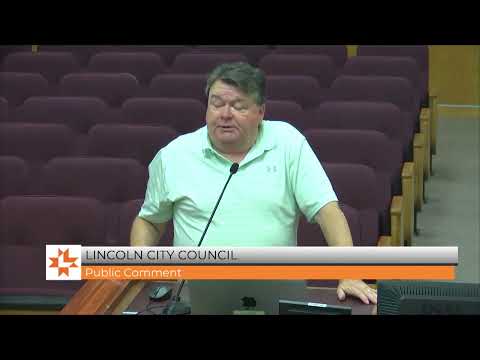
Public commenters at the meeting included residents and representatives from environmental and consumer groups. Several residents described hardship risks for low‑income households and urged the council and LES to prioritize bill assistance and energy efficiency. Representatives from Nebraska Interfaith Power & Light and Sierra Club urged LES to prioritize renewable energy and energy efficiency investments and to avoid long‑lived reliance on additional gas generation where possible. The Lincoln Chamber of Commerce supported the turbines as a necessary near‑term investment to avoid service failures and more costly penalties.
After discussion, the council did not approve the LES budget or rate changes on June 9. Instead, the council carried a motion to continue the public hearing and delay votes on the LES revised 2025 budget and revised rate schedules to a special continued hearing on June 23, 2025. The motion to delay carried 6–0.
Why it matters: LES’s plan addresses reliability rules that affect the entire SPP footprint; the utility says the new turbines are the most cost‑effective near‑term option to avoid penalties and potential service shortfalls. The decision to postpone a final vote gives the public additional time to review LES’s financial plans and to weigh tradeoffs between short‑term costs and long‑term resource choices.
Next steps: LES will return to council with the proposed budget and rate schedules for action at the continued public hearing on June 23. LES staff said they would provide more detail on affordability protections and on the timing and financing plan for the turbines.