Get Full Government Meeting Transcripts, Videos, & Alerts Forever!
Get email alerts on the Public Art Pricing topic
No spam. Unsubscribe anytime.
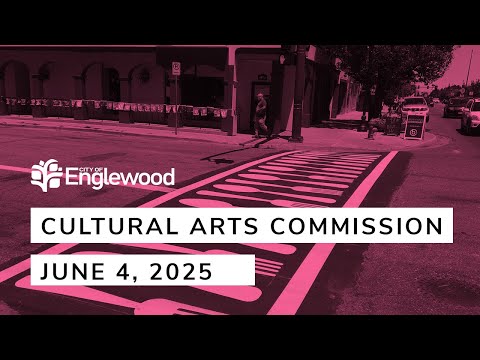
Englewood arts commission debates pay, pricing and durability for crosswalks, cabinet wraps and murals
Summary
The Englewood Cultural Arts Commission spent the bulk of its meeting discussing a draft art-pricing policy that would standardize how the city compensates artists and budgets for three project types: creative crosswalks, traffic cabinet wraps and murals.
The Englewood Cultural Arts Commission spent the bulk of its meeting discussing a draft art-pricing policy that would standardize how the city compensates artists and budgets for three project types: creative crosswalks, traffic cabinet wraps and murals.
The proposal presented by the commission staff sets a baseline artist payment of $500 for selected crosswalk and traffic cabinet wrap designs, with the city establishing a project budget for each call. The staff member who introduced the policy said selected artists would be asked to submit a W-9 and would be paid after an installation is confirmed.
Why it matters: commissioners and staff said the policy is intended to increase consistency and transparency, make artist pay predictable, and help the commission plan annual budgets. Several members raised concerns about whether a $500 fee fairly compensates professional artists once the often high installation and materials costs are factored in.
Staff framed the three-part policy as a flexible framework. "Selected artists will receive $500 for their selected artwork that will be featured on a crosswalk in the city of Inglewood," the presenter said, later adding that the same baseline was modeled for traffic cabinet wraps because it matched recent practice. The presenter said a project budget established by the City of Englewood would determine how many artists are selected for each call.
Commission discussion focused on several recurring issues: the disparity between artist design fees and installation costs, how to handle replication or reuse of a design, and timing of payment. Members said installation and printing often cost far more than the artist fee: staff estimated printing and installation could range from about $15,000 to $100,000 depending on scope and medium. Several commissioners urged clearer rules for when an artist receives payment if a project is delayed or not installed.
On replication, commissioners debated paying artists a small residual when a single design is used multiple times. One commissioner suggested a modest per-use fee (for example, $50) if an approved design is later applied elsewhere. Staff reported there is no current “stamp” process that would materially lower recurring production costs for replicated designs; in practice, reprinting a design does not significantly reduce installation costs.
Murals prompted the longest debate. Staff presented comparative rates from nearby Colorado programs: Littleton’s current call was discussed at roughly $11 per square foot and the Fort Collins Mural Project at about $7.50 per square foot, while national platforms sometimes list significantly higher figures. The presenter said she had modeled a high-end estimate at $40 per square foot but acknowledged that number would limit how many murals the commission could fund.
Commissioners discussed several funding approaches: (a) awarding a modest fixed contribution (staff said the commission has in prior conversations considered $1,500–$2,000 contributions to business-funded murals), (b) establishing a per-square-foot guideline of roughly $12–$20 (staff recommended $12–$15 as a level that would allow funding more murals), or (c) a distinct city-building pricing policy that could allow higher per-square-foot rates for municipal projects. One compromise offered in the meeting was to use a scaled approach—lower per-foot rates for calls intended to support local or emerging artists, and higher rates for curated calls advertised on national artist platforms.
Other operational clarifications staff said they will add to the policy draft: a materials- vs. hourly-cost comparison, template sizing and dimension files to reduce artists’ upfront work, a maintenance schedule for damaged work, and explicit language about payment timing. Staff also proposed adding guidance on whether the commission will fund full mural production or only provide partial matching funds to businesses or property owners.
Commissioners asked staff to check market rates before issuing calls for artists and to include templates and technical specifications with each call so applicants can understand expected deliverables. Several commissioners emphasized the commission’s interest in prioritizing local engagement and giving emerging artists pathways to participate—one idea was partnering with a local nonprofit to offer mentorship for artists without full portfolios.
Next steps: staff said they will research materials/installation costs, template dimensions and average hours to install crosswalks and cabinet wraps; add policy language on replication and payment timing; and return with an updated draft at the July meeting. The commission did not take a formal vote on the policy at this meeting.
A note on terminology: the presenter used the fund name "RAPs and Crosswalks Fund" to describe a dedicated funding source for some projects; commissioners flagged that money in that fund may be restricted and would require City Council action to reallocate for other uses.