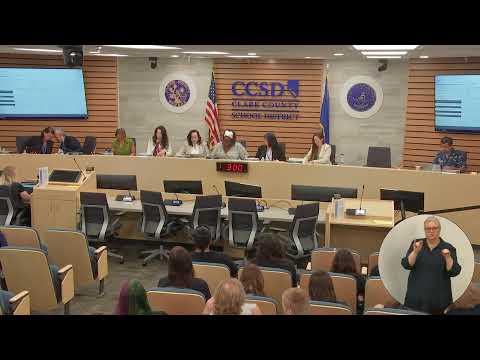
Facility master plan team presents data showing enrollment decline, community priorities and options to right‑size schools
Loading...
Summary
District staff and consultants presented the facility master plan spring update on June 12, showing a post‑2018 enrollment decline, community survey results and facility condition data that will inform options to be released in August.
The Clark County School District and its consultants presented a spring update on the district's facility master plan on June 12, laying out data on building condition, enrollment trends, community survey results and the next steps for drafting options the board will consider in August.
Consultants from Cannon Design and the district’s planning team summarized outreach and data collection. The planning team said they held 18 community forums, assembled five geographically based stakeholder advisory groups and engaged a district planning group of educational and operations leaders. The project website, hosted on ccsd.net, contains interactive dashboards and a document repository, staff said.
Key findings presented: - Enrollment trends: After decades of growth, district enrollment in CCSD schools peaked around 2018 and has declined by about 13% since then; staff and consultants said validated projections indicate an additional roughly 8% decline over the next five years. Consultants said that decline shifts strategic emphasis toward reinvestment in existing facilities rather than expansion, with specific pockets of projected growth (southwest and northeast areas).
- Community survey: A month‑long survey drew 1,860 responses; roughly 30% of respondents were students. Respondents ranked safety and security as the top priority for improvements; next priorities were access to a wide range of programs and depth of course offerings. When asked hypothetically whether respondents preferred a newer, well‑equipped facility further from home over a smaller, more convenient building, about 3.5 times as many supported the better‑equipped facility; that ratio increased for prioritizing program quality over convenience.
- Facilities condition and capacity: The district's facility condition data indicate a mix of older buildings that either have been or will be candidates for replacement and a significant cohort of schools built in the 1990s–2000s that need reinvestment such as roofs and HVAC work. The team noted a range of school sizes and utilization levels across the district and flagged surplus capacity at many elementary and middle sites, in some places including portables that might be removed or repurposed.
- Strategic implications: Consultants said the data support options that emphasize “trade‑up” strategies (fewer, better‑equipped schools) in some areas, aligning feeder patterns to reduce splits and improving access to career and technical education (CTE) and advanced courses where geographic gaps exist. The team cautioned that options must be vetted in affected communities and that open change conversations are necessary.
The district and consultants said they have begun drafting options and that they will present a menu of specific cases and strategies to the board on Aug. 28. The next engagement phase will include a more specific survey asking community members to respond to named, school‑level options rather than conceptual priorities.
Trustees asked for transparency about stakeholder advisory group membership and requested detailed breakdowns by planning area. Trustee Esparza Stravagan asked the team to report back the advisory group rosters; staff agreed to provide the list through the superintendent's office. Trustees also asked how non‑instructional uses of space (for example, community providers or wraparound services) are counted in utilization metrics; district staff said they are refining measures to separate occupancy from instructional utilization so planners can account for community partnerships while assessing classroom capacity.
The board will receive option drafts in late August and additional community engagement materials and surveys thereafter. Any proposed reconfigurations, consolidations or capital investments would return to the board for formal consideration later in the process.