Get Full Government Meeting Transcripts, Videos, & Alerts Forever!
Get email alerts on the Student Technology Policy topic
No spam. Unsubscribe anytime.
Pelham district outlines "bell-to-bell" ban and locker-first plan for internet-enabled devices
Summary
Pelham Memorial High School Principal Sean Llewellyn presented the district's implementation plan for the new New York State law banning student use of internet-enabled devices during the school day. The board discussed logistics, equity exemptions, storage options and a timeline requiring the district to post its plan by Aug. 1.
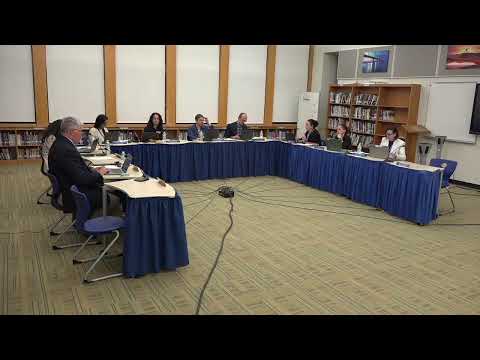
Pelham Memorial High School Principal Sean Llewellyn told the Pelham Union Free School District Board of Education on June 11 that the district must implement a "bell-to-bell" ban on smartphones and other internet-enabled devices under a state law enacted this spring and outlined how the district plans to comply.
Llewellyn said the law requires public school districts to prohibit student use of internet-enabled devices across all school property during the entire school day, while allowing local discretion on storage methods and limited exemptions for individual needs. "This is a bell to bell ban on smartphones and Internet enabled devices, and that's a phrase that I'm gonna use," he said.
The presentation summarized a year-long committee process that included students, teachers, parents and administrators, and incorporated surveys of each group. Key findings Llewellyn shared: about 40% of students reported they used phones less this year; roughly 84% of surveyed students said they personally were not distracted by phones in class; and 73% of teachers said this year's policy had a positive classroom impact. The parent survey (173 respondents) showed wide variation in views on whether students should be allowed phone access during the school day.
Why it matters: the governor's announcement and the resulting state law require districts to post their implementation plans by Aug. 1 and include annual reporting to ensure enforcement does not fall disproportionately by demographic group. The law also earmarks state funding for storage solutions, which Llewellyn said has been quoted at about $13.5 million statewide for districts, though he had not seen detailed guidance about applying for those funds.
How Pelham plans to comply
- Scope and exemptions: The proposed district implementation will ban personal internet-enabled devices (smartphones, tablets, smart watches) on school grounds from arrival to dismissal. Exemptions will mirror the law and existing practice: written administrative authorizations; students with IEP or 504 accommodations; school-issued devices (for example, Chromebooks); and narrowly documented caregiver responsibilities.
- Storage: The administration recommended a locker-first approach for the high school because most students already have lockers (about 850 lockers for roughly 890 students) and many lockers sit unused. Llewellyn said the district needs roughly 40 additional full-size lockers to cover demand and that lockers are preferable to concentrating hundreds of students at a single entrance or pouch station.
- Alternatives considered: magnetized pouch systems (for example, Yondr) and dedicated phone lockers were discussed. Llewellyn said Yondr-like pouches cost roughly $25 per student per year and require logistics at entrances/exits; dedicated phone lockers range widely in price (about $5 to $100 per phone depending on features). He warned that pouch-based arrival/dismissal checks could create bottlenecks at an open campus high school with multiple entry points.
- Enforcement and discipline: Staff will be expected to enforce the rules as any other school policy. Teachers are primarily responsible for classroom compliance, and other staff will monitor hallways and common areas. The presenter noted the law prohibits suspending students solely for device use violations; discipline will instead follow a graduated set of responses used this year (confiscation for the day, parent notification, detentions, or temporary morning-drop arrangements).
- Special circumstances: Emergencies, evacuations and athletics were discussed as operational questions. Llewellyn said regular drills assume students do not retrieve lockers during an evacuation and that communication channels (main office phones, counselor phones, district email) will be emphasized to reach students and families during urgent events.
Timeline and next steps
Llewellyn said the district legal team and policy committee are drafting a new board policy that largely follows the state language; the district must post its plan by Aug. 1. Administrators plan to: publish building-level procedures before the end of June, re-communicate in August, collect a parental/student sign-off at the start of school in September, and continue stakeholder input through an "Internet Enabled Device" committee to monitor implementation and recommend adjustments.
Board discussion
Board members praised the committee work but urged flexibility. Board member Treves, who said he had read Jonathan Haidt's The Anxious Generation, told the room, "even if it's only half true, we have a major problem on our hands." Another board member, who asked to be identified as Will, urged administrators to "be open to pivoting" if the locker solution proves impractical and suggested piloting alternate approaches such as pouches or dedicated lockers.
Llewellyn acknowledged the likely need for iterative change. "We will continue to collect data and stakeholder input throughout the implementation of the process so that we can refine the policy if need be," he said, emphasizing that any change in the district's approach must remain within the constraints of the state law.
What the district will tell families
Administrators said communications this summer will include clear, repeated explanations of the policy, the storage method selected for each building and the mechanics of family-to-student contact during the day (use of main office phones, counselors, and emergency notices). The district also plans opening-year assemblies and sign-offs clarifying expectations and consequences.
Support and next review
Multiple board members said they support a firm initial rollout with the expectation of adjustments based on observed operations and peer-district examples. Administrators offered to report back next year with implementation data and recommended changes.
Ending
The presentation closed with a recognition that the law addresses school-time access but not the larger societal issues of device and social-media use outside school hours. Board members urged the state and federal level to pursue complementary steps to address those broader problems, while reiterating the district's role in creating a distraction-free learning environment during school hours.